
Mild Cognitive Impairment Linked to Less Stable Trip Recovery in Lab Study
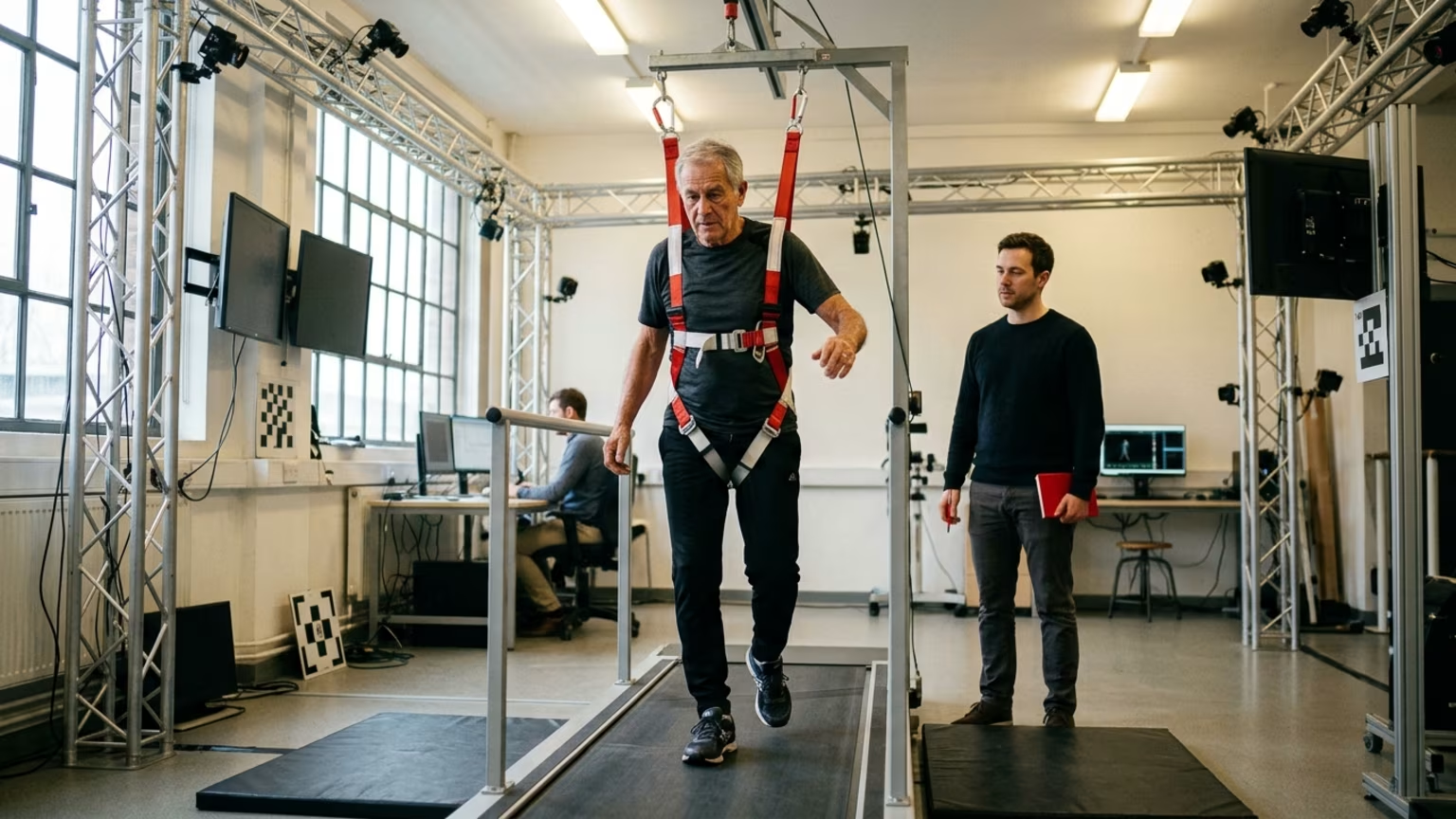
On September 7, 2026, GeroScience published research by Jessica Pitts and Tanvi Bhatt of the University of Illinois at Chicago examining recovery from a trip-like walking disturbance. The study compared older adults with mild cognitive impairment with cognitively intact adults during a controlled treadmill test.
How did researchers test recovery from a trip-like disturbance?
The researchers enrolled 50 adults aged 55 to 90. Participants were divided evenly between a group with mild cognitive impairment, or MCI, and a cognitively intact comparison group. The primary analysis included 47 participants.
Three participants were excluded from that analysis because they used a distinct immediate forward-stepping response. This matters when reading the findings: the main comparison describes the recovery patterns included in the analysis rather than every response observed during testing.
Participants walked on a treadmill while wearing a safety harness. An abrupt movement of the treadmill belt caused a forward loss of balance. The researchers then examined how participants placed their feet and controlled their body position during recovery.
The study used a specific definition of a fall. Harness loading had to exceed 30% of body weight, and the event was verified by video. That definition allowed researchers to classify the response while the harness protected participants during the disturbance.
Testing focused on one high-intensity perturbation, meaning a sudden disturbance to the walking surface. A total testing-session duration is not specified in the reported study details. This was an assessment of an immediate recovery response rather than a trial conducted over a training period.
The authors described a gap in earlier research. Previous studies involving people with MCI had focused more on slip-like disturbances that caused backward losses of balance. This experiment examined a forward loss of balance instead.
What differences did the study find?
The GeroScience paper reported differences in recovery stability alongside several measures that did not differ significantly between groups. Its main findings were:
- Walking before the disturbance was similar on several measures. The groups did not differ significantly in their pre-perturbation margin of stability, step length or trunk angle. The MCI group did have lower measured toe clearance during undisturbed walking.
- The broad recovery strategies were similar. Most participants first lowered the swinging leg toward the ground. They then took a longer recovery step with either the opposite leg or the same-side leg. The distribution of those two strategies did not differ significantly between groups.
- Stability at recovery-step touchdown differed. The MCI group had a higher margin-of-stability measure when the recovery foot landed. Under the study’s measurement convention, the authors interpreted this as a more forward and less stable body position relative to the feet. The difference remained statistically significant after adjustment for baseline mobility and treadmill speed.
- Recovery steps averaged about 15% shorter in the MCI group. That difference did not remain statistically significant after the study’s false-discovery-rate correction for multiple comparisons. It is therefore a tentative finding rather than an established group difference.
- Fall rates were not significantly different. The experiment did not establish that participants with MCI were more likely to fall during this task. The authors noted that very high fall rates in both groups may have limited their ability to detect a difference.
- Some muscle-coordination patterns differed. Exploratory analyses found differences in lower-limb muscle-synergy patterns, meaning patterns of muscles working together. The number of synergies did not differ significantly between groups.
Why does a higher stability measure mean a less stable response here?
The name “margin of stability” can make a higher value sound favorable. In this study, the direction of the measure matters. The authors interpreted the higher value at recovery touchdown as a more forward position of the body’s extrapolated center of mass relative to the feet.
Their conclusion was that reactive stepping restored center-of-mass stability less effectively in the MCI group under the tested conditions. The finding concerns the body’s position when the recovery step landed. It is not simply a report that one group chose a different type of step.
That distinction is useful. Two people can use the same broad recovery strategy without reaching the same measured position at touchdown. Here, the strategy categories were similar while the stability outcome differed.
The authors also found an association between reactive step length and the stability outcome in an exploratory regression analysis. This connects two measured features of recovery, but it does not establish that deliberately taking a longer step would correct the stability difference.
Taken together, the results point toward the effectiveness of the recovery response rather than a clear difference in which recovery strategy participants selected. That is a narrower conclusion than saying MCI caused more falls.
What limits the findings, and who funded the study?
This was a small laboratory study. Its group results should not be treated as a prediction of an individual’s fall risk during daily life. A person’s result in this experiment and their likelihood of falling outside the laboratory are different questions.
The authors also cautioned that a treadmill support-surface disturbance may not reproduce a real-world trip over an obstacle. Findings from this intense task may not transfer to gentler disturbances or repeated exposures. They called for larger studies using different perturbation intensities and more representative overground tasks.
The muscle recordings covered only selected lower-limb muscles. Larger studies are needed to confirm the muscle-coordination findings. These results do not establish a specific brain mechanism.
The authors proposed possible explanations involving sensorimotor processing or the selection and execution of motor commands. Those are hypotheses about why the groups responded differently, not mechanisms demonstrated by the experiment.
The study did not test a training intervention. It therefore provides no evidence that a particular stepping routine prevents falls or improves trip recovery in people with MCI. The harness-supported treadmill procedure is not a model for practicing sudden disturbances at home or in a gym.
Funding came from two National Institute on Aging grants. The authors declared no competing interests.
Does this change how older adults should approach mobility?
For men who want to remain active and independent, the useful topic is reactive balance: what happens when walking is unexpectedly disturbed. This study makes that aspect of mobility worth discussing without supplying a ready-made exercise plan.
When unsteadiness or falls are a concern, balance and recovery ability are appropriate subjects for an individualized discussion with a qualified clinician or physical therapist. The question is not whether someone should copy the laboratory task. It is how their mobility concerns should be assessed in their own circumstances.
Useful questions for that discussion include:
- Should recovery from an unexpected loss of balance be part of the mobility assessment?
- How should concerns about cognition be discussed alongside walking and balance?
- What type of assessment is appropriate for the person’s reported difficulties?
For related context, Everfitguys also covers walking pace in relation to cognitive health and research involving movement paired with mental tasks. These are related research questions rather than interchangeable measures of recovery from a trip.
The clearest reading of this paper is specific: the MCI group reached a less favorable stability position during a controlled recovery step. Keeping that finding separate from claims about everyday falls or exercise benefits preserves its value.
What this changes: This study adds detail to existing knowledge about cognition and mobility rather than changing current best practices or establishing a proven training approach.
How Everfitguys helps
Trip-recovery research loses precision when a measured stability difference becomes a promise about exercise, so Everfitguys keeps its coverage tied to the evidence. For men past 45 concerned about energy and physical capability, the publication explains healthy-aging findings in plain English while keeping uncertainty visible and individual medical decisions outside its editorial role.
Sources
Stay sharp
Get stories
The best writing on craft and life, delivered once a week. No noise, just the good stuff.


