Many men over 45 notice subtle shifts in how stable they feel on their feet. You might search online for why stepping off a curb in the dark feels hesitant, or why your footing slips on rough trails. You might wonder if losing your footing is an unavoidable part of getting older. This guide provides a definitive assessment framework and progressive training plan to build physical balance, reaction speed, and lasting confidence.
Current Evidence On Postural Control And Stability
Research shows that balance is not a single physical trait. It is a coordinated system combining sensory input, cognitive processing, muscular strength, and rapid movement responses. According to data from the Centers for Disease Control and Prevention (CDC), falls are the leading cause of injury-related death among adults aged 65 and older. The age-adjusted fall-death rate increased by 21 percent between 2018 and 2024, rising from 64.7 to 78.4 per 100,000 older adults. Furthermore, roughly 37 percent of older adults who fall suffer injuries that require medical attention or restrict daily activity for at least one day.
Clinical research demonstrates that balance decline is not an overnight event that begins in late retirement. The physiological reserves that keep you upright begin to decrease during midlife. World Health Organization data indicates that approximately 28 to 35 percent of people aged 65 and older fall each year. That number rises to 32 to 42 percent among people over 70.
Targeted exercise interventions provide substantial protection against these outcomes. A comprehensive Cochrane review analyzing 59 studies and nearly 13,000 participants found that exercise programs reduce the rate of falls by approximately 23 percent in community-dwelling older adults. Multi-component exercise programs that combine strength, functional balance, and dynamic movement show the strongest protective effect.
Research also highlights the specific value of multi-directional practices like tai chi. Meta-analyses demonstrate that regular tai chi practice can lower the risk of experiencing a fall by 20 percent and reduce the overall rate of falls by 31 percent. The evidence confirms that balance responds directly to systematic training at any age.
Understanding these facts allows you to approach training proactively. Falling is not an inevitable consequence of aging. It is a manageable physical risk that you can reduce through consistent, structured physical preparation. You can learn more about preserving joint health and movement quality in our guide to mobility and recovery.
The Physiological Mechanics Of Balance Decline
Balance relies on three primary sensory systems working together with your muscles and brain. When you walk, your visual system scans the ground ahead for drop-offs, cracks, and obstacles. Your somatosensory system uses nerve endings in your soles, ankles, and joints to tell your brain where your limbs are in space. Your vestibular system, located inside your inner ear, monitors head movement, gravity, and acceleration.
The central nervous system uses a process called sensory reweighting. When you stand on a firm floor in daylight, your brain balances input easily across all three senses. If you walk across wet grass at dusk, visual and surface information decreases. Your brain must instantly shift greater reliance to your inner ear and deep joint sensors.
After age 45, changes occur across each of these sensory channels. Visual contrast sensitivity and depth perception gradually diminish, which makes low-contrast edges harder to spot. Nerve conduction velocity slows slightly, which reduces the speed of tactile feedback from the bottom of your feet. Vestibular hair cells also decline in number over time, which can reduce the precision of gaze stabilization during quick head turns.
Motor changes compound these sensory shifts. Muscle mass and maximal strength decline slowly without resistance training, but lower-body power declines at an even faster rate. Strength represents the raw force you can produce against resistance. Power represents how quickly you can express that force.
When your foot catches on an uneven sidewalk tile, brute strength alone cannot prevent a fall. Your nervous system must register the trip and snap your swing leg forward in a fraction of a second. This reactive step requires rapid force production from your hip flexors, quadriceps, and calf muscles. Without regular power-focused training, the time needed to execute that recovery step increases, which increases the likelihood of hitting the ground. Maintaining functional strength through strength and muscle training builds the foundational force required for these rapid corrections.
Real-World Functional Impact On Active Men
In daily life, these physiological changes affect physical reserve. Physical reserve is the gap between the demands of your environment and your maximum physical capacity. When you are 25, your sensory and motor systems have wide safety margins. You can read a text message, step over a dog toy, and navigate a broken sidewalk without conscious effort.
As reserve narrows, simple movements demand more conscious attention. Walking in low light while carrying heavy grocery bags becomes a complex physical challenge. Stepping down from a truck bed onto uneven gravel requires deliberate focus. If an unexpected disturbance occurs while your attention is divided, your remaining reserve might not be wide enough to prevent a stumble.
Researchers categorize balance into four distinct components:
Fall Risk
Fall risk is the statistical probability that an individual will lose their balance during daily activities. It reflects baseline sensory acuity, muscle power, and environmental exposure.
Fall Consequences
Fall consequences represent the severity of injury if an impact occurs. Bone mineral density, lean muscle padding, joint mobility, and the ability to roll or absorb force dictate the physical outcome of a fall.
Fall Resilience
Fall resilience is your physical ability to arrest a loss of balance before reaching the ground. It also includes your capacity to recover quickly and maintain physical autonomy after a minor stumble.
Confidence And Participation
Confidence dictates whether you continue hiking, traveling, lifting, and playing sports. Fear of falling can create a negative behavioral cycle. A 2023 systematic review revealed that fear of falling increases actual fall risk with an odds ratio of 2.82. When fear causes a man to restrict his outdoor activity, his legs lose strength, his reaction time slows further, and his true fall risk escalates.
The goal for active men is not to eliminate physical exposure by staying indoors on safe floors. The goal is to build enough physical resilience to handle unpredictable environments with complete confidence. Maintaining this functional independence is a core theme in healthy aging research.
Comprehensive Assessment And Functional Screening Protocols
A comprehensive assessment helps you identify hidden deficits before they lead to an actual fall. Rather than relying on a single test, you should evaluate your movement through a balanced screening profile.
Self-Reported Screening Questions
The CDC STEADI protocol uses three core screening questions to establish baseline risk:
- Do you feel unsteady when standing or walking?
- Do you worry about falling?
- Have you fallen in the past year?
Answering yes to any of these questions indicates that your balance reserve has narrowed. You should add further practical questions to this screen:
- Do you regularly use your hands to push yourself out of a standard chair?
- Do you feel unsteady when turning your head to look behind you while walking?
- Do you avoid walking on unpaved trails or dimly lit paths?
- Have you experienced unexplained lightheadedness or dizziness when standing up quickly?
Timed Up-And-Go Test
The Timed Up-and-Go test evaluates functional mobility, transitional strength, and turning capability. Place a standard dining chair on a non-slip floor. Measure a distance of ten feet (three meters) in front of the chair and place a small marker on the floor.
Sit in the chair with your back resting against the backrest and your arms on the armrests or thighs. Start a stopwatch as you stand up, walk at your normal, comfortable pace past the ten-foot mark, turn around, walk back to the chair, and sit down completely.
A completion time of 12 seconds or longer indicates an increased fall risk according to CDC guidelines. Beyond the total time, observe your movement quality. Look for hesitation when initiating movement, wide turns, or loss of balance during the transition to sitting.
The 30-Second Chair Stand Test
This test measures lower-body functional strength and muscular endurance. Use a sturdy, armless chair with a seat height of approximately 17 inches placed securely against a wall.
Sit in the middle of the seat with your feet flat on the floor, shoulder-width apart. Cross your wrists over your chest so your arms remain out of the movement. Set a timer for 30 seconds. On the command to start, rise to a full standing position with straight hips and knees, then sit back down fully.
Count the number of complete stands you execute within the 30-second window. If you must use your arms to push off your legs or the chair, the standardized protocol records a score of zero. Men between 45 and 64 typically complete 14 to 19 clean repetitions. Falling below 12 clean repetitions highlights a clear deficit in lower-body force capacity.
The Four-Stage Balance Test
This progressive test evaluates static balance across progressively narrower bases of support. Stand next to a sturdy counter or wall so you can grab support if you lose balance.
- Position 1: Stand with your feet side-by-side, touching each other, for 10 seconds.
- Position 2: Move one foot half a step forward so the instep of one foot touches the big toe of the other foot (semi-tandem) for 10 seconds.
- Position 3: Place one foot directly in front of the other so the heel of the front foot touches the toes of the back foot (full tandem) for 10 seconds.
- Position 4: Lift one foot completely off the floor and stand on a single leg for 10 seconds without letting your legs touch each other.
An inability to hold the tandem stance for 10 seconds or the single-leg stance for at least 5 seconds indicates a sensory or motor deficit that requires structured training.
Red Flags Requiring Medical Assessment
Self-directed training is appropriate for general conditioning, but certain symptoms require thorough medical evaluation before you begin balance exercises. Schedule a clinical examination if you experience:
- Recurrent, unexplained falls or near-falls.
- Episodes of true vertigo, where the room feels like it is spinning.
- Lightheadedness, visual graying, or faintness when standing upright.
- Sudden changes in your walking pattern, such as dragging a foot or asymmetric shuffling.
- New visual disturbances, double vision, or loss of peripheral sight.
- Balance problems accompanied by chest pain, irregular heartbeat, or shortness of breath.
For a deeper look at physical assessments, review our comprehensive longevity science and optimization resources.
Systematic Training Progressions For Fall Resilience
Effective balance training must challenge your motor and sensory systems in a progressive manner. Standing on two feet on a flat floor quickly stops producing meaningful adaptations. A four-phase model provides structured progression from basic stability to high-level reactive capability.
Phase 1: Foundation Stability
The initial phase builds baseline leg strength, establishes correct joint alignment, and develops stable weight shifting.
- Box Squats: Stand in front of a sturdy chair or bench. Lower your hips back and down under control until you lightly touch the seat, then stand up powerfully without using your hands. Perform 3 sets of 8 to 10 repetitions.
- Supported Heel Raises: Stand tall with fingertips resting lightly on a counter for safety. Press through the balls of your feet to lift your heels as high as possible, hold for one second, and lower under control over three seconds. Perform 3 sets of 12 to 15 repetitions.
- Narrow-Stance Weight Shifts: Stand with your feet touching side-by-side. Shift your body weight smoothly onto your right foot, pause for two seconds, then shift your weight onto your left foot. Perform 2 sets of 10 shifts per side.
- Tandem Holds with Support: Place one foot directly in front of the other beside a wall. Maintain an upright posture with minimal fingertip contact for 20 to 30 seconds per side.
Phase 2: Capacity And Directional Control
The second phase introduces single-leg loading, multi-directional stepping, and greater strength demands.
- Split Squats: Take a long step forward into a staggered stance. Lower your back knee toward the floor while keeping your torso upright, then drive through the front heel to return to the top. Perform 3 sets of 6 to 8 repetitions per leg.
- Step-Ups with Controlled Lowering: Step up onto a sturdy 6 to 8-inch step. Drive through the lead foot to stand tall, pause briefly at the top on one leg, then lower your trailing foot back down over three slow seconds. Perform 3 sets of 8 repetitions per leg.
- Multi-Directional Clock Steps: Stand on your left leg. Step your right foot forward to 12 o'clock, tap the ground lightly, and return to center. Step out to 3 o'clock, tap, and return. Step back to 6 o'clock, tap, and return. Perform 5 complete cycles per leg.
- Side-Stepping with Resistance Bands: Place a light elastic band around your ankles. Step laterally across a 15-foot space, maintaining tension on the band and keeping your toes pointed straight forward. Perform 3 sets in each direction.
Phase 3: Adaptability And Sensory Integration
The third phase challenges your balance by altering sensory inputs and introducing cognitive tasks.
- Head-Turn Walking: Walk in a straight line across a room. As you walk, turn your head smoothly to look to the left, then to the right, keeping your steps steady and straight. Perform 4 passes across the room.
- Low-Light Balance Holds: Stand in a tandem stance or on one leg in a dimly lit room with a sturdy counter within easy reach. This forces your nervous system to rely on foot sensation and inner-ear input rather than clear visual cues. Hold for 15 to 20 seconds per side.
- Dual-Task Stepping: Perform multi-directional clock stepping while counting backward from 100 by sevens, or naming cities that start with a specific letter. This builds the ability to maintain stability while your brain processes cognitive tasks.
- Dynamic Step-Overs: Place three to four low objects (such as yoga blocks or small cones) along a walking path. Step over each object with deliberate knee lift, avoiding any foot contact. Perform 4 sets back and forth.
Phase 4: Real-World Reaction And Floor Recovery
The final phase prepares you for unpredictable environments and ensures you can recover if you do end up on the ground.
- Reactive Step Drills: Stand tall with a partner or trainer. Have your partner call out a random direction (forward, back, left, right). Step explosively in that direction, plant your foot firmly to absorb force, and return to center. Perform 10 to 12 random steps.
- Rapid Sit-to-Stands: Sit on a sturdy bench. Stand up as fast as possible while maintaining complete control, pause for a second, then lower yourself slowly over three seconds. This trains the high-velocity power required for trip recovery. Perform 3 sets of 5 explosive repetitions.
- Turkish Get-Up Transitions or Ground-to-Stand Practice: Lie flat on your back on an exercise mat. Roll to your side, push up to your elbow, move to your hand, sweep your leg under into a half-kneeling position, and stand up without relying on furniture. Practice getting down and up using different movement patterns for 5 total repetitions.
- Variable Terrain Walks: Walk on outdoor surfaces such as packed dirt trails, gravel paths, and gentle grassy inclines. This exposes your ankles and nervous system to real-world surface variations.
Review our complete collection of functional movement and mobility guides for detailed movement breakdowns.
Footwear, Environment, And Medication Factors
Physical training represents only one half of fall resilience. You must also manage external and biological factors that influence your footing.
Foot Mechanics And Footwear Selection
Your foot is your sole point of contact with the ground. Weak intrinsic foot muscles and stiff ankles limit your ability to make fine balance adjustments. Incorporate toe spreading exercises, calf stretching, and deliberate barefoot walking on firm indoor surfaces to build foot strength.
When selecting everyday footwear, avoid extreme designs. Thick, overly cushioned shoes with high heel-to-toe drops disconnect your soles from the ground, which reduces sensory feedback. Conversely, thin minimalist shoes may cause pain or bruising if your feet lack conditioning or if you have existing joint problems.
Choose shoes with:
- A wide toe box that allows your toes to splay naturally.
- A secure closure (laces or straps) that prevents your foot from sliding inside the shoe.
- A low, stable heel profile that keeps your center of mass balanced.
- A high-traction outsole suited to the surfaces you walk on daily.
Medication Management And Blood Pressure Shifts
Medication side effects represent a major contributor to balance problems in men over 45. Certain blood pressure medications, sleep aids, muscle relaxants, and antidepressants can cause sedation, slowed reaction times, or sudden drops in blood pressure.
Orthostatic hypotension occurs when your blood pressure drops sharply upon standing, causing dizziness, visual dimming, or unsteadiness. Clinical guidelines recommend checking your blood pressure while lying down and again after standing for one, three, and five minutes. If you experience lightheadedness when rising from bed or a deep chair, consult your doctor. Never adjust or discontinue prescribed medications on your own.
Environmental Design
A resilient man manages his physical surroundings to eliminate unnecessary hazards. Extrinsic hazards account for a large percentage of domestic stumbles:
- Ensure high-traffic pathways and stairwells have adequate lighting with easily accessible switches.
- Secure or remove loose throw rugs that slide on hardwood or tile surfaces.
- Keep walkways free of electrical cords, pet toys, and clutter.
- Install secure handrails on both sides of indoor and outdoor stairways.
Analysis Of Common Balance Misconceptions
Several widespread myths cause men to waste effort or avoid necessary training.
Myth 1: Being Able to Stand on One Leg Means Your Fall Risk Is Low
Single-leg balance on a flat gym floor is a basic static test. It does not measure your ability to step rapidly when tripped, turn quickly in a crowded hallway, or navigate low-light outdoor terrain. Balance requires dynamic, reactive capability across multiple movement planes.
Myth 2: Regular Walking Provides All the Balance Training You Need
Walking is an excellent baseline activity for cardiovascular health. Walking at a steady, comfortable pace on predictable pavement does not sufficiently challenge muscle power, lateral stability, or sensory reweighting. You need multi-directional movement, strength training, and balance challenges to maintain a wide physical reserve.
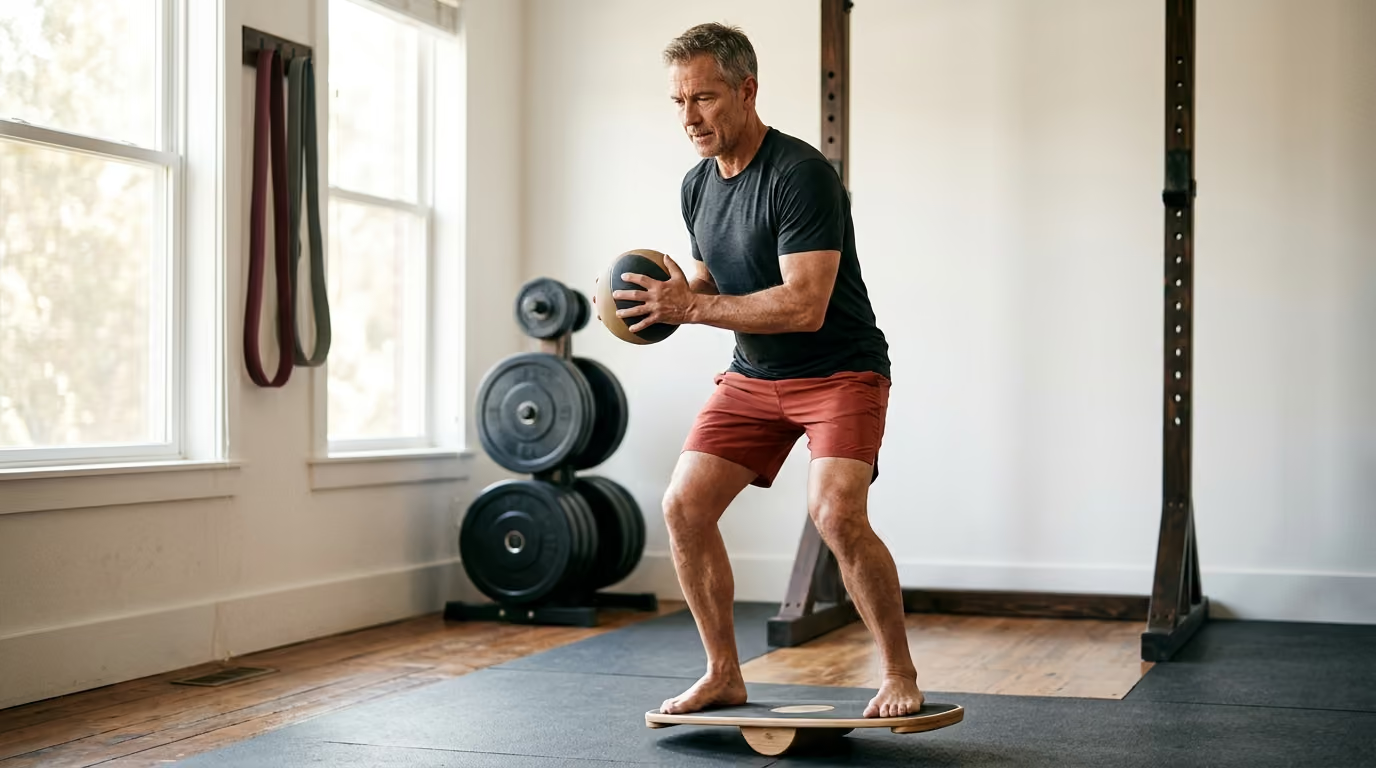
Myth 3: Balance Training Requires Wobble Boards and Inflatable Discs
Standing on highly unstable surfaces like foam pads or balance balls reduces your ability to produce muscular force. Research indicates that performing strength and stepping exercises on solid ground translates more effectively to real-world fall recovery. Unstable equipment has specific uses in late-stage ankle rehabilitation, but it is not necessary for building balance resilience.
Myth 4: Dizziness Is Always an Inner-Ear Problem
While inner-ear conditions like benign paroxysmal positional vertigo (BPPV) are common, dizziness can stem from cardiovascular issues, medication interactions, dehydration, cervical spine stiffness, or visual misalignment. Any persistent dizziness requires a professional medical evaluation to identify the exact cause.
Myth 5: Barefoot Training Is Always Superior for Foot Strength
Going barefoot indoors can stimulate sensory receptors in healthy feet. For men with peripheral neuropathy, severe foot deformities, or diabetes, barefoot walking increases the risk of skin breakdown and unnoticed injuries. Match your footwear choices to your individual medical status and foot structure.
For more evidence-based perspectives on midlife fitness, explore our men's health research library.
Gaps And Limitations In Balance Research
While the broad benefits of exercise are well-established, specific areas of balance science require more investigation.
Laboratory Perturbation Training Versus Real-World Translation
Recent research highlights the effectiveness of perturbation training, where participants wear safety harnesses while specialized treadmills induce sudden slips and trips. These protocols produce rapid improvements in reactive stepping within the laboratory. Researchers are still evaluating how long these adaptations last and how well they transfer to complex real-world environments like icy sidewalks or crowded sports fields.
Predictive Value of Single Clinical Tests
Many standard clinical tools, such as the Berg Balance Scale, were developed for frail clinical populations. Systematic reviews show that these tests have limited accuracy when used in isolation to predict falls in healthy, active community-dwelling adults. Research supports using comprehensive assessment profiles rather than relying on a single test score.
Digital Balance Apps and Consumer Devices
Wearable sensors and smartphone apps that track balance metrics are increasingly common. While these tools provide interesting data on postural sway, clinical evidence confirming that app-based balance training reduces real-world fall rates remains early and preliminary. Traditional multi-component exercise programs backed by peer-reviewed trials remain the gold standard.
The Core Principle For Long-Term Independence
Balance and fall resilience depend on maintaining broad physical and sensory reserves through progressive strength, power, and dynamic movement training. Protecting these capabilities allows you to move through the world with complete confidence, physical freedom, and lasting autonomy.
Immediate Action Steps For Weekly Training
Use this checklist to integrate balance and fall resilience work into your routine starting this week:
- [ ] Complete the baseline screen: Perform the Timed Up-and-Go, 30-Second Chair Stand, and Four-Stage Balance tests to identify your current baseline.
- [ ] Add rapid sit-to-stands: Include 3 sets of 5 explosive sit-to-stands twice per week at the start of your regular workouts to develop lower-body power.
- [ ] Practice single-leg and tandem holds: Perform 30 to 60 seconds of tandem or single-leg balance holds while brushing your teeth or waiting for coffee in the morning.
- [ ] Incorporate multi-directional movement: Add lateral band walks, clock steps, and controlled step-ups into your weekly lower-body training sessions.
- [ ] Schedule an updated vision exam: Book a comprehensive eye examination to verify your depth perception and contrast vision, especially if you wear bifocals or progressive lenses.
- [ ] Audit your home environment: Check stairways for proper lighting, secure any loose floor coverings, and clear common walking paths of clutter.
Sources
- Clinical Resources | STEADI - Older Adult Fall Prevention | CDC
- Assessment 30-second Chair Stand
- The Berg Balance Scale as a clinical screening tool to ...
- Falls in older adults: a practical approach - PMC
- Outcome Measure Toolkit
- Usefulness, assessment and normative data of the Functional Reach Test in older adults: A systematic review and meta-analysis
- THE BERG BALANCE SCALE AS A SCREENING TEST TO PREDICT FALLS IN OLDER ADULTS: A SYSTEMATIC REVIEW
- Assessment Timed Up & Go (TUG)
- Usefulness, assessment and normative data of the ...
- The Berg Balance Scale as a clinical screening tool to predict fall risk in older adults: a systematic review
- World guidelines for falls prevention and management ... - PMC
Stay sharp
Get the word
Join our newsletter for the best writing advice and stories from the field.