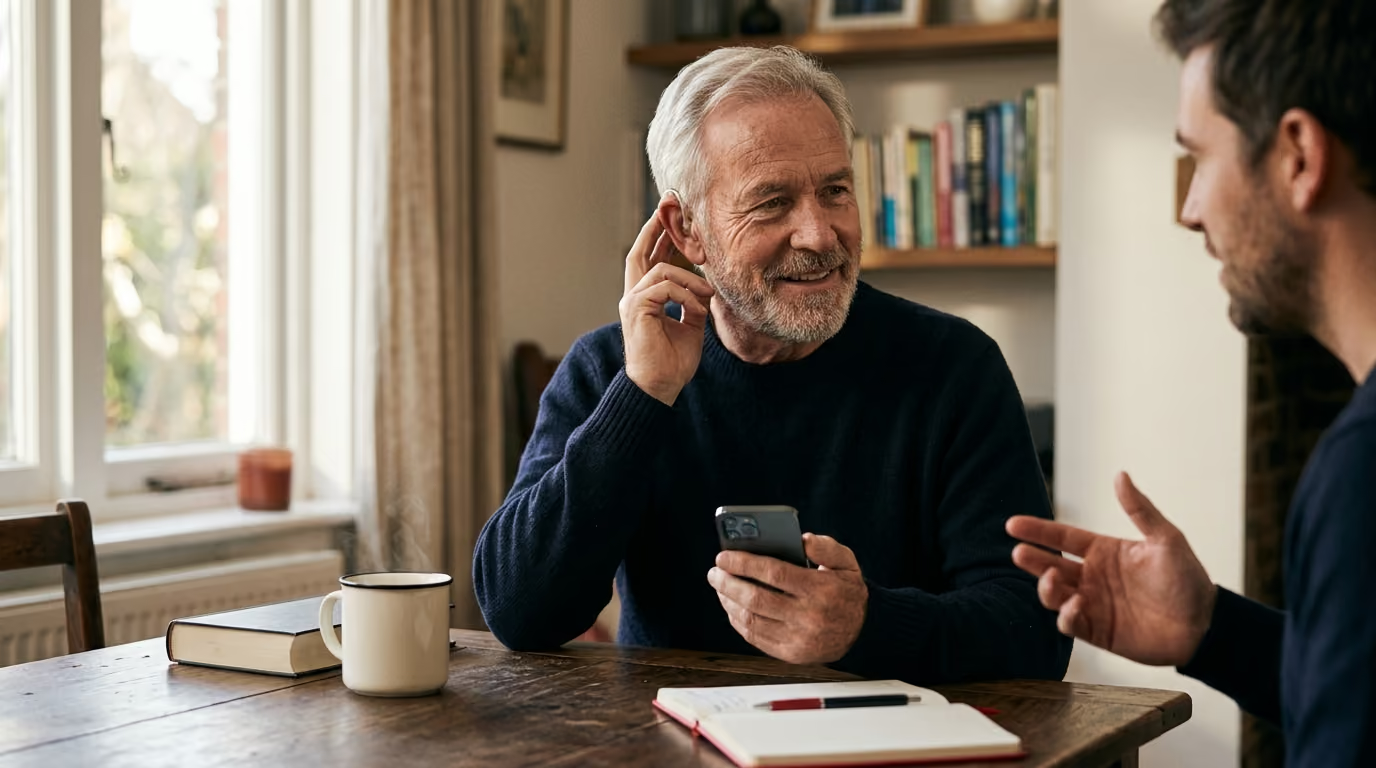
Most men treat hearing loss as an inevitable nuisance that only requires turning up the television. That assumption is backward and misses how the brain actually works.
Auditory decline after midlife is rarely just about ear health. It is a fundamental communication and cognitive workload problem. When your ears miss incoming sound signals, your brain must divert scarce processing power away from thinking, remembering, and problem solving just to decipher words.
Understanding this link gives you a practical advantage. By addressing hearing changes early, you protect your daily energy, maintain sharp communication, and support long-term mental fitness and cognitive performance.
Examine What the Science Proves About Hearing and Cognition
The connection between auditory function and cognitive decline has received intense scientific focus over the last decade. Researchers want to know whether treating hearing problems preserves brain function as men age.
Data from the World Health Organization shows that more than 1.5 billion people worldwide live with hearing loss. Around 430 million adults currently require rehabilitation for disabling hearing loss. By 2050, projections indicate that nearly 2.5 billion people will experience auditory decline, with more than 700 million needing clinical care. More than 25 percent of adults over age 60 experience disabling hearing loss.
- Worldwide Hearing Loss Burden (WHO Estimates)
- Current affected population: Over 1.5 billion people
- Current needing rehabilitation: 430 million people
- 2050 projected affected: Nearly 2.5 billion people
- 2050 projected needing rehabilitation: Over 700 million people
- Adults over 60 affected by disabling loss: Over 25 percent
The 2024 Lancet Commission report classified hearing loss as one of the major modifiable risk factors for dementia. Research synthesized in that report shows a 37 percent increased relative risk of incident dementia among adults with audiometer-measured hearing loss. This risk estimate controls for standard health variables like age, high blood pressure, and smoking.
This 37 percent statistic represents a relative association across large populations. It does not mean an individual man has a 37 percent chance of cognitive failure. Observational studies demonstrate an association, but association does not prove direct causation.
The landmark ACHIEVE randomized controlled trial offered crucial insights into this relationship. Researchers followed older adults with untreated mild-to-moderate hearing loss over three years. One group received hearing aids, assistive technology, and communication counseling, while the control group received standard health education.
In the total study sample, the hearing intervention did not show a statistically significant reduction in three-year global cognitive decline. The intervention group changed by -0.200 standard deviation units, while the control group changed by -0.202 units.
- ACHIEVE Trial: 3-Year Cognitive Change Comparison
- Overall Cohort
- Hearing Intervention: -0.200 standard deviation units
- Health Education Control: -0.202 standard deviation units
- Difference: 0.002 (p 0.96, no significant difference)
- High-Risk Subgroup
- Cognitive change reduced by 48 percent in hearing intervention group
The results shifted dramatically when researchers analyzed a prespecified subgroup of participants who started the trial with higher baseline risks for cognitive decline. In this vulnerable subgroup, the hearing intervention reduced cognitive change by 48 percent over three years.
The trial also evaluated functional communication. Participants using hearing interventions experienced substantial reductions in self-reported communication difficulty within six months. Those improvements remained stable across the entire three-year observation period.
Current evidence supports two facts. Untreated hearing loss increases daily mental strain and drives social disengagement. Hearing care improves communication performance immediately and may support cognitive stability in men facing elevated health risks.
Track Why Auditory Processing Changes After 45
Hearing changes after 45 are driven by normal biological adjustments in the inner ear, auditory pathways, and central nervous system. These shifts happen gradually and often go unnoticed for years.
Age-related hearing loss, known clinically as presbycusis, primarily involves sensorineural changes. Microscopic hair cells in the cochlea sustain wear from decades of noise exposure, changes in microvascular blood supply, and cellular aging. These hair cells do not regenerate once damaged.
The loss typically begins at high frequencies. High-frequency sounds correspond to soft consonant sounds like "s," "f," "t," "th," and "k." Vowels carry low-frequency energy and convey vocal volume, while consonants provide speech clarity and word definition.
A man with high-frequency loss can hear someone speaking because the vowel sounds remain loud. He will struggle to comprehend the specific words because the consonant definitions are missing. This leads to the common complaint that other people are constantly mumbling.
- Frequency Impact on Speech Comprehension
- Low Frequencies (Vowels)
- Function: Carries vocal volume and power
- State in Midlife: Often well-preserved
- Result: Speech sounds loud enough
- High Frequencies (Consonants like s, f, t, k)
- Function: Carries word clarity and crisp definition
- State in Midlife: First to decline
- Result: Words blur together; feels like others mumble
Auditory processing within the brain changes alongside the ear. The auditory cortex must separate the primary voice from competing background noise, reflections from hard walls, and environmental sounds.
With age, the neural timing precision required to separate simultaneous sounds slows slightly. A crowded restaurant or an open office creates an acoustic environment where speech streams collide. The brain must work substantially harder to organize those competing audio streams into coherent sentences.
Middle-ear mechanics can also alter auditory input. Conductive issues from stiffened ossicular bones or earwax accumulation can combine with sensorineural shifts to produce mixed hearing loss.
These physical shifts are a natural aspect of midlife biology. Tracking them allows you to implement smart adjustments before communication breakdowns create unnecessary stress or professional friction.
Recognize the Mental Energy Cost in Everyday Life
The primary day-to-day consequence of untreated auditory decline is elevated cognitive load. Human mental capacity is finite, operating like a computer processor with a fixed amount of working memory.
Under optimal conditions, clear sound arrives at the ear and travels directly to the auditory cortex. The brain processes the words automatically, leaving ample mental capacity for analyzing ideas, reading body language, and forming responses.
When auditory signals arrive degraded or incomplete, your brain cannot rely on automatic decoding. It must activate conscious executive networks to reconstruct missing fragments using context, lip movements, and conversational history.
- The Resource-Allocation Framework
- Clear Auditory Input
- Listening Effort: Low
- Cognitive Capacity Used: Minimal decoding demand
- Remaining Brainpower: Available for memory, focus, and strategic thinking
- Degraded Auditory Input
- Listening Effort: High
- Cognitive Capacity Used: Heavy decoding and guessing
- Remaining Brainpower: Depleted, causing fatigue and slower responses
This dynamic is explained by the resource-allocation framework. Every unit of mental energy directed toward identifying missing words is energy stolen from working memory, reasoning, and long-term storage.
This continuous compensation leads directly to auditory fatigue. Auditory fatigue is physical and mental exhaustion caused by hours of high-strain listening. It differs from general physical tiredness or poor sleep because it stems from sensory strain.
- Distinguishing Types of Fatigue
- Auditory Fatigue
- Primary Driver: Sustained concentration to decode unclear sound
- Manifestation: Irritability, mental burnout after dinners or meetings
- Cognitive Fatigue
- Primary Driver: Extended periods of intense problem solving
- Manifestation: Slower analytical speed, reduced working memory
- General Fatigue
- Primary Driver: Poor sleep quality, physical overexertion, illness
- Manifestation: Whole-body lethargy, low physical drive
High listening effort often creates the false appearance of memory decline. A man might leave a business meeting or a family gathering unable to recall specific details, names, or tasks.
His memory system did not fail. The information was never properly stored because his working memory was consumed by the mechanical effort of decoding speech. You cannot remember information that your brain never had the spare capacity to encode.
Over time, this strain alters social behavior. Men begin avoiding loud venues, skipping business networking events, or sitting quietly during group conversations.
This behavioral withdrawal begins the signal-effort-participation cycle. Sensory loss leads to high effort, high effort drives withdrawal, and withdrawal reduces the rich mental stimulation that supports long-term brain vitality.
- The Signal-Effort-Participation Cycle
- Degraded Sound Signal
- High Listening Effort
- Auditory & Mental Fatigue
- Behavioral Withdrawal
- Reduced Social Stimulation
- Higher Long-Term Cognitive Strain
Addressing hearing is a direct method to preserve mental energy for work, training, and personal focus. Exploring strategies for mind and focus requires protecting your sensory inputs.
Assess Real-World Scenarios and Communication Breakdowns
Real-world hearing challenges rarely happen in quiet testing booths. They show up during complex daily activities when sound, distance, and visual distractions mix together.
Illustrative Model: The Business Dinner
Consider a common scenario involving an active 54-year-old manager. At home in a quiet room, he follows conversations without missing a beat.
During a client dinner at a busy restaurant with hard floors and background music, his performance shifts. He misses key phrases, laughs along with jokes he did not hear, and feels exhausted after two hours.
- Anatomy of Restaurant Listening Breakdown
- Acoustic Environment: High reverberation from bare surfaces
- Sound Mix: Competing background chatter and kitchen noise
- Visual Barriers: Dim lighting reducing facial cues
- Listener Cost: Constant mental guessing to piece together sentences
- Outcome: Exhaustion, missing details, apparent forgetfulness
The issue is poor signal-to-noise ratio combined with high-frequency sound loss. The ambient clatter masks high-frequency consonants, forcing his brain to guess missing words continuously.
By the end of the meal, he has consumed his mental reserves. He forgets parts of the discussion the next morning, not from cognitive decline, but from sensory overload and incomplete encoding.
Illustrative Model: The Hybrid Conference Call
Consider another regular workplace challenge: the multi-person video conference call. A 49-year-old executive finds himself struggling to follow remote presentations.
Laptops compress audio streams, strip out subtle frequency cues, and create tiny audio delays. When multiple people speak at once, the auditory cues that identify who is talking disappear.
- Hybrid Meeting Audio Stressors
- Digital Compression: Removes high-frequency speech nuances
- Audio Latency: Tiny delays disrupt conversational timing
- Lack of Spatial Separation: All voices come from a single speaker point
- Brain Effort: Visual tracking must work overtime to identify speakers
He notices a sharp decline in his afternoon focus after these virtual meetings. His ears were straining to decode low-fidelity digital sound while his visual system worked overtime to read lips on a small screen.
Simple environmental adjustments solve these issues. Using high-quality headphones, turning on automated live captions, and setting structured conversational turns instantly lowers mental workload.
Illustrative Model: Unilateral Deficits and Tinnitus
Unilateral hearing loss occurs when one ear experiences greater auditory decline than the other. This creates an asymmetric sound picture that disrupts spatial localization.
The brain uses tiny differences in sound timing and volume between both ears to pinpoint where a sound originates. When one ear underperforms, locating speakers in a group becomes difficult.
- Unilateral Hearing Loss Challenges
- Loss of Spatial Awareness: Difficulty locating sound sources quickly
- The Head Shadow Effect: High-frequency sounds blocked by head geometry
- Group Confusion: Slower reaction times when speakers alternate
Tinnitus often accompanies this pattern. Tinnitus involves the perception of ringing, buzzing, or hissing without an external sound source.
Tinnitus creates an internal noise floor that competes for executive attention. Managing background acoustics and seeking targeted clinical care helps reduce the cognitive intrusion of persistent ringing.
Apply Practical Adjustments to Protect Daily Communication
Managing your hearing requires a comprehensive system. The Person-Technology-Environment model offers an organized framework for improving communication and reducing mental fatigue.
- The Person-Technology-Environment Model
- Person
- Visual engagement, position strategy, pacing, listening breaks
- Technology
- Hearing aids, directional microphones, streaming devices, captions
- Environment
- Acoustic management, lighting, seating location, noise reduction
Optimize Your Personal Habits
Simple behavioral shifts dramatically improve how well you receive and process spoken information. Small changes in how you position yourself reduce listening strain.
- Position yourself with your back to the wall in social settings to eliminate noise from behind.
- Keep the primary speaker's face well-lit so your brain can process subtle lip movements.
- Request that colleagues or family members secure your attention before speaking.
- Schedule short, quiet listening breaks during long meetings or large social gatherings.
- Ask conversation partners to rephrase unclear sentences rather than simply repeating them louder.
Adjust Your Physical Environment
Modifying your surroundings removes acoustic barriers before sound waves reach your ears. Environmental management reduces background chaos.
- Choose restaurants with carpets, upholstered chairs, and sound-dampening drapery.
- Sit away from open kitchens, service stations, and loud air conditioning units.
- Turn off background televisions, radios, and loud appliances during important discussions.
- Use soft furnishings and acoustic panels in home offices to eliminate hard room echoes.
- Gather in smaller, well-lit spaces when discussing complex or critical topics.
- Environmental Comparison for Clear Communication
- Challenging Environments
- Hard tile floors, bare walls, high ceilings, dim mood lighting
- Center tables near kitchen doors, open-concept floor plans
- Favorable Environments
- Carpeted dining rooms, draped windows, soft acoustic panels
- Corner booths, well-lit meeting rooms, quiet personal offices
Use Modern Hearing Technology
Modern auditory technology has advanced far beyond the whistling analog devices of previous generations. Digital devices act as customized communication processors.
- Obtain a comprehensive audiologic evaluation that includes speech-in-noise testing.
- Utilize digital hearing aids with directional microphones to isolate voices in loud spaces.
- Connect direct audio streamers to your television, smartphone, and computer.
- Use wireless remote microphones placed near speakers during large boardroom meetings.
- Activate real-time automated captions on all virtual conferencing platforms.
Combining behavioral habits, environmental adjustments, and modern technology creates a strong defense against auditory fatigue. Maintaining active sensory function supports broad vitality within healthy aging.
Discard Common Misunderstandings About Hearing and Memory
Clear facts help you make rational choices about auditory health. Several pervasive myths keep men from taking constructive action.
- Common Auditory Myths vs. Evidence-Based Facts
- Myth: Hearing loss causes dementia directly.
- Fact: Observational links exist, but direct causation is unproven.
- Myth: Hearing aids guarantee complete dementia prevention.
- Fact: Devices improve communication; cognitive protection varies by risk.
- Myth: Hearing loud sounds means your hearing is fine.
- Fact: Loudness detection differs from high-frequency speech clarity.
- Myth: Standard booth tests capture all functional listening issues.
- Fact: Pure-tone tests miss real-world speech-in-noise processing deficits.
Misreading 1: Hearing Loss Inevitably Causes Dementia
Many popular wellness articles claim that hearing loss directly destroys brain tissue and causes dementia. This claim misinterprets statistical association.
Observational studies establish that hearing loss correlates with higher dementia rates. Correlation does not prove that auditory loss is the direct biological cause.
Shared underlying factors like vascular disease, metabolic dysfunction, and cellular aging may drive both sensory decline and cognitive changes simultaneously. Approaching hearing care as one component of an overall wellness plan is far more accurate.
Misreading 2: Hearing Aids Guarantee Complete Cognitive Protection
Marketing campaigns often position hearing aids as a guaranteed safeguard against all forms of cognitive decline. The clinical trial evidence is more nuanced.
The ACHIEVE randomized trial proved that hearing interventions significantly improved communication and reduced social strain across all participants. A reduction in cognitive decline over three years occurred specifically in the high-risk subgroup, not the healthy volunteer group.
Hearing devices are vital tools for speech clarity, connection, and energy preservation. They should not be viewed as standalone medical cures for dementia.
Misreading 3: If You Can Hear Loud Sounds, Your Hearing Is Fine
Men often dismiss hearing concerns because they can hear a door slam, an engine rev, or a television blaring. Volume detection does not equal speech comprehension.
You can possess normal hearing thresholds in the lower frequencies while losing critical high-frequency fidelity. When this happens, sound comes through loudly, but words remain muffled.
- Loudness vs. Clarity Breakdown
- Low-Frequency Sounds (Vowels, Engines, Bass)
- Perceived as volume and presence.
- Can remain normal even when hearing is damaged.
- High-Frequency Sounds (Consonants, Nuances)
- Perceived as crispness, separation, and clarity.
- Drops early, causing severe comprehension loss without loss of volume.
Speech understanding requires frequency balance and central temporal processing. Judging your auditory capability solely by volume leads to delayed care.
Misreading 4: Standard Booth Tests Show Your Entire Hearing Ability
A standard pure-tone audiogram measures the softest single-frequency beeps you can detect in a silent, soundproof booth. This test provides a baseline, but it does not reflect real-world capability.
A man can achieve a normal score on a basic pure-tone test while struggling to follow a multi-person conversation in a noisy restaurant. Real-world listening requires separating speech from noise, tracking multiple speakers, and processing fast sentences.
A complete assessment must include speech-in-noise testing and self-reported communication evaluations. Relying solely on a simple audiogram can cause clinicians to overlook real functional challenges.
Identify Where the Clinical Evidence Remains Thin
A rigorous, research-led approach requires recognizing where scientific evidence is incomplete. Acknowledging these gaps prevents overstating claims or buying unproven treatments.
- Evidence Quality Across Key Auditory Domains
- Well-Supported by Evidence
- Association between hearing loss and higher dementia risk
- Immediate communication benefits from hearing technology
- High listening effort causes cognitive fatigue
- Early or Mixed Evidence
- Universal screening for completely symptom-free adults
- Precise biological mechanisms linking sensory loss to brain change
- Direct cognitive protection for low-risk, healthy adults
- Commercially Claimed or Unproven
- Dietary supplements that claim to restore lost hearing
- Guarantees that hearing aids eliminate all cognitive decline
The United States Preventive Services Task Force evaluated universal hearing screening for asymptomatic adults aged 50 and older. The Task Force concluded that current evidence is insufficient to assess the overall balance of benefits and harms of screening adults who report no hearing symptoms.
This recommendation applies specifically to population-level screening of people without symptoms. It does not suggest that men with noticeable hearing difficulties, tinnitus, or communication struggles should avoid clinical evaluation.
Scientists are still investigating the precise pathways that connect hearing loss, social isolation, and cognitive decline. A 2024 systematic review determined that evidence is currently insufficient to prove that social isolation acts as the primary mediator between hearing loss and dementia.
- Evaluating the Mediating Pathways
- Hearing Loss
- Social Isolation
- (Direct Link Unproven) (Direct Link Unproven)
- Cognitive Decline
Auditory research also contains mixed evidence regarding commercial brain-training software and over-the-counter supplements. No dietary supplement, herb, or vitamin blend has been clinically proven to reverse sensorineural hearing loss or rebuild hair cells in the cochlea.
Over-the-counter hearing aids offer accessible amplification for perceived mild-to-moderate loss, but long-term comparative data versus professional fittings remains early. Understanding where the science is solid and where it is thin protects you from commercial hype.
Recognize Red Flags Requiring Immediate Medical Attention
Most age-related hearing changes happen gradually over several years. Certain auditory symptoms point to underlying conditions that require rapid medical evaluation rather than routine lifestyle adjustments.
- Immediate Medical Red Flags vs. Gradual Age-Related Changes
- Urgent Clinical Red Flags
- Sudden hearing loss occurring over hours or days
- Significant hearing asymmetry between left and right ears
- Severe dizziness, vertigo, or loss of balance
- Persistent localized ear pain, drainage, or physical pressure
- Gradual Age-Related Changes
- Slow decline in speech clarity over years
- Trouble hearing consonants in noisy restaurants
- Increasing the television volume slightly over time
Sudden sensorineural hearing loss is a medical emergency. If you experience an abrupt drop in hearing in one or both ears over hours or days, seek emergency medical care immediately.
Rapid medical treatment within the first two weeks provides the best chance of recovering lost auditory function. Waiting weeks to see if it clears up on its own can result in permanent hearing damage.
Unilateral symptoms also require thorough medical diagnostics. Significant asymmetry between your ears, localized pain, persistent fluid drainage, or severe dizziness should be assessed by an otolaryngologist to rule out middle-ear disease, acoustic neuroma, or vascular issues.
Routine presbycusis develops symmetrically and painlessly across both ears over a long timeline. Identifying these clinical boundaries helps you manage normal aging safely while addressing medical issues quickly.
Connect Auditory Health to Comprehensive Male Vitality
Auditory performance does not exist in isolation from your general physical health. The inner ear is an active sensory organ that relies on healthy microvascular circulation and stable metabolic function.
The cochlea contains a delicate capillary network called the stria vascularis, which maintains the chemical environment required for auditory hair cells to function. High blood pressure, systemic inflammation, insulin resistance, and cardiovascular disease can impair this microvascular supply.
- Shared Physiological Pathways
- Cardiovascular Health
- Proper blood pressure protects delicate inner-ear capillaries.
- Metabolic Health
- Stable blood glucose limits microvascular damage to the stria vascularis.
- Aerobic Exercise
- Sustained blood flow supports auditory and cognitive vitality.
- Sleep Quality
- Restorative sleep clears metabolic waste and restores mental energy.
Maintaining cardiovascular health protects your ears alongside your heart and brain. Aerobic conditioning, strength training, and metabolic management support optimal blood flow throughout your nervous system.
Good sleep hygiene is equally vital for handling auditory workload. Deep sleep restores the executive brain networks taxed by daily listening effort, reducing mental fatigue.
Treating hearing care as a standard pillar of your wellness routine supports every aspect of your life. Protecting your sensory inputs helps you stay sharp, capable, and confident across midlife and beyond. Explore our broader guidance on men's health after 45 to build a strong physical foundation.
Master the Daily Strategy for Auditory and Brain Health
Protecting your communication and cognitive performance after 45 does not require extreme interventions. It requires consistent execution of practical, evidence-backed habits.
Use this operational checklist to evaluate your hearing environment, spot auditory fatigue early, and maintain clear communication across daily life.
- Operational Auditory Health Checklist
Key Takeaways
- Age-related hearing decline after 45 is a communication and cognitive load challenge, not merely a minor volume issue.
- High listening effort drains working memory and processing speed, causing auditory fatigue and the false appearance of memory loss.
- Large observational studies associate untreated hearing loss with a 37 percent increased relative risk of dementia, but direct causation remains unproven.
- The ACHIEVE clinical trial demonstrated significant improvements in communication for all participants, with a 48 percent reduction in cognitive change among high-risk individuals.
- Universal screening for symptom-free adults remains unproven, but men experiencing communication struggles should obtain a diagnostic hearing test with speech-in-noise evaluation.
- Modifying your environment, positioning yourself strategically, and using modern digital hearing tools directly reduces daily mental strain.
- Sudden drops in hearing, marked asymmetry between ears, or severe dizziness are medical emergencies that require prompt evaluation.
Protecting your hearing after 45 preserves your mental energy, keeps your communication sharp, and allows you to stay fully engaged in your work, relationships, and daily life.
Sources
- Deafness and hearing loss
- Screening for Hearing Loss in Older Adults
- Hearing Loss and Dementia Risk: What the 2024 Lancet ...
- Screening for Hearing Loss in Older Adults - odphp
- Deafness and hearing loss
- 2024 Update of Lancet Commission on dementia ...
- Screening for Hearing Loss in Older Adults
- Hearing impairment and dementia: cause, catalyst or ... - PMC
- Screening for Hearing Loss in Older Adults: US Preventive ...
Stay sharp
Get the word
Join our newsletter for the best writing advice and stories from the field.