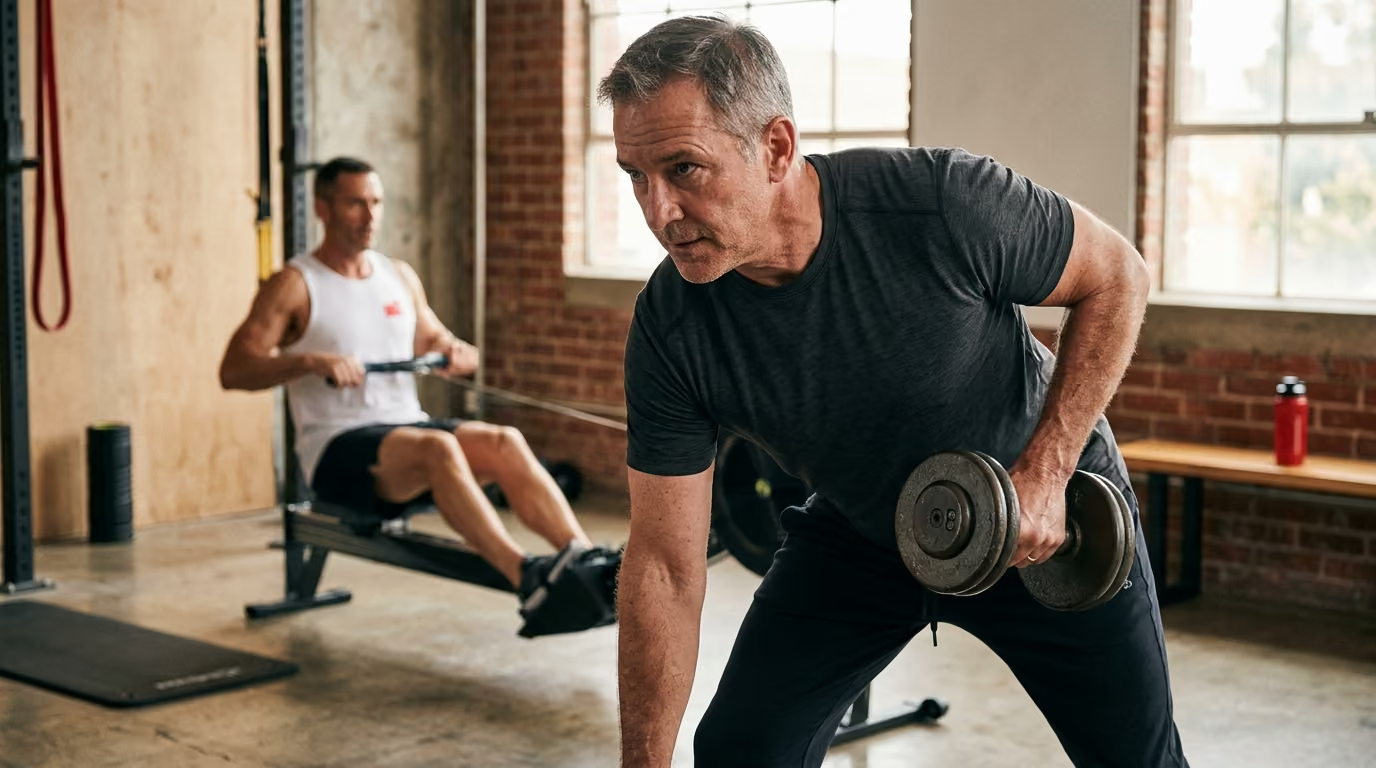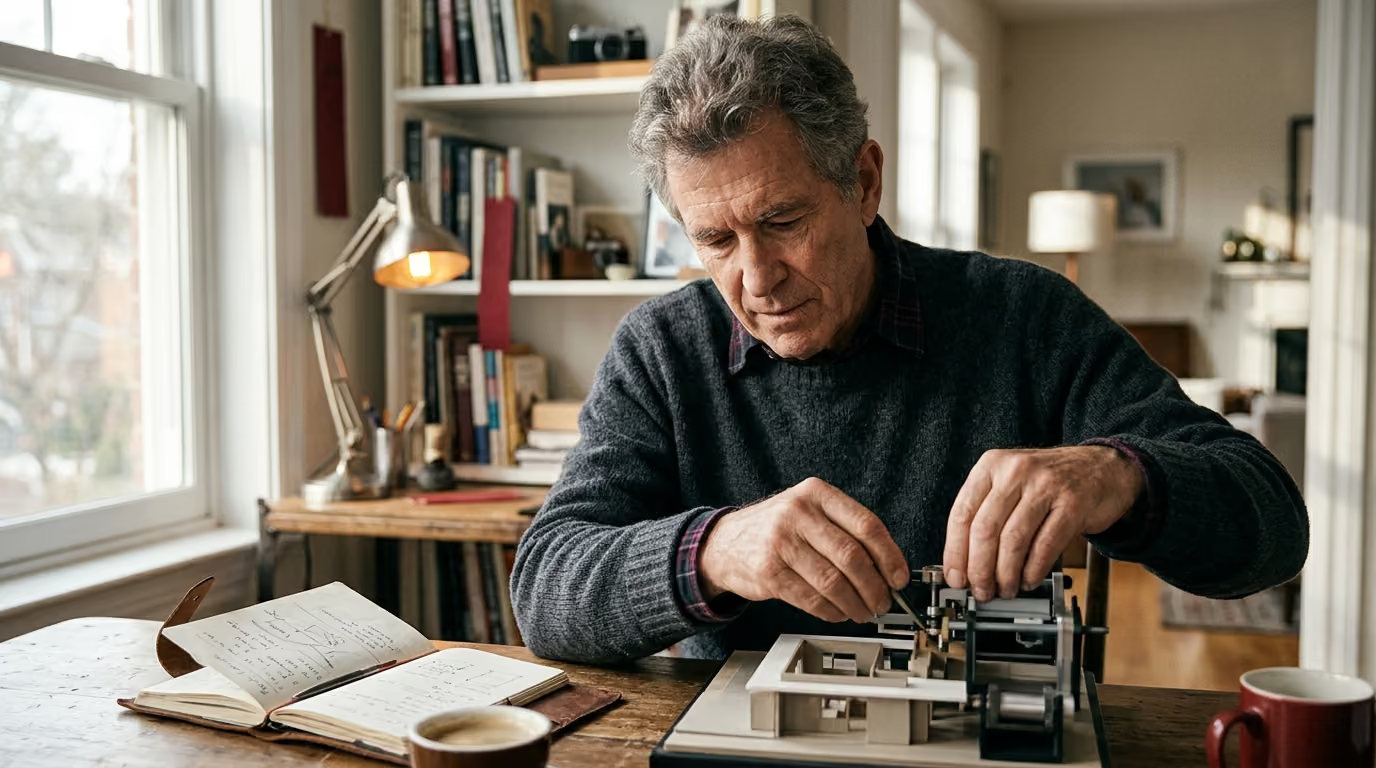
Most people assume that learning becomes difficult after 45 because the brain loses its capacity to change. That belief is backward. The primary barrier for mature adults is rarely biological decline. The true problem is that adults stop placing themselves in demanding, structured learning environments and rely entirely on existing habits.
When you spend decades relying on what you already know, learning a complex physical movement or a new intellectual discipline feels foreign. The friction you feel is not a permanent cognitive deficit. It is the natural resistance of a system that has not been asked to adapt in years.
Adapting after midlife requires an intentional framework. You cannot learn a language, a complex barbell lift, or a technical instrument by using the casual methods of your twenties. You need clear practice design, immediate error correction, and a sustainable format that works alongside your career and family responsibilities.
Understanding how your brain and body acquire new patterns allows you to build real capability at any age. This guide examines what scientific research demonstrates about adult learning capacity, how cognitive and physical systems change over time, and how to structure your practice for long-term competence.
Examine What The Research Actually Shows About Learning Capacity
The scientific evidence regarding adult neuroplasticity is clear. The mature nervous system retains a strong capacity to restructure itself in response to demanding training. Studies examining cognitive training demonstrate that older adults can achieve significant improvements in cognitive performance.
These adaptations are not limited to mental tasks alone. Research shows that physical training and deliberate practice lead to structural brain changes in older adults. These structural shifts include measurable increases in gray matter and cortical volume. Your brain physically modifies its architecture when you subject it to challenging, repeated tasks.
The research also reveals clear boundaries. While learning capacity remains intact, improvements are most reliable on the exact tasks you practice. When you practice a specific cognitive task or motor pattern, your proficiency in that exact task rises sharply.
Evidence that this practice transfers to completely unrelated cognitive tasks is far more limited and mixed. A comprehensive study called the Synapse Project examined older adults who engaged in productive activities such as digital photography and quilting. The researchers found that while participants learned the specific skills, there was no broad, automatic improvement in intraindividual variability in cognitive speed.
Real-world skill learning produces measurable gains when the challenge is genuine. A 15-week intervention examined adults who simultaneously learned multiple demanding skills, including Spanish, painting, and digital technology. Participants in this intensive program showed meaningful improvements in working memory and cognitive control compared to a passive control group. The reported effect size reached 0.66, representing an increase of more than one standard deviation on composite cognitive scores.
These findings point to a practical principle. Novel, demanding learning alters cognitive function because it forces the nervous system to coordinate unfamiliar actions. Casual consumption of information does not create the same adaptation.
Motor learning research reveals an identical trend. The capacity to acquire new movement patterns, from kettlebell swings to fly fishing casting, persists throughout life. Progress may occur at a slightly slower pace than in early adulthood, but the physiological mechanism of adaptation remains functional.
Improving your physical and mental fitness requires consistent, targeted effort. If you want to build durable focus and mental sharpness, you can review structured frameworks in our guide to mental fitness and cognitive performance.
Recognize How Cognitive And Physical Processing Shift After 45
Learning changes in midlife because the underlying cognitive architecture shifts its strengths. This shift is a normal developmental progression, not a clinical disease.
Psychologists categorize cognitive capability into two main categories: fluid intelligence and crystallized intelligence. Fluid intelligence involves rapid processing speed, short-term working memory capacity, and the ability to solve novel problems quickly without prior instruction. Crystallized intelligence represents your accumulated repository of knowledge, vocabulary, professional judgment, and deep pattern recognition.
Fluid processing speed and working memory reach their statistical peaks in early adulthood and slowly decline across subsequent decades. Crystallized abilities, however, remain resilient and often continue expanding well past your fifties and sixties.
This mechanical shift explains why learning feels different after 45:
- Explicit learning, which requires memorizing arbitrary lists, abstract rules, or isolated facts without context, takes more time and conscious effort.
- Implicit learning and contextual understanding remain stable, allowing you to absorb complex systems when they connect to things you already understand.
- Working memory holds fewer pieces of completely new information at one time.
- Rapid processing of multiple incoming streams of raw data creates higher cognitive fatigue.
Physical motor systems experience a parallel transition. Connective tissue compliance decreases, and the nervous system requires slightly more repetitions to automate a brand-new movement sequence. Reaction time to sudden visual cues becomes slightly slower.
Your accumulated movement vocabulary offsets this reduction in raw speed. A man with decades of athletic experience can draw upon existing physical balance and muscle coordination to learn a new sport. He recognizes balance adjustments and body positioning faster than an inexperienced younger beginner.
Adults who understand these shifts can design their practice to favor their natural strengths. Instead of forcing rapid memorization under intense time pressure, you can structure your learning around deep conceptual models. You use your crystallized knowledge to organize new facts into sensible patterns.
Aging does not eliminate your ability to master complex disciplines. It simply means that your training must prioritize deliberate repetition, clear context, and structured feedback over chaotic, fast-paced cramming. You can explore how these factors influence broader vitality in our collection on healthy aging.
Translate Deliberate Practice Into Everyday Capability
The difference between casual practice and deliberate practice explains why some adults improve rapidly while others stay stuck at the same level for years. Simply repeating an activity you already know how to do does not produce adaptation. Playing a round of golf, strumming the same five guitar chords, or reading industry articles maintains your existing baseline. It does not build new capacity.
Deliberate practice is systematic, focused work targeted directly at a single, isolated weakness. It demands complete mental presence and occurs right at the boundary of your current skill level.
Motor learning science demonstrates that deliberate practice is the primary driver of skill acquisition in mature learners. When you isolate a movement flaw and apply corrective feedback, your neuromuscular pathways refine their firing sequence.
To implement deliberate practice in physical or intellectual pursuits, use this six-step execution loop:
- Define one observable subskill. Break a large, complex task into small components. If you are learning Olympic lifting, do not try to fix the entire lift at once. Isolate the transition from the floor to the knee. If you are learning a programming language, isolate how to write a basic conditional loop.
- Work at the edge of current ability. Select a task difficulty where you succeed roughly 70 to 80 percent of the time. If you succeed 100 percent of the time, the task is too easy to trigger adaptation. If you fail more than half the time, the task is too difficult and creates frustration without clear learning signals.
- Obtain immediate information about errors. You must know instantly whether an attempt was correct. In physical training, this means using video analysis, mirrors, or an experienced coach. In mental disciplines, this means checking answers against an objective key, running code, or speaking with a fluent partner.
- Adjust the next attempt. Do not mindlessly repeat a failed attempt. Analyze the specific mechanical or conceptual error. Modify your physical setup or mental model before initiating the next repetition.
- Repeat until performance becomes reliable. Perform focused, high-quality repetitions until the subskill feels stable and repeatable. Stop the session before physical or mental exhaustion degrades your movement quality. Practicing errors under extreme fatigue ingrains bad habits.
- Test the skill in a new context. Once a subskill is stable in isolation, integrate it back into the complete movement or broader intellectual problem. Test your clean deadlift technique inside a full lifting session. Test your new vocabulary words inside an unscripted conversation.
Applying this loop transforms training. A 50-year-old learning the barbell back squat should not just add weight to the bar every week. He must isolate hip hinge mechanics, refine ankle mobility, and practice bracing the trunk under submaximal loads with precise feedback.
If you are developing complex physical capabilities, combining deliberate motor learning with dedicated physical preparation is critical. You can review how to structure your training safely in our resources on strength and muscle.
Compare The Five Primary Learning Formats
Adult learners must choose the right environment for their goals. Each learning format serves a specific function and presents distinct advantages and trade-offs. The scientific literature does not support a single hierarchy where one format beats all others. The best choice depends on your starting competence, safety requirements, and scheduling constraints.
Evaluate Self-Directed Learning Alone
Self-directed study is intentional learning where you set the curriculum, choose the materials, and control the schedule. The Organization for Economic Co-operation and Development (OECD) categorizes this as informal learning, which includes self-study, learning by doing, and self-guided trial.
Self-study offers complete flexibility. You can study or practice early in the morning, late at night, or during travel without coordinating with an instructor. It works well when reliable books, recorded demonstrations, and digital software exist for your chosen topic.
The primary limitation of solo learning is diagnostic blindness. Beginners rarely know what they are doing wrong. You cannot see your own back rounding during a heavy lift, and you cannot hear subtle mispronunciations when learning a foreign tongue.
Because mature brains adapt specifically to the exact tasks they practice, practicing with flawed technique locks in incorrect motor and mental patterns. Self-study requires strong self-discipline and the humility to constantly test your work against objective standards.
Leverage One-On-One Coaching And Instruction
Coaching pairs you with an experienced instructor who provides real-time error correction, customized progressions, and individualized accountability.
Research on physical activity adherence highlights supervision, direct professional involvement, clear communication, and structured feedback as strong predictors of success. A skilled coach instantly identifies the root cause of an error. Instead of telling you that a movement looks wrong, an expert coach tells you which joint angle or muscle group failed to engage.
Private instruction is the premier choice when:
- Physical safety and injury prevention are immediate concerns, such as returning to heavy lifting or dynamic movement after years of inactivity.
- The skill involves subtle tactile or mechanical adjustments that cannot be captured in a book or video.
- You have hit a hard plateau despite months of consistent personal effort.
- Your available practice time is limited, making maximum efficiency your top priority.
The trade-off is cost and scheduling rigidity. Professional coaching requires a financial commitment and fixed meeting times. Peer-led physical programs also show positive adherence outcomes, meaning you do not always need expensive instruction once foundational mechanics are established.
Utilize Structured Classes And Group Curriculums
Classroom environments provide a structured, sequential syllabus led by an instructor alongside a group of peers. Classes take away the cognitive burden of deciding what to practice next.
Systematic reviews of community-based group exercise programs for older adults report an average adherence rate of approximately 69 percent. Participants consistently identify social connectedness, clear program design, and instructor guidance as primary reasons for continuing.
Classes provide clear structural advantages:
- Fixed schedules create external accountability that forces regular attendance.
- Curriculums follow a planned progression that prevents you from skipping difficult foundational steps.
- Watching peers struggle and overcome similar obstacles normalizes the learning curve.
- Financial costs are substantially lower than individual private coaching.
Classes become less effective when individual learning speeds diverge. If the group moves too fast, you risk accumulating uncorrected errors. If the class moves too slow, you waste valuable practice time waiting for others.
Join Clubs And Practice Communities
Clubs and community groups gather people around a shared activity without a formal pedagogical curriculum. Examples include cycling clubs, chess groups, recreational tennis leagues, woodworking guilds, and foreign-language conversation tables.
Research indicates that peer-delivered and peer-supported activity groups successfully promote ongoing participation. While peer groups may not always improve raw physical markers faster than specialized training, they excel at maintaining long-term behavioral consistency.
Clubs provide an environment for real-world application. They transform an abstract hobby into a core part of your social identity. You transition from someone who is taking a photography class to someone who is an active photographer.
Clubs are poor environments for learning initial foundations. Peers rarely possess the diagnostic skill to correct complex technical flaws. Join a club once you have acquired basic competence and need regular opportunities to apply your skills under realistic conditions.
Seek Mentorship For Strategic Direction
Mentorship involves a relationship with a senior practitioner who helps you navigate a broader discipline, choose high-value projects, and avoid strategic dead ends.
Mentoring differs from technical coaching. A coach teaches you how to execute a specific movement or solve a distinct problem. A mentor helps you understand how the field works, which skills are worth learning next, and how to maintain focus over several years.
Mentorship provides high value when:
- You are navigating a complex intellectual domain with hundreds of competing resources.
- You need help evaluating the quality of your own independent projects.
- You want to understand the mental frameworks and decision-making habits of seasoned experts.
Mentoring is not designed for repetitive motor skill acquisition. A mentor cannot swing a kettlebell for you or memorize German verb conjugations on your behalf. Mentors provide strategic orientation, leaving the daily deliberate practice to you.
Build A Sustainable Hybrid Learning Routine
The most practical approach for an adult over 45 is a blended model. Relying on a single learning channel creates blind spots. Combining the distinct strengths of coaching, solo practice, and community application produces rapid, stable progress.
A functional weekly learning plan balances instruction, deliberate practice, and real-world use:
- One instructional session per week: Use a private coach or a structured class to receive progressive assignments and correct emerging technical errors.
- Two to three solo practice sessions per week: Dedicate 20 to 45 minutes to quiet, uninterrupted deliberate practice. Focus entirely on the specific subskills assigned during your instructional session.
- One community session per week or biweekly: Attend a club, league, or study group to apply your skills in a social, unscripted environment.
This structure respects your recovery capacity. Intense deliberate practice places high demands on your central nervous system. Trying to perform two hours of grueling deliberate practice every single day leads to mental burnout, physical joint irritation, and poor retention.
Short, frequent practice sessions outperform sporadic, marathon weekend efforts. Thirty minutes of focused practice four days a week produces far better neural consolidation than two hours crammed into a single Sunday afternoon.
You must also protect your physical foundation. Memory consolidation and motor pattern integration occur primarily during deep sleep. If you are chronically sleep-deprived or under high systemic stress, your brain cannot efficiently build the new synaptic connections required for skill retention.
If you want to understand how broader recovery and lifestyle habits support brain function, review our guides on longevity science and optimization. Maintaining deep focus during your practice blocks is equally critical. You can learn specific attention strategies in our guide to mind and focus.
Avoid Common Misreadings About Midlife Learning
Several persistent myths circulate regarding adult learning and brain health. Examining what the evidence actually disproves prevents wasted time and unrealistic expectations.
Misreading 1: Commercial Brain Games Make You Universally Smarter
A widespread commercial claim suggests that playing digital brain-training puzzles for ten minutes a day prevents general cognitive decline and sharpens your overall intelligence.
The research evidence does not support this claim. Systematic reviews consistently show that computerized brain games make you better at playing those specific games. The cognitive gains rarely transfer to broad, real-world abilities like financial decision-making, reading comprehension, or navigation.
If you want to maintain cognitive vitality, spend your time learning a real, complex skill. Learning to read sheet music, speak conversational Japanese, or operate technical drafting software demands far more integrated neural processing than tapping shapes on a smartphone screen.
Misreading 2: Adults Over 45 Cannot Master Demanding Physical Skills
Many men assume that learning complex athletic skills is impossible past midlife. They believe that if they did not learn Olympic weightlifting, gymnastics movements, or martial arts in their youth, the window has permanently closed.
Motor learning research contradicts this fatalistic view. The human neuromuscular system retains the capacity to learn complex motor coordination at every stage of life. Progress may require more structured warm-ups, slightly longer recovery between intense sessions, and careful volume management, but the learning process itself remains functional.
Adults fail to learn physical skills not because of their age, but because they rush the process, skip foundational mobility work, or use unstructured training plans that lead to preventable joint strain.
Misreading 3: Passive Exposure Leads To Mastery
Another common mistake is confusing passive familiarity with active competence. Watching hundreds of hours of instructional videos on woodworking, listening to conversational podcasts in French, or reading books about strength training feels like learning.
Passive consumption requires minimal cognitive effort. Your brain recognizes the material when presented, creating a false illusion of mastery. Real learning occurs only when you force your brain to retrieve information without assistance or execute a movement under active evaluation.
You do not learn by watching someone else perform. You learn by attempting the task yourself, making an error, diagnosing the failure, and adjusting your next attempt.
Identify Where The Scientific Evidence Remains Thin
A rigorous look at adult learning requires acknowledging the limitations of current scientific literature. Not every popular learning theory is backed by robust data.
- Broad cognitive transfer remains unproven: While intensive skill-learning interventions show improvements in working memory, researchers still debate how far these benefits extend. There is no conclusive proof that learning an instrument in midlife will protect you against clinical neurodegenerative conditions decades later.
- Direct format comparisons are limited: Very few clinical trials directly compare self-study against one-on-one coaching and group classes in head-to-head matchups for the exact same skill. Most recommendations rely on observational data and exercise adherence studies rather than definitive educational trials.
- Optimal practice dosages are unknown: Science has not established an exact, universal number of practice minutes per day for optimal adult neuroplasticity. Individual recovery rates, baseline fitness, sleep quality, and prior skill levels create wide variations in how much training volume an individual can handle.
- Long-term retention studies are sparse: Most adult learning studies run for 8 to 24 weeks. Long-term data tracking how well older adults retain newly acquired complex skills over five, ten, or twenty years without ongoing practice remains sparse.
Recognizing these gaps keeps your expectations grounded. You should approach skill building as a practical pursuit of capability and enjoyment rather than an ironclad medical shield against aging.
Apply Practical Rules To Choose Your Learning Path
Selecting the right learning format requires matching your current bottleneck to the appropriate structural solution. Use these straightforward rules to decide where to invest your time and energy:
- Choose self-study when the barrier is access: If private instruction is unaffordable, geographically unavailable, or impossible with your work schedule, start alone using structured books or software. Schedule periodic expert check-ins to catch hidden technical errors before they become ingrained habits.
- Choose coaching when the barrier is safety or technique: If the skill carries an injury risk or relies on precise joint mechanics, hire an expert coach immediately. Getting professional feedback on your barbell lifts, swim stroke, or instrument hand positioning saves months of wasted effort and prevents chronic strain.
- Choose a class when the barrier is structure: If you consistently struggle with procrastination, abandon projects after three weeks, or do not know what topic to tackle next, enroll in a formal class. The predetermined syllabus and weekly deadlines provide the external framework you need to establish consistency.
- Choose a club when the barrier is persistence: If you already understand the technical fundamentals but struggle to practice regularly, join a community club. The social connection, friendly competition, and shared identity will keep you engaged long after your initial enthusiasm fades.
- Choose a mentor when the barrier is strategic direction: If you are overwhelmed by competing options within a broad discipline, seek guidance from a senior practitioner. A mentor will help you select the most valuable projects and avoid costly dead ends.
- Apply deliberate practice everywhere: Whatever format you choose, reserve focused time for single-subskill refinement. Classes provide structure, coaches provide feedback, and clubs provide fun, but deliberate practice is the engine that builds real, permanent capability.
Key Takeaways
- Adult neuroplasticity remains functional throughout midlife, allowing you to learn complex intellectual and physical skills with proper training design.
- Age-related cognitive shifts reduce raw processing speed and working memory capacity while preserving crystallized knowledge, pattern recognition, and contextual judgment.
- Learning gains are highly task-specific, meaning you should practice the exact skill you want to improve rather than relying on commercial brain-training games.
- Deliberate practice requires isolating specific subskills, working at the edge of your ability, getting immediate error feedback, and making targeted adjustments on every repetition.
- A blended model combining professional instruction for error correction, solo deliberate practice for skill consolidation, and community groups for real-world application provides the most sustainable path to mastery.
Consistent, focused practice combined with smart structural choices allows any man over 45 to build high-level competence and maintain a sharp, capable mind for decades to come.
Sources
- Age, Ageing and Skills: Results from the Survey of Adult Skills
- The Impact of a Sustained Cognitive Engagement Intervention on Cognitive Variability: The Synapse Project - PubMed
- REDUCING INTRAINDIVIDUAL VARIABILITY IN COGNITIVE SPEED VIA PRODUCTIVE ACTIVITY ENGAGEMENT: THE SYNAPSE PROJECT
- (PDF) Adult Learning - The World Bank
- Trends in Adult Learning (EN) - wb6net4vet.net
- The impact of sustained engagement on cognitive function in older adults: the Synapse Project - PubMed
- THE IMPACT OF LEARNING MULTIPLE NEW SKILLS ON ...
Stay sharp
Get the word
Join our newsletter for the best writing advice and stories from the field.