Resistance Training and Recovery As Drivers of Functional Longevity
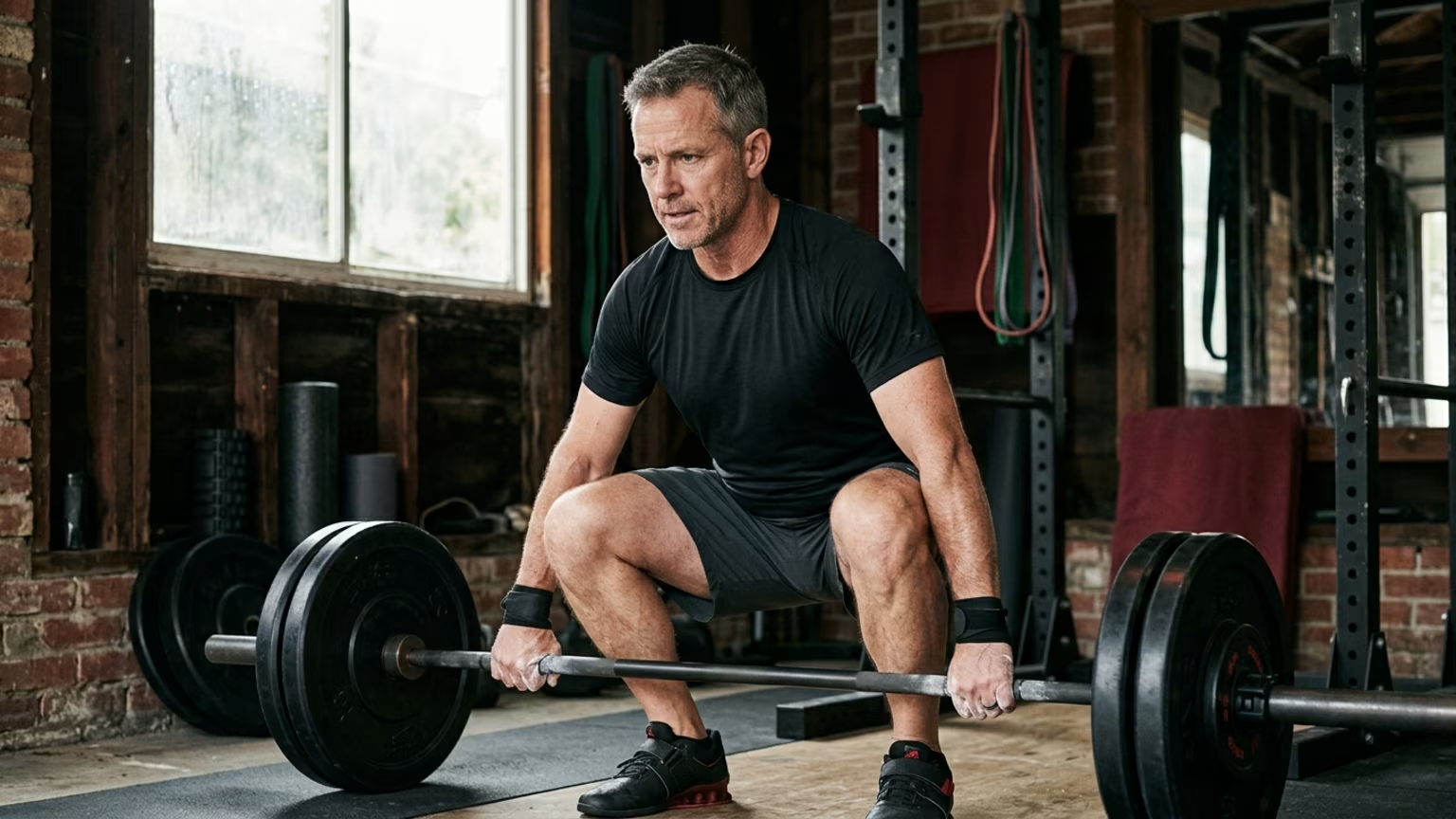
On September 10, 2026, Canyon Ranch published “The Hidden Longevity Benefits of Resistance Training and Recovery”. The publication outlines how physical strength and targeted rest work together to preserve movement capacity and independence as adults age.
Evaluating Strength Interventions
The article draws on several specific data sets to evaluate movement, strength and longevity. Canyon Ranch cites an unnamed study tracking inactive men aged 65 to 78. A separate systematic review summarized in the search results examined adults aged 75 and older. This review specifically included participants aged 80 and above.
Research on older populations often separates healthy individuals from those with specific physical limitations. Another systematic review evaluated older adults diagnosed with sarcopenia. These different demographics provide a broad view of how aging bodies respond to mechanical tension. Understanding these distinct participant groups helps clarify how strength routines affect daily physical capability.
Defining Functional Metrics
Canyon Ranch defines mobility as the ability of joints to move freely through their range of motion without pain. The publication describes flexibility more specifically as muscle elasticity and the ability to bend without restriction. Both of these physical qualities can decline with age. The article argues that consistent resistance training can help preserve or improve them.
A man focusing on hip mobility after 45 can use strength routines to maintain his overall range of motion. Canyon Ranch reports that resistance training may improve range of motion to a degree comparable with stretching. The practical goal is controlled movement through the range needed for everyday activities. Achieving this control allows older adults to navigate physical spaces without pain or restriction.
Measurable Changes in Capability
The findings show distinct physiological improvements from structured training interventions. In the cited study of inactive men aged 65 to 78, participants found flexibility improvements of 3 to 12 percent with low-intensity resistance training. That same group recorded flexibility improvements of 8 to 28 percent with high-intensity training. These figures demonstrate that structured physical loading directly influences muscle elasticity.
The systematic review of adults aged 75 and older reported strong strength adaptations. The overall strength effect was 0.97 standard-deviation units, with a 95 percent confidence interval of 0.50 to 1.44. The strength effect in adults aged 80 and above was 1.28, with a 95 percent confidence interval of 0.28 to 2.29. This review also confirmed that resistance training significantly improved whole-muscle hypertrophy in these older populations.
Older adults with sarcopenia also demonstrated notable physical adaptations after structured exercise. The review reported a standardized mean difference of 1.26 for knee-extension strength. Participants achieved a standardized mean difference of 1.28 for gait speed. The same group recorded a standardized mean difference of -0.93 for Timed Up and Go performance.
Applying Data to Movement Deficits
Sarcopenia represents a significant loss of skeletal muscle mass and functional strength. Older adults living with this condition face elevated risks of physical frailty and mobility loss. The standardized mean difference for knee-extension strength indicates a powerful improvement in the muscles responsible for standing. The improvement in Timed Up and Go performance demonstrates better agility, balance and directional control during movement.
Canyon Ranch argues that healthy longevity means preserving independence and movement capacity rather than merely extending lifespan. The publication cites the American Heart Association for the broader benefits of resistance exercise. These benefits include slowing age-related losses in muscle mass, strength and power. The AHA also notes that resistance exercise improves physical function while reducing fall risk.
The AHA statement provides critical context for why maintaining strength matters for long-term health. Slowing the loss of muscle mass protects the body from metabolic decline and structural weakness. Preserving muscle power helps older adults react quickly to sudden changes in balance or uneven terrain. Reducing fall risk remains one of the most vital strategies for avoiding severe orthopedic injuries and long hospital stays.
Structuring Daily Activity
The practical interpretation is that strength, stability and neuromuscular control all contribute to useful movement. This represents a broader functional-aging perspective than a bodybuilding-oriented approach focused only on muscle size. Training movements should resemble daily demands to increase functional return. These daily patterns include sitting, standing, carrying and reaching.
Canyon Ranch cites the Centers for Disease Control and Prevention recommendation for basic weekly activity. The CDC advises at least two days per week of moderately intense muscle-strengthening activity involving all major muscle groups. Suggested equipment includes bodyweight exercises, resistance bands, dumbbells, kettlebells and pull-up bars. Men can build an effective routine at home or in a dedicated gym facility.
The Centers for Disease Control and Prevention guidelines offer an accessible starting point for untrained individuals. By requiring at least two days per week of moderately intense training, the CDC establishes a realistic baseline. This frequency provides enough stimulus to trigger physical adaptation without overwhelming a recovering nervous system. The requirement to involve all major muscle groups guarantees that the legs, back, chest and arms receive adequate loading.
Equipment and Progressive Loading
Using bodyweight exercises allows beginners to learn basic movement mechanics without external risk. Resistance bands provide constant tension through the entire range of motion to help stabilize weak joints. Dumbbells and kettlebells introduce free-weight loading that challenges physical coordination and core stability. Pull-up bars build upper back strength and improve grip capacity for carrying heavy objects.
Focusing on all major muscle groups supports a balanced physical structure that resists daily wear. The legs, back, chest and shoulders manage the heaviest physical demands during recreational activities. Building foundational strength in these areas supports functional longevity after 45 by keeping the entire kinetic chain engaged. A balanced training stimulus prevents the joint stiffness that often accompanies aging.
Walking, gentle stretching or easy yoga can serve as low-intensity movement on non-training days. These activities can complement strength training without replacing the necessary physical stimulus. Tracking practical outcomes such as stair confidence and walking speed often matters more than monitoring gym numbers. A man managing joint pain must learn to adjust routines based on post workout aches before increasing his weekly intensity.
Evaluating physical capability requires focusing on practical outcomes rather than peak gym performance. Being able to easily lift luggage into an overhead compartment provides a direct measure of shoulder stability. Walking confidently on uneven hiking trails demonstrates sufficient ankle mobility and lower body coordination. These real world applications matter far more than reaching arbitrary maximum weights on exercise machines.
Men returning to exercise after a layoff should begin with manageable weights or resistance bands. They can then gradually increase resistance as their technique and physical tolerance improve. Exercise selection, current pain status and overall balance heavily influence physical outcomes. Men with significant joint pain, neurological symptoms or recent surgery might require clinical assessment before starting.
The Role of Recovery and Nutrition
Canyon Ranch frames recovery as an active component of training rather than mere inactivity. The article recommends seven to nine hours of sleep, one or two rest days per week, gentle movement and adequate protein. A separate review found that adding protein supplementation to resistance exercise produced greater gains in lean mass and leg strength than training alone. The reported standardized mean differences were 0.58 for lean-mass gain and 0.69 for leg-strength gain.
Adequate protein and overall nutritious food remain the most reliable physiological inputs for muscular repair. The evidence indicates that protein supplementation may improve lean-mass adaptations when combined with resistance exercise. However, the current research does not justify treating supplements as mandatory for every older man. Consuming high-quality protein from whole food sources can effectively support muscle repair and tissue growth.
Recovery habits dictate how well the physical body adapts to heavy resistance. Sleep needs, training frequency and overall recovery requirements vary with age, health, workload and stress. Older men can benefit from structuring a practical framework for recovery and resilience to manage systemic fatigue. Proper pacing prevents excessive muscle damage and allows the central nervous system to repair itself.
Canyon Ranch lists massage, warm baths and saunas as potential recovery rituals. These practices may be personally useful for managing soreness after a difficult training block. However, the source does not establish that these specific interventions are necessary for muscle adaptation, longevity or overall mobility.
Limitations and Context
The available data carries several structural limitations and missing details regarding specific claims. Canyon Ranch does not provide the study title, authors, journal or publication date for the flexibility trial involving inactive men. The publication also notes that the observed flexibility gains reversed when training stopped. Furthermore, the source does not establish a universal protein dose for every older man.
The lack of publication details for the flexibility study limits how professionals can interpret the findings. Without knowing the exact low-intensity protocols, older men cannot accurately replicate the specific training volume. The reversal of flexibility gains after training stopped highlights the transient nature of physical adaptations. Muscles and joints require ongoing mechanical loading to maintain their elasticity and strength over time.
Higher training intensity is not automatically superior for every person returning from a long break. Canyon Ranch reports larger flexibility improvements with high-intensity training, but the article lacks enough methodological detail to determine how intensity was defined. Improvements documented in older adults with sarcopenia should not be treated as identical to outcomes in healthy, active men aged 45 to 70.
A 2026 review identified several areas of uncertainty regarding exercise interventions. The review noted that resistance and multicomponent exercise programs can reduce mobility disability in older adults with functional impairment. However, the researchers identified uncertainty about durability beyond several months, cost-effectiveness and delivery at scale. Consistent training preserves capacity, but the evidence does not support claims of reversing aging or preventing all disability.
This research confirms existing knowledge that consistent resistance exercise, when combined with dedicated recovery, remains a primary driver of functional independence and physical capability as men age.
How Everfitguys helps
Resolving poor sleep and slow recovery often falls to the active adult attempting to manage his own midlife stress, and this daily routine becomes highly practical when Everfitguys translates the latest functional evidence. Unmanaged fatigue regularly disrupts consistent resistance training, and we clarify the clinical data so you can build habits that maintain strength and independence over time. Read the research
Sources
- Effects of Resistance Training on Muscle Size and Strength in Very Elderly Adults: A Systematic Review and Meta-Analysis of Randomized Controlled Trials.
- Effects of resistance training in healthy older people with sarcopenia: a systematic review and meta-analysis of randomized controlled trials.
- The Hidden Longevity Benefits of Resistance Training and Recovery
Stay sharp
Get stories
The best writing on craft and life, delivered once a week. No noise, just the good stuff.