Researchers Propose 'Movement Span' to Measure Functional Aging
On June 2, 2026, the Journal of Sport and Health Science published a proposal by Professor Li Li of Georgia Southern University introducing "movement span" as a new dimension of aging. The concept argues that evaluating long-term functional independence requires measuring how confidently a person moves in daily life rather than just relying on basic disease status.
How the Research Was Conducted
The new publication is structured as a conceptual opinion paper rather than an empirical trial with a specific duration or a measured participant demographic. Identified as Volume 15 of the journal with DOI 10.1016/j.jshs.2026.101150, the article presents a theoretical framework for measuring and understanding age-related functional decline. Because the document is a concept proposal, it does not report experimental data, a patient sample size, or specific clinical trial results. The researchers instead reviewed existing frameworks around human mobility to propose a new method for categorizing physical capability over time.
The Primary Findings and Movement Span Indicators
The proposed framework categorizes human aging into three distinct but overlapping circles of measurement. It places lifespan as the broadest measure of human longevity, healthspan as a smaller circle within lifespan, and movement span as a highly specific measure residing within both. Professor Li defines movement span explicitly as the duration of life during which an individual can move with confidence, responsiveness, and adaptive control. The article identifies several measurable physical capabilities as potential components of a formal movement-span assessment.
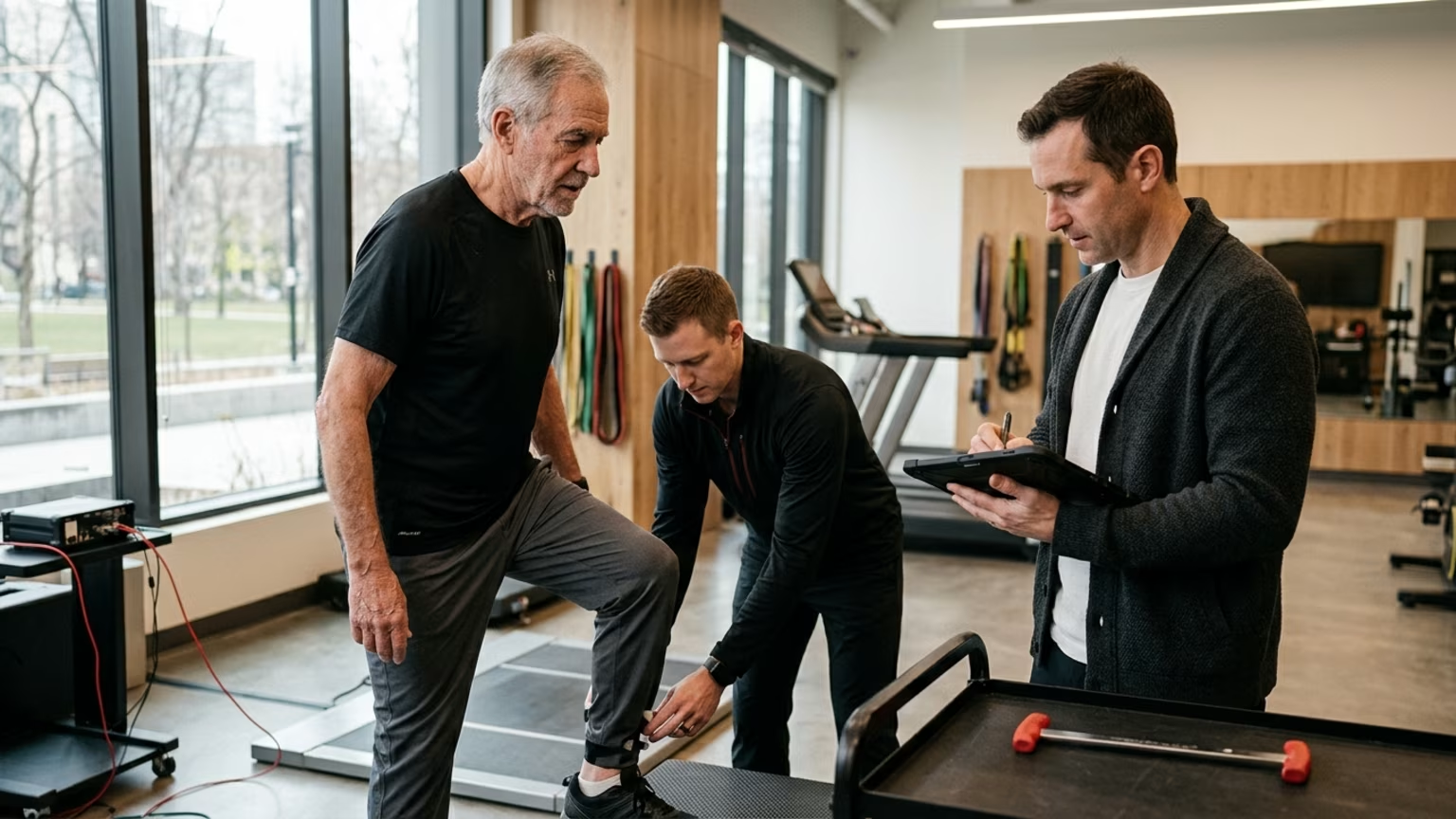
These potential assessment components include gait speed and physical balance. Reaction time, basic movement transitions, and adaptive control are also included. The researchers specifically highlight the Timed Up and Go test as a practical example of how these transitions might be measured in a clinical setting. This established functional test combines standing from a chair, walking three meters across a room, turning around, and sitting down again.
The paper states that among all the listed functional indicators of aging health, gait speed currently holds the strongest existing evidence base. A related public-health perspective detailed in the article defines human mobility as the actualization of locomotor capacity within a given person’s environment. This perspective clarifies that physical mobility requires a foundation of raw locomotor capacity. This baseline capacity includes joint function, basic muscle strength, physical balance, and cardiovascular endurance. The researchers note that evaluating these factors together provides a much clearer picture of physical independence than measuring straight-line walking speed alone.
Why Traditional Aging Metrics Fall Short
Traditional medical discussions about aging usually prioritize measuring how long a person lives and how many of those years are spent free from a disabling disease. The movement span proposal argues that these standard measures often fail to capture the practical reality of navigating daily life. A man over 45 might technically retain the ability to walk without assistance while silently losing the ability to move through his environment smoothly. He might become increasingly cautious in crowded spaces, struggle with quick directional changes, or avoid walking on uneven ground.
These subtle shifts in physical confidence matter deeply for long-term autonomy even if they do not qualify as a diagnosed disease. Evaluating movement quality helps practitioners spot physical hesitation before major losses in physical capability occur. Falls remain a primary reason for paying attention to these early changes in movement confidence and reaction time. The CDC reports that more than one in four adults aged 65 and older falls each year, while fewer than half of those who fall actually report the incident to their doctor.
Understanding Locomotor Capacity
Distinguishing between raw physical capacity and environmental mobility is highly relevant for men trying to preserve their physical independence. Locomotor capacity represents the foundational elements of physical performance like joint function, basic muscle strength, physical balance, and muscular endurance. Mobility is the practical expression of that baseline capacity when a person is forced to navigate stairs, uneven hiking trails, or unpredictable crowds. An assessment that evaluates only your ability to walk on a treadmill fails to measure how you react to sudden physical obstacles.
Men who want to continue hiking, lifting weights, or participating in recreational sports must actively preserve this environmental adaptability. Rebuilding lower-body strength and trunk control is often more valuable than focusing entirely on building maximum lifting numbers or accumulating walking mileage. Reviewing resources like a functional longevity scorecard can provide a baseline for understanding your current capacity. Maintaining baseline muscle strength and joint function helps provide the physical reserves needed to adapt to unexpected environmental challenges.
The Paradox of Avoidance in Older Adults
The conceptual framework highlights a specific behavioral risk pattern known as the paradox of avoidance. When individuals begin to lose confidence in their physical capabilities, they frequently self-restrict their daily activities to avoid encountering challenging environments. A person might decide to stop navigating busy public spaces, avoid uneven walking surfaces, or completely abandon a favorite recreational activity. While this conscious avoidance successfully reduces immediate physical challenge, Li’s paper notes that this self-restriction may actually accelerate long-term physical decline.
Maintaining a robust movement span requires safe but consistent exposure to a variety of physical demands and uneven environments. You can support this objective through deliberate practices focused on maintaining mobile joints and functional movement patterns that incorporate multi-directional steps and unexpected transitions. When you stop challenging your physical balance and reaction time, your body gradually loses the ability to manage sudden physical shifts. Staying actively engaged in physically complex environments remains a critical component of preserving long-term physical autonomy.
Practical Assessment for Men After 45
For men in midlife, the most practical takeaway from this research is to view mobility as much more than the simple ability to walk in a straight line. The proposed framework focuses on maintaining the physical capacity to safely start, stop, turn, and recover balance. A well-rounded physical training program should deliberately include strength work, single-leg balance practice, and gradual exposure to unpredictable terrain. Treating physical training as practice for real-world environmental challenges builds the exact adaptive control described in the new research framework.
Paying close attention to your own movement confidence can serve as an excellent functional self-check over time. Notice whether simple everyday tasks like getting up from a low chair, stepping off a steep curb, or turning while carrying a heavy object feel slower than they did a decade ago. Practicing specific movements like getting down to and up from the floor can help you measure and sustain your daily physical adaptability. Readers who experience repeated falls, new physical weakness, or sudden balance changes should seek clinical assessment rather than attempting to train through these unexplained symptoms.
Structural Limitations of the Proposal
The most prominent structural limitation of this publication is that movement span remains entirely a proposed conceptual construct rather than an established clinical diagnostic test. Because the document is an opinion paper, it does not provide any empirical validation, longitudinal patient outcomes, or quantified relationships with actual falls or disease progression. The source document does not establish a new standardized movement-span score, a specific diagnostic threshold, or any medical cutoff point for practitioners to use.
The researchers explicitly acknowledge that concepts like physical confidence, adaptive control, and movement fluidity will require reliable measurement protocols before they can become standardized public-health tools. The proposed framework heavily overlaps with several existing gerontology concepts, including functional ability, intrinsic physical capacity, and generalized physical performance. A single functional screening result should never be treated as a comprehensive measure of a person’s overall health or future physical independence.
The Paradigm Shift
While this conceptual framework does not yet alter established clinical protocols, it alters how we evaluate physical independence by proposing that everyday movement confidence matters just as much as basic disease prevention.
How Everfitguys helps
Measuring environmental mobility requires evaluating complex movement transitions rather than relying on basic straight-line walking tests. Poor sleep, stress and slower recovery frequently drain the baseline energy needed to manage these daily physical challenges confidently, so Everfitguys interprets current physiological research to help you restore that foundational vitality safely. Read the research
Sources
Stay sharp
Get stories
The best writing on craft and life, delivered once a week. No noise, just the good stuff.