Floor Transfers and Functional Mobility After 45
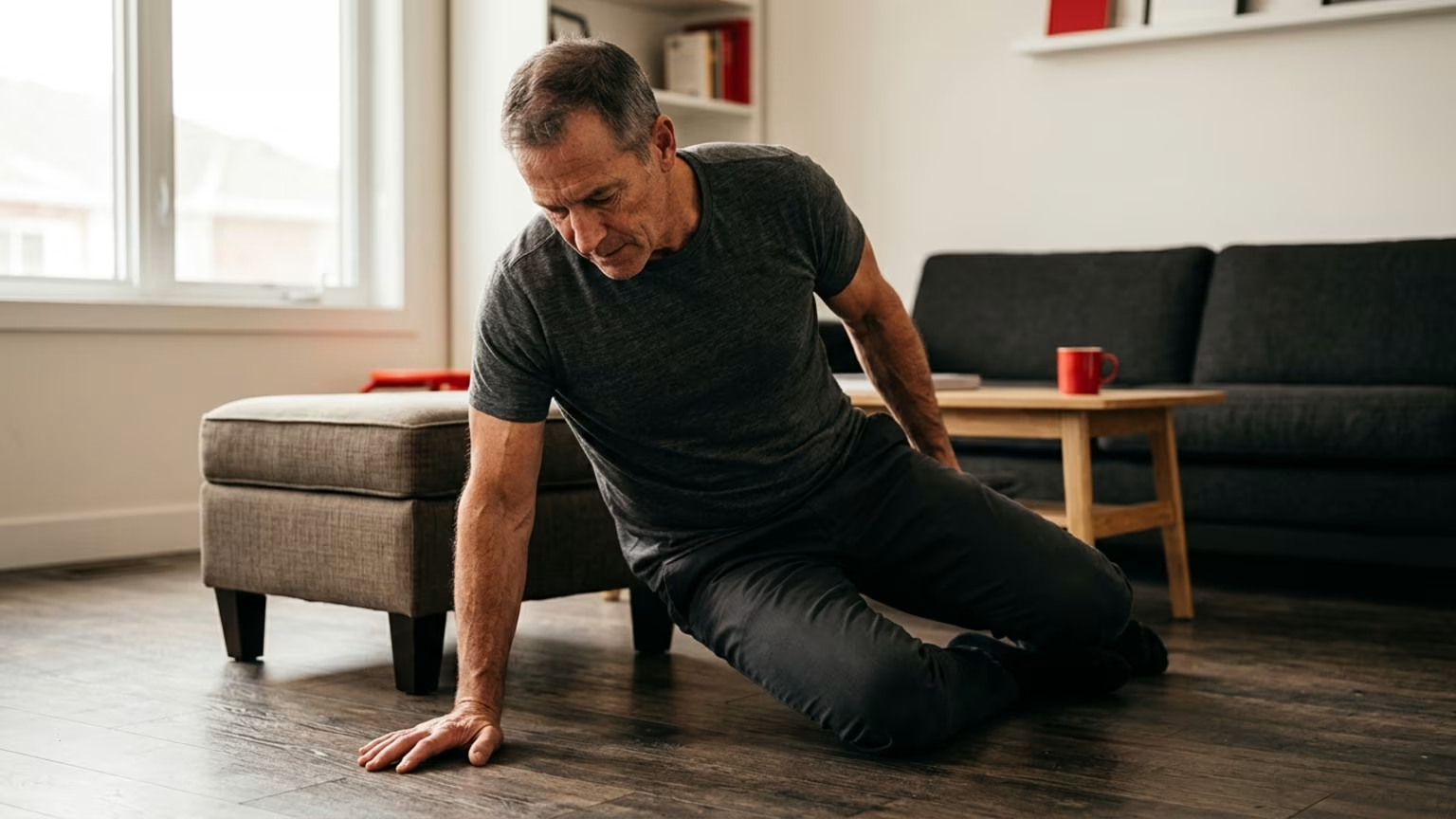
On September 9, 2026, The New York Times published "A 20-Minute Workout for Aging Well". The article details a moderate intensity routine focused entirely on the practical task of moving from standing to the floor and returning to standing.
The fitness experts designed this movement protocol specifically around older adult demographics. Coach Fuhrmann contributed to the workout design using her experience specializing in functional aging with women in their 60s and 80s in Michigan. The session involves a specific 20 minute duration of moderate intensity effort. The routine is structured carefully to develop the required strength and flexibility separately before combining them into a full movement.
Additional observational research on this test tracked 2,002 adults aged 51 to 80. Researchers followed these specific participants for a median trial duration of six years to assess mortality outcomes. The experts approach the floor transfer movement as a progressive challenge. They instruct participants to first develop individual capacities before attempting to integrate them into a complete transfer.
The Physical Demands of Floor Transfers
Getting down to the floor and standing back up requires multiple physical capacities working together. The New York Times article identifies muscular strength and joint flexibility across multiple muscle groups as absolute prerequisites for rising comfortably. The sitting-rising test is commonly described as assessing several of these physical capacities at exactly the same time. The specific movement evaluates muscle strength, joint flexibility, basic balance, and overall body coordination simultaneously.
The exercises in the floor transfer routine begin on the ground and progressively move toward standing. This specific sequence allows participants to rehearse each individual stage of the transition carefully. Practicing the transition in distinct parts helps older adults build confidence before attempting the full movement. The structured workout builds the required components separately before combining them into the full floor to standing motion.
A separate New York Times article on exercises for aging well includes other movements that build these physical traits. Physical therapists highly recommend controlled sit to stand practice and hip-hinge work for preserving mobility. They also suggest core training and push-ups to develop the necessary physical foundation for older adults. Developing these important physical capacities aligns directly with managing the natural ways movement changes with age.
The Scoring Protocol of the Sitting-Rising Test
The sitting-rising test functions as a highly structured performance measure for basic mobility. A clinical report summarizing the test describes a specific scoring system used to evaluate participants. An individual earns exactly five points for descending to the floor successfully during the assessment. They earn another five points for rising from the floor back to a full standing position.
Points are automatically deducted during the evaluation if the participant uses a hand, a knee, or external support. The test operates strictly as a basic screening measure rather than an independent medical diagnosis of overall health status. A perfect test score is not strictly necessary for maintaining functional independence in daily life.
Performance on this mobility test can be heavily affected by factors completely unrelated to general fitness. Chronic knee pain, severe hip pain, and complex neurological conditions can lower a score significantly. Sudden dizziness, a strong fear of falling, specific body proportions, and the immediate physical environment also influence test results. Being able to rise from the floor remains a highly useful functional capability regardless of the exact point tally.
Personal Independence and Fall Prevention
The central premise of the floor transfer workout remains its direct relevance to personal independence. This capability is particularly true for older adults who live entirely alone or simply want to preserve their day to day autonomy. The New York Times connects floor transfers directly with ordinary daily activities that matter immensely to mature adults. These common activities include playing actively with grandchildren, regular gardening, and reaching for dropped objects under heavy furniture.
Maintaining this ability directly supports building a reliable physical reserve for later life. Fall prevention serves as the broader rationale for practicing this specific movement pattern regularly. The New York Times article describes falls as a major source of severe injury among adults. Because unexpected falls pose such a tremendous physical risk, balance and body coordination remain important targets for training.
The Centers for Disease Control and Prevention formally identifies falls as an incredibly important older adult health issue. The government agency points readers directly toward its STEADI fall-prevention resources for comprehensive safety guidance. A separate New York Times article describes balance as highly important for basic fitness and everyday adult life. Physical therapist Conor Nordengren states clearly that balance tends to deteriorate with age unless it is deliberately practiced.
Clinical Outcomes and Mortality Data
The primary clinical outcomes associated with floor transfer capabilities center heavily on severe long term health risks. The specific research on the 2,002 adults aged 51 to 80 revealed highly significant survival differences based entirely on movement capacity. Researchers discovered formally that the lowest scoring group had a five to six-fold higher risk of death from any cause than the highest scoring group.
Physical therapist Ashley Katzenback, based in Sandwich, Massachusetts, states clearly that getting up from the floor is a very important capability for older adults. She strongly recommends practicing the movement at least once a day for optimal results. Katzenback advises older clients to use whatever support is totally necessary to complete the repetition safely. Her highly practical recommendation is not to wait until someone is completely unable to rise from the hard floor.
Coach Fuhrmann frames the movement strictly as a form of functional preparation for real life situations. The specific routine provides a highly practical way to rehearse moving body weight carefully through physical space. The movement is not intended to serve as a conventional gym exercise for building massive strength. Practicing the actual movement builds specific competence for ordinary adult life requirements.
Understanding the Clinical Context
The mortality association described strictly in the cohort report does not establish a definitive causal relationship. An observational association between test performance and outcomes is not actual proof that the exercise itself causes a much longer life. The five to six-fold mortality risk comparison simply summarizes a specific group of older adults. It should not be generalized loosely as a definite prediction for every single man over 45.
The available article content does not include a proper randomized trial to validate these specific longevity outcomes. There is absolutely no mortality analysis showing that this specific 20 minute routine extends human life directly. The formal report lacks any numerical outcome showing that the routine actively reduces falls or improves human cognition. The published article does not present the workout as a formal clinical treatment or a validated longevity protocol.
The routine is listed strictly as moderate intensity, but the text completely lacks specific training parameters. The guidance does not provide specific heart rate targets, clear progression standards, or a formally validated training dose. There is absolutely no clinical evidence that exactly 20 minutes is superior to a much shorter or slightly longer session. The provided source material does not establish any actual benefits for testosterone, metabolic health, daily sleep, or long term cardiovascular outcomes.
The floor itself can present a very serious fall hazard for some specific individuals. This risk applies heavily to someone with poor balance, active osteoporosis, a recent surgery, or a clear history of falls. A highly stable support such as a heavy chair and a completely clear area may be highly appropriate for basic safety. The New York Times article explicitly supports practicing the movement with extensive assistance.
The experts state clearly that a completely hands free performance should not be treated as the absolute mandatory goal for absolutely everyone. The movement is completely aimed at functional movement rather than building comprehensive strength. The routine is absolutely not a substitute for individualized physical therapy prescribed by a medical professional.
Practical Applications for Men Over 45
Men should treat the floor transfer as a highly useful capability to practice rather than a simple pass or fail test. Start carefully with a movement version that feels controlled and completely secure. Lower your body to the floor using a highly stable support and pause completely at the bottom of the movement. Return carefully to standing with as much assistance as necessary to maintain steady balance.
The related New York Times article actively recommends using light support from a chair, wall, or sturdy countertop. This specific guidance applies whenever a balance exercise is very difficult or feels highly unstable. This specific modification principle is completely consistent with the floor transfer advice to use any means necessary. Keep the overall effort highly moderate and stop completely if pain, sudden dizziness, or a severe loss of control appears.
Learning specifically how these patterns work relates very closely to maintaining connective tissue health and mobility. Practice daily in a completely clear space and position a highly sturdy support nearby. This specific safety precaution is particularly important when returning to daily exercise after a very long break. A highly useful progression is to reduce personal reliance on support gradually over multiple weeks.
Older men who desperately want to preserve muscle mass should absolutely not assume that daily floor practice replaces progressive resistance training. Use the functional movement strictly as a daily complement to a much broader overall training plan. This plan should absolutely include progressive strength work, daily walking, careful balance practice, and adequate recovery.
Ultimately, this research confirms existing knowledge that maintaining functional capabilities requires regular, deliberate practice rather than relying solely on conventional gym exercises.
How Everfitguys helps
Not knowing which longevity and healthy aging claims are actually supported by research often leads mature men toward unproven mobility routines. The inability to distinguish observational associations from causal proof creates confusion about what actually prevents physical decline, and Everfitguys analyzes clinical studies to help you evaluate functional training methods safely.
Sources
Stay sharp
Get stories
The best writing on craft and life, delivered once a week. No noise, just the good stuff.