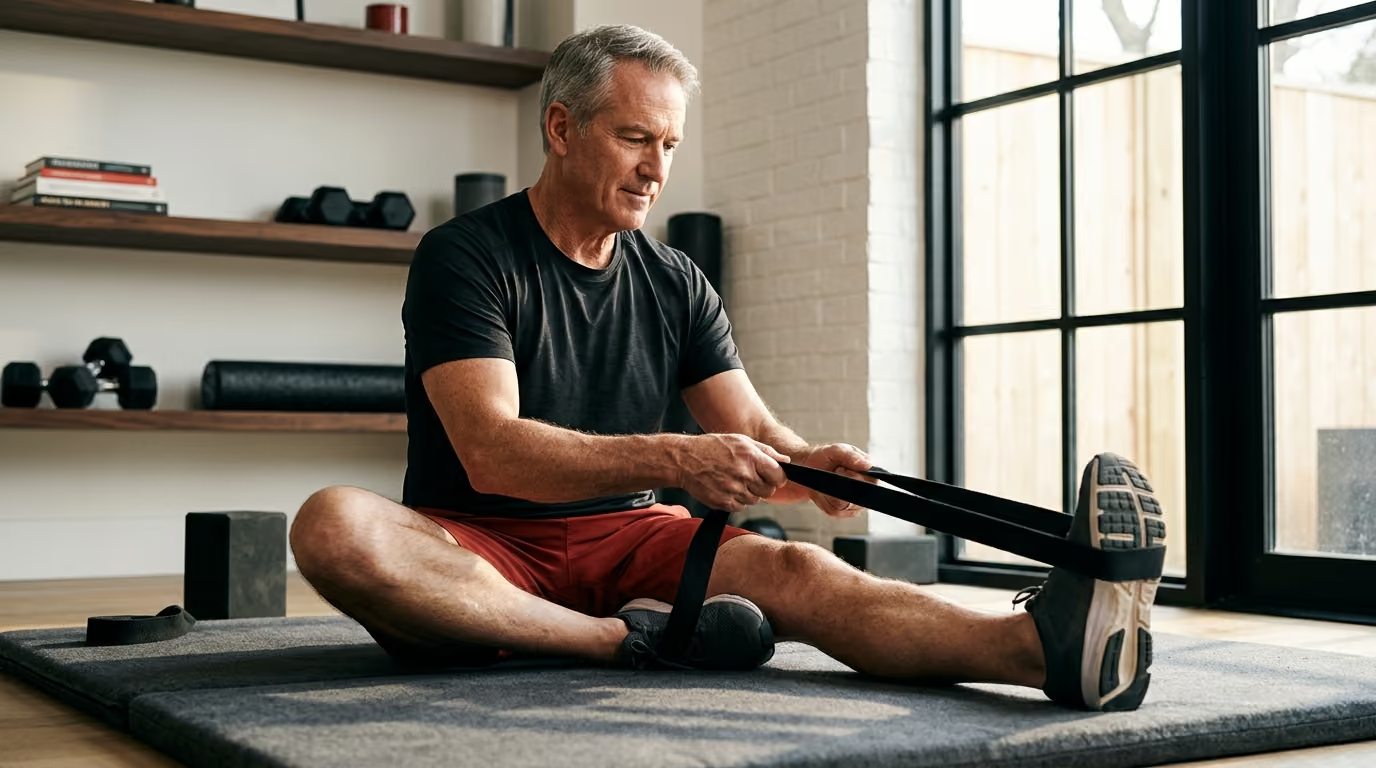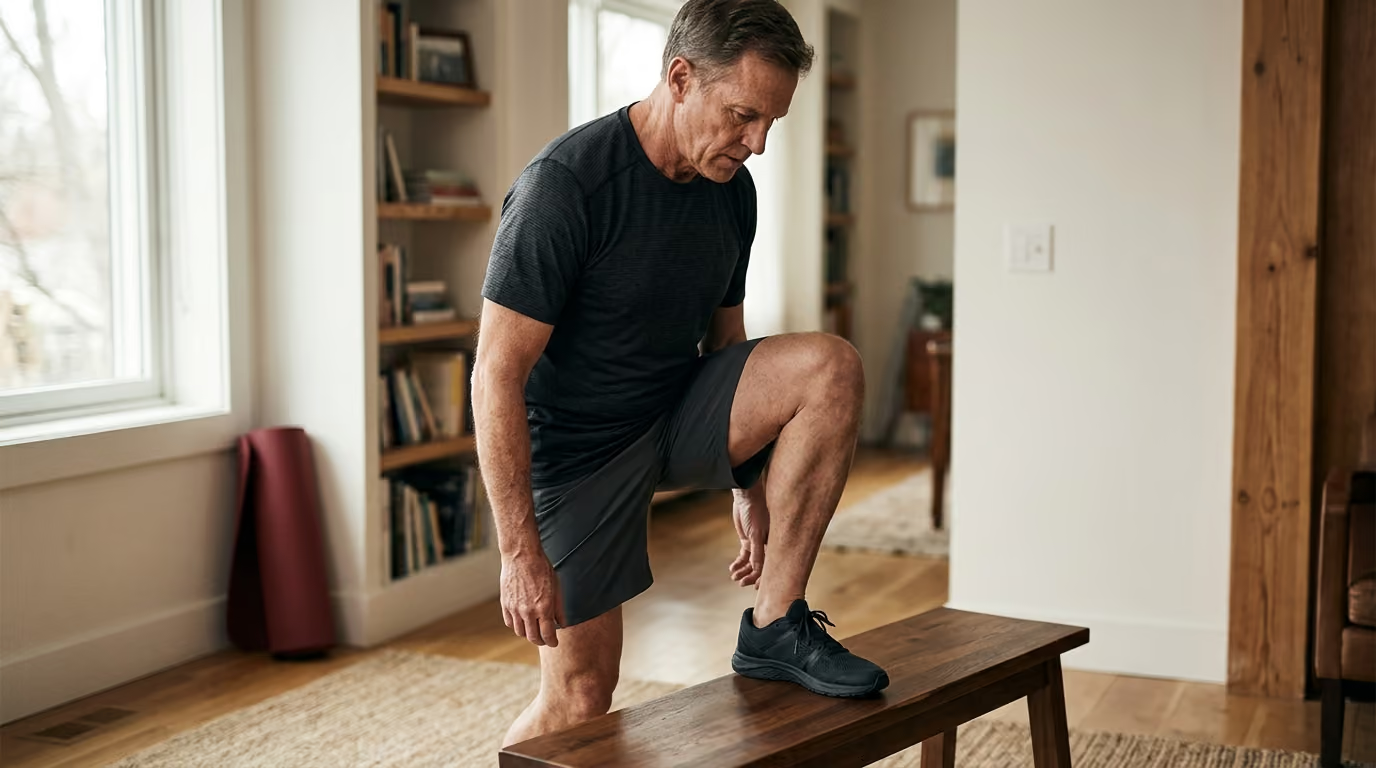
You step off a curb on a brisk morning, or you reach across the backseat of your car to grab a heavy gym bag. A decade ago, your body absorbed these movements without a second thought. Now, you might feel a sharp twinge in your Achilles tendon, a deep ache in your shoulder, or a persistent stiffness across your hips that takes an hour to loosen up.
It is easy to assume that after 45, your joints and soft tissues are simply wearing down like old tires. Popular fitness culture often reinforces this fear. It warns men that their joints are ticking clocks, or promises that a particular powder can restore youthful tissue in thirty days.
The biological reality is far more interesting and encouraging. Aging changes the physical properties of your connective tissue, but it does not make your body fragile or biologically inert. Your tendons, ligaments, cartilage, fascia, and bones remain responsive to mechanical load throughout your life. Understanding how these tissues change, and how they adapt to intelligent training, is the key to maintaining mobility, joints, and functional movement as you age.
What the Research Shows About Aging Connective Tissue
Connective tissue is not a single material. It is an umbrella term for distinct biological structures that perform specialized mechanical jobs throughout your body.
Tendons connect muscle to bone and transmit large forces. Ligaments connect bone to bone to guide and stabilize joint motion. Articular cartilage provides a slippery, low-friction surface inside joints. Fibrocartilage forms tough shock absorbers like the menisci in your knees and the discs between your vertebrae. Fascia wraps and links muscle groups into integrated functional chains. Bone provides the rigid mineralized framework that anchors the entire system.
Each of these tissues relies on an extracellular matrix made largely of water, proteoglycans, and structural proteins. The most important of these proteins is collagen.
When researchers study what happens to connective tissue over time, they find specific structural shifts rather than a simple loss of material
. Tendons in older adults often exhibit altered vascularity, lower cellular activity, and changes in the surrounding extracellular matrix. Material stiffness, measured as Young's modulus, often declines with physical inactivity. However, systematic reviews confirm that mechanical loading, particularly resistance training, stimulates collagen remodeling and increases tendon stiffness across all age brackets.
A critical nuance in the scientific literature is that much of the direct training data comes from adults aged 65 and older. Studies specifically isolating men aged 45 to 64 are fewer in number. We must be careful to distinguish between findings directly proven in middle age and principles extrapolated from older adult cohorts.
The clear consensus across both groups is that tendons and muscles retain substantial plasticity. Connective tissue detects physical stress through a process called mechanotransduction. When cells inside the tendon or ligament experience tensile load, they release growth factors and initiate structural repair. The capacity to adapt never disappears. What changes after 45 is the baseline state of the tissue, the rate of recovery, and how much sudden stress the matrix can tolerate before becoming irritated.
Why Connective Tissue Changes After 45
The shifts you experience in your joints and muscles after 45 are driven by normal cellular and metabolic processes. They are not signs of a disease, nor are they evidence of structural failure.
One primary mechanism is the accumulation of non-enzymatic crosslinks known as advanced glycation end-products. As we live, sugars interact spontaneously with proteins throughout our long-lived tissues. Tendons and cartilage have slow protein turnover rates, which allows these crosslinks to build up gradually over decades.
These crosslinks alter how collagen fibers interact with one another. In healthy, youthful tendon tissue, parallel collagen fibrils slide smoothly past each other when a load is applied, allowing the tissue to absorb shock. Crosslinking can restrict this sliding motion. When the fibers cannot slide easily, the tissue becomes less viscoelastic, shifting more direct physical strain onto individual collagen fibrils.
A parallel process occurs in articular cartilage. Crosslinks increase the intrinsic stiffness of the cartilage collagen meshwork, altering its ability to distribute compressive forces across the joint surface. This change in mechanical behavior can make joints more sensitive to abrupt spikes in training volume.
Cellular dynamics also shift with midlife. The population of tendon stem and progenitor cells decreases, and their signaling speed slows down. Blood flow to dense connective structures, which is naturally modest compared to skeletal muscle, decreases slightly with age.
Metabolic health plays an intertwined role here. Blood glucose control, systemic inflammatory tone, and body mass directly influence the rate of crosslinking and tissue recovery. Connective tissue aging is a multifaceted interaction between natural biological maturation, daily movement habits, and metabolic health.
The Difference Between Flexibility, Mobility, and Capacity
Many men over 45 mistakenly treat every sensation of physical tightness as a flexibility problem. When a joint feels stiff, the default reaction is often long, passive stretching.
Passive range of motion is only a small piece of functional movement. To understand how your body functions in daily life, you need to separate four related terms:
- Flexibility: The absolute passive range of motion available at a joint when pulled by an external force or gravity.
- Mobility: The active, controlled range of motion you can move into, stabilize, and exit under your own muscular power.
- Stability: The capacity of your neuromuscular system to limit unwanted movement and protect a joint from unexpected forces.
- Capacity: The total volume, speed, load, and repetition of work a tissue or joint can absorb before becoming irritated.
A useful way to think about physical capability is:
> Mobility = Range + Control + Strength + Tissue Tolerance.
You can have tremendous passive flexibility in your hips while lying on an examination table, yet lack the muscular strength or stability to control a deep squat. If you lack strength at the outer edge of your range, your nervous system responds by increasing resting muscle tone to protect the joint. You feel tight because your body lacks control, not because your muscles are physically too short.
Furthermore, connective tissues are viscoelastic. They exhibit properties such as creep, where tissue gradually lengthens under a constant load, and stress relaxation, where tension declines over time while held at a fixed length.
When you sit at a desk for eight hours, your hip flexors and lower back tissues settle into a shortened or slackened position. The resting tension of the entire muscle-tendon unit changes. Simply yanking on those tissues with passive stretches does not restore their dynamic spring or their capacity to transmit force. You must build active strength throughout the complete range to give that mobility practical value.
How Aging Changes the Muscle-Tendon Unit
Your muscles and tendons function together as a unified system. You cannot isolate tendon health from the condition of the muscle attached to it.
When you contract a muscle to lift a weight, climb stairs, or hike up a hill, force travels from the individual muscle fibers into an internal connective sheet called the aponeurosis, then through the tendon, and finally into the bone. If the muscle loses strength, the mechanics of this force transfer change dramatically.
Sarcopenia, the age-related loss of muscle mass, strength, and physical function, places low muscle strength at the center of functional decline. When your major muscle groups lose force-producing capability, ordinary daily tasks demand a much higher percentage of your maximum capacity.
Stepping off a tall ledge or catching your footing on an uneven trail requires rapid force production. If your quadriceps or calf muscles lack adequate strength, the kinetic energy from that step cannot be absorbed effectively by active muscle contractions. Instead, the force bypasses the muscle and drives directly into the passive connective structures, such as the patellar tendon, Achilles tendon, plantar fascia, and joint cartilage.
This mechanical reality explains why strength training is fundamental to joint longevity. Building larger, stronger muscle fibers provides a dynamic shock-absorbing system that shields your connective tissues from excessive impact.
At the same time, heavy resistance exercise sends a mechanical signal directly to the tendon core and periphery. It prompts fibroblasts to remodel the matrix, organize collagen fibers, and maintain the structural stiffness necessary for efficient movement. If you want resilient joints after 45, you must build strong muscles to support them through dedicated strength and muscle development.
Practical Loading Strategies for Tendon and Joint Strength
To improve connective tissue after 45, you must apply mechanical loading in a way that respects the slower adaptation timeline of tendons and ligaments compared to muscles.
Muscles have rich blood supplies and adapt relatively quickly to new training programs. Tendons, ligaments, and cartilage adapt at a steadier, slower pace. If you progress your training volume too rapidly based on how your muscles feel, your connective tissues may lag behind, leading to localized inflammation or persistent aches.
The Value of Heavy, Controlled Loading
For decades, middle-aged adults were advised to avoid challenging weights and stick exclusively to light resistance. Modern exercise science has updated this perspective.
Research evaluating tendon mechanical properties demonstrates that heavy resistance training produces superior adaptations in tendon stiffness and material modulus compared to very light loading. Light weights can build local muscular endurance, but they often fail to provide the mechanical strain required to stimulate deep tendon remodeling.
Heavy loading does not mean reckless maximal lifting. It means selecting a resistance that allows you to perform controlled repetitions with excellent technique, finishing a set with two to three repetitions left in reserve.
Contraction type is another area where old assumptions have evolved. Eccentric training, which emphasizes the lowering phase of an exercise, was long thought to be the only way to rehabilitate and strengthen tendons. Controlled studies show that both concentric (lifting) and eccentric (lowering) contractions produce positive tendon adaptations, as do static isometric holds.
The total magnitude of mechanical tension and the consistency of the training program matter far more than relying on a single contraction style.
Progressive Loading Framework
Building joint resilience requires a structured progression. You can organize your training into three practical phases:
- Phase 1: Establish Tolerance
- Low-impact movements, controlled tempos, bodyweight or assisted loading
- Phase 2: Build Strength & Active Range
- Progressive resistance, full usable range of motion, multi-joint patterns
- Phase 3: Dynamic Capacity & Power
- Faster movement tempos, multidirectional stepping, light impact loading
Phase 1: Establish Tolerance
This phase focuses on introducing steady mechanical tension to joints and connective tissues while minimizing soreness and irritation.
- Squat Pattern: Box squats or assisted split squats with a slow, three-second lowering phase.
- Hinge Pattern: Unloaded hip hinges with a dowel along the spine to learn hip mechanics.
- Push/Pull: Elevated push-ups against a sturdy bench and seated cable or band rows.
- Lower Leg: Double-leg standing calf raises on a flat floor with a two-second hold at the top.
- Isometric Holds: Wall sits or split-squat holds for 20 to 30 seconds to load the patellar tendon without joint motion.
Phase 2: Build Strength and Active Range
Once your joints tolerate baseline movements without lingering ache, you can introduce external loads through complete, controlled ranges of motion.
- Squat Pattern: Goblet squats holding a dumbbell or kettlebell, descending to a comfortable, deep depth.
- Hinge Pattern: Romanian deadlifts with dumbbells or a barbell, focusing on hamstring and glute tension.
- Push/Pull: Dumbbell overhead presses and single-arm dumbbell rows.
- Lower Leg: Single-leg calf raises off a step, lowering below the step level to train the Achilles tendon through a full stretch.
- Carries: Heavy farmer's walks carrying dumbbells at your sides to challenge grip, shoulder stability, and trunk stiffness.
Phase 3: Dynamic Capacity and Power
Power, which is the ability to produce force quickly, declines faster with age than pure strength. Power is what allows you to catch your balance during a stumble or quickly navigate uneven terrain.
- Speed Work: Fast-tempo sit-to-stands or step-ups onto a low box with rapid upward drive.
- Upper Body Power: Medicine ball chest passes against a solid wall or overhead slams.
- Dynamic Stepping: Controlled lateral lunges and multidirectional stepping drills.
- Low-Impact Elasticity: Low-amplitude line hops or jump-rope intervals for individuals with adequate baseline strength and joint tolerance.
Mobility, Balance, and Fall Prevention
Maintaining connective tissue resilience is closely tied to balance and spatial coordination. Mobility is useless if you cannot organize your body under changing conditions.
A major finding in healthy aging research is that walking alone, while great for cardiovascular baseline health, is often insufficient to preserve balance or prevent falls. Fall prevention guidelines highlight that structured programs incorporating balance challenges and multidirectional functional movements reduce fall rates by roughly 24 percent in older populations.
Your connective tissues and joint capsules are packed with mechanoreceptors. These specialized sensory nerve endings constantly inform your central nervous system about joint position, tension, and velocity. When you move only in straight lines, such as on a treadmill or stationary bike, these sensory pathways receive limited stimulation.
To keep this sensory and mechanical system sharp, incorporate diverse movement patterns into your weekly routine:
- Tandem Stance and Walking: Placing one foot directly in front of the other while standing or walking along a straight line.
- Single-Leg Balance: Standing on one foot while turning your head slowly from side to side, or while holding a light weight in the opposite hand.
- Multidirectional Stepping: Stepping forward, backward, and laterally over low obstacles placed on the floor.
- Floor Transitions: Practicing getting down to the floor and standing back up without relying on furniture for support.
These exercises train your nervous system to coordinate muscular contractions around your joints, ensuring your connective tissues are loaded safely and evenly during unexpected trips or missteps. To learn more about organizing your weekly movement habits, review our guide to healthy aging strategies.
Managing Training Load and Avoiding Common Setbacks
Most connective tissue injuries in active men over 45 do not occur because a tissue was weak. They happen because the training load spiked faster than the tissue could adapt.
A familiar scenario is the "weekend warrior" pattern. A man sits at a desk Monday through Friday, moves very little, and then plays three hours of competitive pickleball, chops firewood for an entire afternoon, or sets out on a ten-mile mountain hike on Saturday.
The cardiovascular system and muscular will can often push through the challenge. However, the tendons and joint capsules, which have had no recent exposure to that volume or speed, end up overwhelmed.
To protect your connective tissues while staying physically ambitious, apply sensible load management principles:
Change One Variable at a Time
When progressing your training, adjust external load, total volume, or movement speed separately. If you decide to lift heavier weights, do not double your total sets in the same week. If you are adding sprint intervals or plyometrics to your routine, reduce your overall lifting volume to give your tendons room to recover.
Use the 24-Hour Symptom Check
Pain during an exercise is not always a sign of damage, but post-exercise symptom patterns provide reliable feedback. Ask yourself three questions the morning after a demanding session:
- Are your joints or tendons significantly stiffer than usual?
- Has your resting pain or aching increased?
- Does the stiffness take longer than thirty minutes of moving around to calm down?
If you answer yes, your connective tissues were loaded beyond their current capacity. You do not need to stop exercising entirely. Instead, reduce the load, speed, or volume by 20 to 30 percent for your next session, establish a pain-free baseline, and progress gradually from there.
Respect Joint History
A knee that underwent meniscus surgery twenty years ago, or an ankle that suffered severe sprains in college, has a different baseline tolerance than an uninjured joint. Connective tissue scars and altered joint kinematics change how stress is distributed across the joint surface. Treat previously injured areas with patience, allowing extra time between heavy loading sessions.
Account for Metabolic Factors
Elevated blood sugar, high systemic inflammation, and poor sleep impair the rate of collagen repair. Prioritizing consistent sleep, balanced nutrition, and stable blood glucose improves your body's internal environment for connective tissue maintenance. You can read more about how metabolic health interacts with physical performance in our guide on energy and metabolism.
Common Misreadings in Connective Tissue Science
Navigating fitness and health information after 45 can be frustrating. Misleading claims often obscure genuine scientific evidence.
Misreading 1: "Aging Joint Cartilage Is Like Tread on a Tire That Inevitably Wears Out"
This mechanical comparison treats human cartilage as dead rubber. In reality, articular cartilage is living, responsive tissue. While its intrinsic repair capacity is limited compared to bone or muscle, cartilage responds positively to intermittent, cyclical loading.
Walking, cycling, and controlled resistance training help circulate synovial fluid throughout the joint cavity, delivering nutrients to chondrocytes and maintaining tissue health. Radiographic evidence of osteoarthritis on an X-ray or MRI does not correlate cleanly with pain or physical disability. Many men with significant imaging changes move freely and without pain because they have strong surrounding muscles and good movement control.
Misreading 2: "Passive Stretching Lengthens Muscles and Prevents All Joint Injuries"
Static stretching increases your short-term tolerance to the sensation of stretch, but it does little to alter the structural stiffness of your tendons or improve joint stability. Holding a passive hamstring stretch for sixty seconds does not teach your nervous system how to decelerate your leg when sprinting or hiking downhill.
If you want to protect your joints and expand your usable range, you must combine movement range with active strength and muscular control.
Misreading 3: "Collagen Supplements Can Replace the Need for Progressive Training"
Commercial marketing frequently claims that taking specific collagen powders or joint formulas will directly rebuild worn joints and restore youthful elasticity.
A 2025 study in middle-aged men found that combining 30 grams of hydrolyzed collagen with 50 milligrams of vitamin C alongside a 12-week resistance program led to modest additional gains in patellar tendon stiffness and cross-sectional area compared to exercise alone.
However, this was a specific study with a specific protocol. It does not prove that collagen supplements alone can rebuild joints, reverse tissue aging, or replace mechanical loading. Mechanical tension remains the primary trigger that tells your cells to synthesize structural proteins. No supplement can compensate for an absence of physical loading.
Where the Evidence Is Thin
Responsible science requires acknowledging what researchers do not yet know with certainty.
First, human data directly tracking the long-term biological effects of various exercise styles on deep fascia and intervertebral disc matrix remodeling remains limited. Much of what is commonly asserted about "fascial release" or "fascial training" relies on animal models, in vitro cell studies, or commercial theories rather than robust clinical trials in humans over 45.
Second, the relationship between sex hormones, menopause, and tendon dynamics is still poorly understood. While hormonal shifts influence collagen synthesis and bone mineral density, systematic reviews evaluating female sex hormone supplementation and tendon outcomes show mixed, low-quality, and sometimes contradictory results. We cannot claim that specific hormonal changes automatically dictate tendon injury risk, or that hormone therapies serve as a universal protection for connective tissues.
Third, while advanced glycation end-products clearly alter collagen mechanics in laboratory settings, clinical interventions aimed at reversing crosslinks in living human tendons are in their infancy. Today, progressive resistance exercise, metabolic health management, and sensible recovery remain the only evidence-backed tools we have for maintaining connective tissue function over time.
For an extensive collection of science-based articles on staying capable in midlife and beyond, explore our men's health research guides.
The Takeaway
Connective tissue changes with age, but it remains fully capable of adapting to progressive mechanical loading well past 45. By combining intelligent strength training, dynamic balance work, and careful load management, you can build resilient joints and maintain full physical capability for decades to come.
When you are ready to adjust your training plan, begin a new outdoor sport, or increase your lifting volume, revisit this resource to review the principles of progressive loading and tissue tolerance. Strong, durable joints are not a matter of luck or quick fixes, but the result of consistent, intelligent physical work.
Sources
- The role of collagen crosslinks in ageing and diabetes - PMC
- Advanced glycation end-product cross-linking inhibits ... - PMC - NIH
- Crosslinking by advanced glycation end products increases ...
- Advanced glycation end-products diminish tendon ...
- The effect of female sex hormone supplementation on tendon in pre and postmenopausal women: A systematic review - PubMed
- Hormonal Shifts and Structural Strain: A Literature Review of ...
- Glucosepane is associated with changes to structural and physical properties of collagen fibrils
Stay sharp
Get the word
Join our newsletter for the best writing advice and stories from the field.