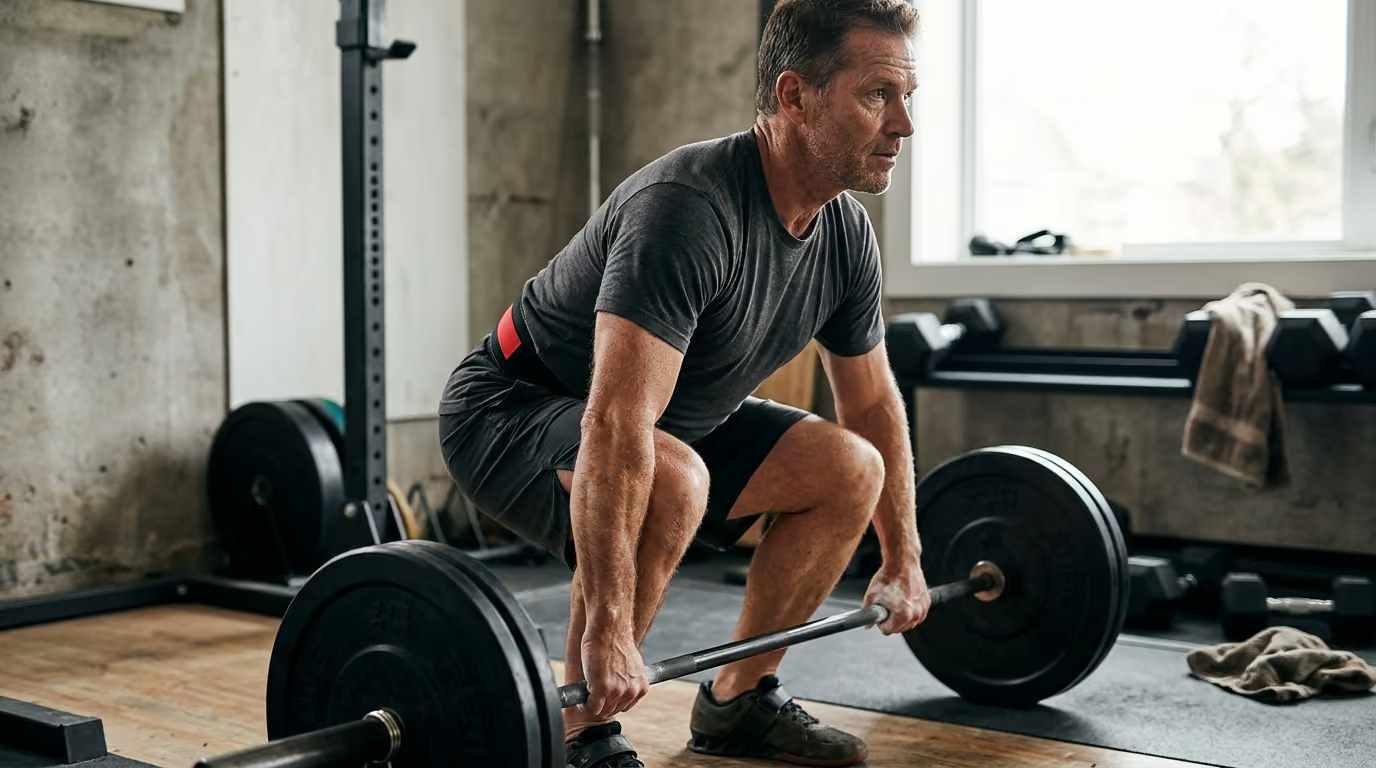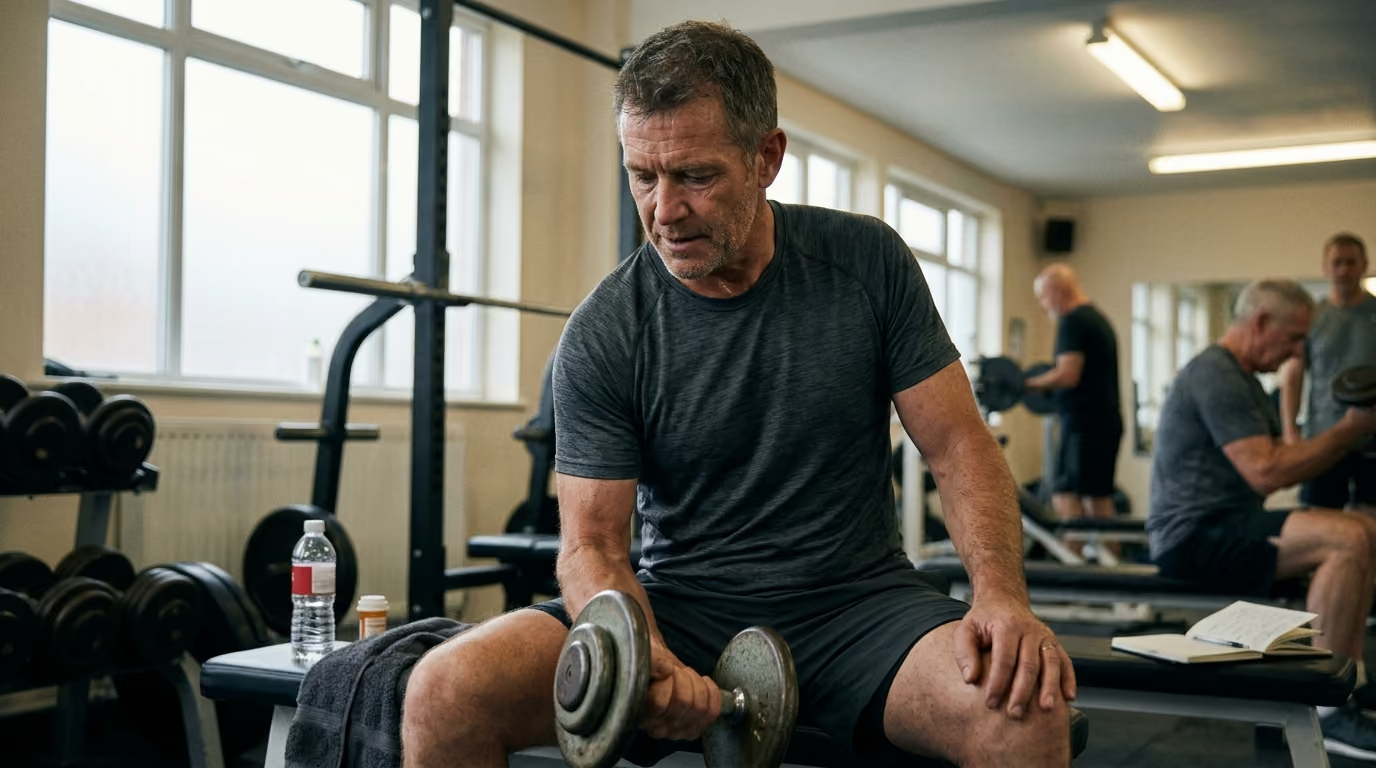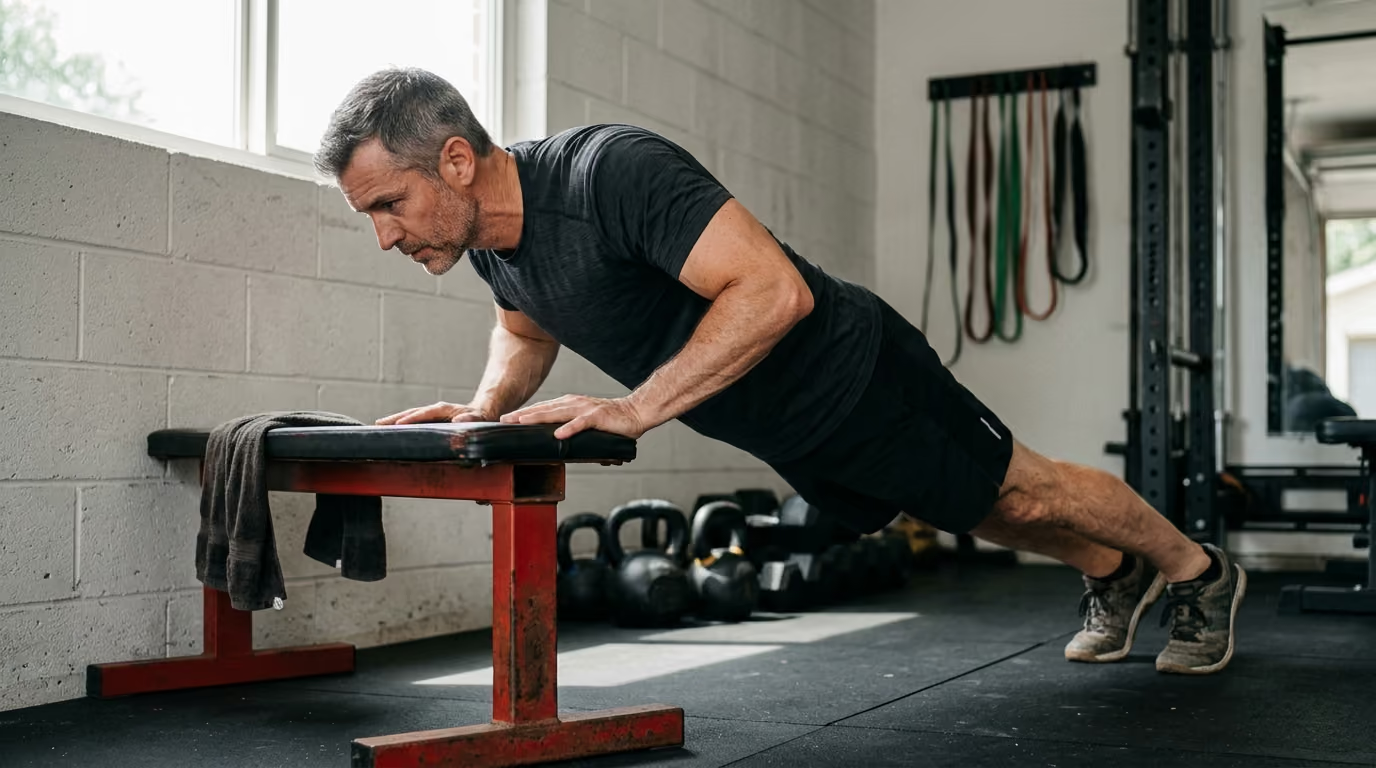
Exercise substitution is the deliberate practice of changing a movement to match your current joint tolerance, mobility, equipment, or skill while keeping the targeted muscular stimulus. It is not an admission of defeat, nor is it an excuse to train with low effort. True regressions preserve the mechanical work on target tissues while removing unnecessary orthopedic strain, balance barriers, or technical fatigue.
This guide details the research behind training adaptations in midlife and later life. You will find a complete decision framework for swapping movements across every major pattern, practical adaptations for joint pain, and clear guidance on where the scientific evidence is solid versus where it remains limited.
What Does the Research Say About Exercise Selection and Aging Muscle?
The scientific literature on resistance training shows that skeletal muscle maintains its capacity to adapt throughout life. Meta-analytic research demonstrates that older adults, including those in their seventies and eighties, achieve meaningful increases in muscle strength and whole-muscle hypertrophy when exposed to progressive resistance training. Muscle tissue does not lose its responsiveness to tension simply because chronological age advances.
A primary finding across contemporary exercise physiology is that muscle hypertrophy can be achieved across a wide spectrum of loading ranges. High-load training using weights above 80 percent of a one-repetition maximum produces the greatest improvements in maximal absolute strength. Hypertrophy, however, occurs across lower, moderate, and higher repetition ranges when sets are performed with high muscular effort close to failure.
This finding is practical for men over 45 who need to protect joint structures. If heavy spinal loading or deep joint flexion causes irritation, lighter loads with moderate or higher repetitions can build and preserve muscle mass effectively. The stimulus that drives muscle growth is mechanical tension experienced by the muscle fibers, not the specific tool or the exact name of the barbell lift.
Research evaluating training frequency and volume indicates that older adults respond well to two or three resistance sessions per week. Dose-response reviews indicate that accumulating adequate weekly volume across major muscle groups creates substantial functional and structural gains. The evidence confirms that preserving the muscular stimulus through smart exercise selection sustains physical performance, bone mineral density, and metabolic health.
You can learn more about managing training volume and capacity in our guide to strength and physical performance.
Why Do Movement Demands Change After 45?
The human body experiences predictable biological shifts as decades accumulate. These changes do not make aging a disease, but they alter how joints, tendons, and the nervous system tolerate specific mechanical demands.
Tendon stiffness and collagen turnover rates shift with age. Tendons become less compliant, which reduces their ability to absorb rapid changes in force without irritation. Articular cartilage in the knees, hips, and shoulders also reflects years of cumulative loading. A joint position that felt comfortable at age 25 may create localized compression or friction at age 50.
Recovery kinetics between workouts change as well. Systemic recovery after high-fatigue lifts, such as heavy deadlifts or full-depth back squats, often takes longer than it did in earlier decades. If the lower back or hips take four days to recover from a single session, subsequent workouts suffer. Modifying an exercise to reduce unnecessary systemic fatigue allows a lifter to train consistently without accumulating chronic aches.
Neural coordination and balance can also become limiting factors before the target muscles reach true fatigue. If an unsupported single-leg lunge fails because of balance rather than quadriceps fatigue, the target muscle never receives an optimal growth stimulus. Modifying the movement to add external support removes balance as the failure point and places the training stimulus squarely on the working muscle.
Exploring these biological shifts further is central to maintaining long-term physical capability, as detailed in our analysis of healthy aging.
How Does the Stimulus Hierarchy Guide Exercise Substitutions?
Exercise selection should follow a structured hierarchy based on how closely an alternative matches the original movement. Instead of guessing, you can move down a clear four-tier ladder to find the right variation for your body.
Level 1: Same Movement Pattern and Similar Resistance Profile
Level 1 substitutions keep the original movement pattern and target muscles while modifying the implement, grip, or stance.
- Barbell flat bench press changes to a dumbbell flat bench press with a neutral grip.
- Barbell conventional deadlift changes to a trap-bar deadlift.
- Barbell back squat changes to a safety-bar squat or goblet squat.
- Standing barbell overhead press changes to a seated dumbbell shoulder press.
These swaps preserve the fundamental mechanics of the exercise. They allow independent limb tracking, reduce wrist or shoulder strain, or shift the center of mass closer to the body. Level 1 changes are ideal when a minor joint ache or grip issue limits a standard barbell movement.
Level 2: Same Target Muscles with a Different Movement Pattern
Level 2 substitutions train the exact same muscle groups while changing the overarching movement pattern to eliminate joint stress or balance demands.
- Barbell back squat changes to a leg press.
- Conventional deadlift changes to a hip thrust combined with a seated leg curl.
- Barbell overhead press changes to a high-incline chest press or landmine press.
- Pull-up changes to a lat pulldown.
In these cases, the target tissues still experience high levels of tension. The mechanical stress on the spine, rotator cuff, or hips is reduced. Level 2 changes work well when a specific joint angle or spinal position creates persistent discomfort.
Level 3: Same Physical Quality with Lower Technical or Orthopedic Demand
Level 3 substitutions preserve the physiological quality, such as lower-body power or knee extension strength, while removing complex technical execution.
- Walking lunges change to supported stationary split squats.
- Heavy bilateral squats change to sit-to-stand repetitions from an elevated box.
- Explosive barbell cleans change to rapid kettlebell swings or medicine-ball chest passes.
- Barbell bent-over rows change to chest-supported machine rows.
These regressions allow you to train hard without risking form breakdown. They are well suited for trainees returning from a layoff, lifters with balance restrictions, or sessions where systemic fatigue is already high.
Level 4: Partial-Range, Supported, or Isometric Training
Level 4 substitutions are deliberate, temporary modifications designed to maintain muscular activation when dynamic full-range movement is compromised.
- Painful deep squatting changes to a box squat set above the symptomatic joint angle.
- Irritable shoulder pressing changes to a multi-angle isometric cable press.
- Patellar tendon irritation during leg extensions changes to sustained isometric quadriceps holds.
- Full-range push-ups change to hands-elevated push-ups against a sturdy bar.
Isometrics and reduced ranges of motion are effective clinical tools. They keep motor units active and preserve tendon loading capacity while allowing irritated structures to settle.
What Are the Best Alternatives for the Core Movement Patterns?
Every strength workout is built around fundamental movement patterns. When an exercise causes friction, use these proven alternatives to keep making progress.
Squat and Knee-Dominant Movements
The standard barbell back squat requires significant ankle dorsiflexion, hip flexion, thoracic extension, and shoulder external rotation. When any of these joints lack range, the lower back or knees absorb excessive stress.
- Barbell Back Squat
- Level 1: Safety-Bar Squat / Goblet Squat
- Level 2: 45-Degree Leg Press / Hack Squat
- Level 3: Box Sit-to-Stand / Supported Squat
- Level 4: Pain-Free Range Box Squat / Quadriceps Isometrics
- Goblet Squat: Holding a dumbbell or kettlebell against the chest shifts your center of gravity forward. This allows an upright torso, reduces lumbar shear forces, and lets the hips sink naturally between the heels.
- Safety-Bar Squat: The padded yoke eliminates the need to crank the shoulders into external rotation. The cambered weight distribution encourages an upright posture, making it easier on the lumbar spine.
- Leg Press: The back pad supports the spine completely. Research shows that while a squat produces higher knee-extension moments, the leg press allows high quadriceps loading with minimal spinal compression.
- Box Squat: Sitting back onto a stable box breaks the stretch-shortening cycle and provides a predictable depth target. This eliminates the risk of dropping into painful end-range knee flexion.
- Spanish Squat or Wall Sit: Using a heavy looped band behind the knees during a squat distributes load away from the patellar tendon. It provides an intense quadriceps workout with minimal joint shear.
Hinge and Posterior-Chain Movements
The deadlift is unmatched for posterior-chain development, but pulling from the floor demands mobility, grip strength, and spinal tolerance.
- Trap-Bar Deadlift: The neutral handles align the weight with your center of gravity instead of placing it in front of the body. This reduces the mechanical moment arm on the lumbar spine while allowing significant hip and quadriceps recruitment.
- Romanian Deadlift (RDL): By starting from the top and focusing purely on the hip hinge, you load the hamstrings and glutes through a controlled eccentric phase without pulling from a dead stop on the floor.
- Kettlebell Deadlift from Blocks: Raising the starting height by four to six inches accommodates limited hamstring flexibility. It protects the lower back from rounding at the floor.
- Hip Thrust: Placing the upper back against a bench and loading across the hips trains the glutes in their shortened position. It produces high glute activation with virtually no axial loading on the spine.
- Chest-Supported Back Extension: Performing a 45-degree hip extension with the torso supported removes the balance and grip demands of a barbell pull. It lets you isolate the glutes and hamstrings cleanly.
Unilateral and Lunge Variations
Single-leg training improves hip stability, addresses side-to-side strength imbalances, and builds functional capacity without heavy spinal loads.
- Supported Split Squat: Holding a sturdy rack or pole with one hand removes the balance variable. This lets you focus entirely on driving force through the front foot and loading the quadriceps.
- Reverse Lunge: Stepping backward is easier on the knees than stepping forward. The deceleration forces are lower, and the shin of the working front leg remains more vertical, reducing patellar stress.
- Step-Up to a Low Box: Using a box height of six to eight inches keeps the knee angle comfortable while challenging hip and knee extension. Leaning slightly forward emphasizes the gluteal musculature.
- Single-Leg Press: Using one leg on a standard leg press machine provides unilateral strength development with complete back support and zero fall risk.
Horizontal Pressing Movements
The flat barbell bench press locks the hands onto a rigid bar, which can cause internal rotation stress and anterior shoulder discomfort in mature lifters.
- Neutral-Grip Dumbbell Bench Press: Dumbbells allow the wrists to turn inward at a 45-degree angle. This opens up the subacromial space in the shoulder joint and reduces friction on the rotator cuff tendons.
- Floor Press: Lying on the floor limits the descent when the triceps touch the carpet. This automatically halts the press at roughly 90 degrees of elbow flexion, protecting the anterior shoulder capsule from hyperextension.
- Machine Chest Press: Modern converging machines match the natural arc of the pectoral muscles. They provide constant tension across the chest without requiring stabilizer muscles to balance the load.
- Hands-Elevated Push-Up: Placing your hands on a sturdy bar inside a rack reduces the percentage of body weight you must lift. It allows a full, pain-free range of motion while teaching proper core bracing.
Vertical Pressing Movements
Pressing straight overhead requires full thoracic mobility and unrestricted shoulder flexion. Many men over 45 experience impingement or neck tension when locking out heavy loads overhead.
- Landmine Overhead Press: Placing a barbell into a floor pivot creates an angled pressing path roughly 45 to 60 degrees from vertical. This upward and forward arc trains the anterior deltoid and upper chest without forcing the arm into full overhead lockout.
- High-Incline Dumbbell Press: Setting an adjustable bench to a 60-degree or 75-degree angle delivers substantial shoulder stimulation while avoiding the lumbar hyperextension common in standing overhead presses.
- Half-Kneeling Single-Arm Cable Press: Setting a cable at chest height and pressing upward at an angle challenges the shoulder and deep abdominal stabilizers without placing compressive loads directly down the spine.
- Dumbbell Scaption Raise: Raising dumbbells in the scapular plane, roughly 30 degrees forward of the side body, trains the deltoids through the joint's most natural anatomical pathway.
Horizontal and Vertical Pulling
Upper-back and lat training builds posture, preserves shoulder mechanics, and balances pressing volume.
- Chest-Supported Row: Resting your chest against an inclined bench removes all lower-back fatigue from the rowing movement. You can take the upper back and lats close to muscular failure without your lumbar spine fatiguing first.
- Single-Arm Supported Dumbbell Row: Placing one hand and one knee on a bench supports the torso securely, allowing you to pull through a full stretch and strong contraction with zero spinal strain.
- Lat Pulldown with Neutral or Dual Handles: If bodyweight pull-ups cause elbow tendinitis or shoulder impingement, a neutral-grip pulldown allows you to adjust the resistance precisely while keeping the wrists and elbows in a joint-friendly position.
- Inverted Bodyweight Row: Setting a bar at waist height in a rack allows you to pull your chest to the bar with your feet on the floor. Bending your knees shortens the lever arm and makes the movement accessible at any fitness level.
For deeper insights into keeping your joints functional between hard workouts, read our practical framework on mobility and recovery.
How Should You Modify Workouts for Joint Pain and Mobility Limits?
Training with joint discomfort requires a systematic evaluation method rather than guesswork. Pain is biological information, not an immediate command to stop moving entirely.
- Is joint pain present during movement?
- No Continue normal progression
- Yes Apply Modification Sequence
- 1. Reduce load
- 2. Shorten range of motion
- 3. Slow the tempo
- 4. Add external support
- 5. Change grip or stance
- 6. Shift to machine or cable
- 7. Use isometrics temporarily
- Apply the 24-Hour Rule
- Are symptoms worse the next morning?
- Yes Step back to an earlier regression
- No Maintain current level and adapt
The 24-Hour Symptom Rule
Clinical guidelines for managing joint conditions such as osteoarthritis recommend using a 24-hour response rule. Mild discomfort during exercise, rated around a 2 or 3 on a 10-point scale, is acceptable if it does not progressively worsen during the session.
The true test occurs the next morning. If the joint feels excessively stiff, swollen, or more painful than baseline 24 hours later, the training volume, load, or range of motion exceeded your tissue tolerance. If the joint returns to its baseline state the next morning, that exercise variation is well tolerated and safe to continue.
The Step-by-Step Regression Sequence
When an exercise causes unwanted joint pain during a set, do not immediately discard the movement pattern. Work through this ten-step troubleshooting sequence:
- Reduce the load: Drop the working weight by 20 to 30 percent and focus on deliberate muscle contraction.
- Shorten the range of motion: Halt the movement just before the joint angle that triggers discomfort.
- Slow the tempo: Use a three-second lowering phase and a one-second pause to eliminate momentum and joint impact.
- Add external support: Use a handrail, bench, or suspension strap to remove balance strain.
- Adjust grip or stance width: Turn the toes out slightly, widen your squat stance, or shift to a neutral grip.
- Change the resistance angle: Switch from a barbell to a cable machine to redirect the line of force.
- Move to a machine: Use a selectorized machine to stabilize the path of motion completely.
- Switch to isometrics: Hold a static contraction at a pain-free joint angle for 30 to 45 seconds.
- Train an adjacent movement: Swap the exercise for another pattern that works the same muscle group.
- Consult a medical professional: If sharp pain, joint swelling, or numbness persists across multiple sessions, obtain a clinical evaluation.
Navigating Joint Flare-Ups
During an acute joint flare-up, avoid complete bed rest. Inactivity leads to rapid muscle deconditioning and reduced joint fluid circulation. Instead, shift your focus to unloaded mobility, short walking intervals, and low-intensity isometrics.
Progress exercise duration before increasing resistance. Once the flare-up settles, reintroduce dynamic resistance training gradually over several weeks.
How Do You Adapt Exercises When Equipment Is Limited?
A lack of heavy barbells or commercial gym machines should never halt your training. You can build an effective workout program using basic tools, body weight, or resistance bands.
Training Without Barbells
Dumbbells, kettlebells, and cables offer distinct biomechanical advantages over barbells. They allow your limbs to move freely through their natural pathways rather than forcing your joints into fixed positions.
- Use goblet squats or front-rack kettlebell squats instead of barbell back squats.
- Use dumbbell Romanian deadlifts instead of heavy barbell pulls.
- Use dumbbell floor presses or push-ups instead of standard bench presses.
- Use single-arm cable rows or band-resisted rows instead of bent-over barbell rows.
Effective Home Workout Substitutions
If you train at home with minimal equipment, you can create high levels of mechanical tension by manipulating leverage, tempo, and stability.
- Lower Body: Perform slow-tempo sit-to-stands from a low chair, elevated step-ups onto a secure platform, or rear-foot-elevated split squats.
- Upper-Body Pressing: Perform push-ups with your hands on an elevated counter to decrease difficulty, or elevate your feet on a couch to increase the load.
- Upper-Body Pulling: Anchor a heavy resistance band to a secure door attachment for horizontal rows, face pulls, and kneeling lat pulldowns.
- Trunk and Hips: Perform bodyweight single-leg glute bridges, side planks, bird-dogs, and slow dead bugs.
Home-based resistance programs and elastic-band training build muscle strength and physical function effectively when sets are taken close to muscular fatigue.
Creating High Tension with Light Weights
If you only have access to lighter dumbbells or bands, you can achieve muscle hypertrophy through several proven training techniques:
- Extend the Eccentric Phase: Lower the weight over three to four seconds to increase time under tension.
- Incorporate Pauses: Hold the bottom position of a goblet squat or split squat for two full seconds before rising.
- Use Unilateral Variations: Shifting from a bilateral movement to a single-leg or single-arm variation immediately doubles the relative load on the working muscle.
- Reduce Rest Intervals: Limiting rest periods to 45 to 60 seconds between light sets increases metabolic stress and muscle fiber recruitment.
For a deeper look into structuring training programs based on peer-reviewed science, explore our library of evidence-led fitness guides.
Which Common Strength Training Beliefs Are Misleading After 45?
Several persistent myths in fitness culture cause mature lifters to either abandon training prematurely or push through dangerous joint pain.
Myth 1: Machines Are Inferior to Free Weights
A common belief claims that free weights are superior and that machines do not build functional strength. The scientific evidence does not support this rigid divide. Machines remove balance and spinal stability constraints, which allows you to take target muscles directly to muscular failure with low joint risk. For hypertrophy and local strength, machines are highly effective tools.
Myth 2: You Must Perform Full-Range Repetitions on Every Exercise
While training through a full anatomical range of motion is beneficial for flexibility and muscle growth, forcing a joint through a painful range is counterproductive. Partial-range training, such as high-box squats or floor presses, allows lifters to load muscles heavily within their current functional envelope. You can build strength in comfortable ranges and gradually expand that range over time.
Myth 3: Lifters Over 45 Should Only Use Light Weights and High Reps
Many men are told that lifting heavy weights after 45 is inherently dangerous and that they should only perform sets of 20 or more repetitions. Research confirms that loads above 80 percent of a one-repetition maximum maximize absolute strength gains in older adults. Provided your technique is sound, your joints are adapted, and you progress sensibly, heavier loads remain a safe and valuable tool for bone density and physical power.
Where Does the Scientific Evidence Remain Thin or Unclear?
A rigorous, research-led approach requires honesty about the limitations of current exercise science.
Much of the comparative literature on specific exercise variations comes from acute biomechanical studies and electromyography (EMG) research. EMG measures electrical activity in a muscle during a lift, but higher EMG readings do not always translate to greater long-term muscle growth over months of training.
Long-term randomized controlled trials directly comparing subtle variations, such as a neutral-grip dumbbell press versus a barbell bench press, over years in master lifters are limited. Many coaching recommendations for exercise substitutions are based on sound mechanical principles and clinical experience rather than large clinical trials.
The relationship between structural imaging findings and actual pain is also complex. Magnetic resonance imaging (MRI) frequently shows rotator cuff tears, spinal disc bulges, or meniscus thinning in individuals who have zero symptoms. Conversely, individuals with severe joint pain may show only minor radiographic changes.
Exercise choices should be guided by your actual symptoms, movement quality, and recovery capacity rather than an imaging report alone.
Frequently Asked Questions About Modifying Strength Exercises
How do you know when it is time to progress back to a standard barbell lift?
You can return to a standard barbell lift when you have achieved two benchmarks: complete pain-free movement across the entire range with lighter implements, and sufficient joint mobility to set up with correct alignment. Begin by introducing the barbell variation as a secondary exercise with light weights. If you pass the 24-hour symptom check with no joint flare-up, you can gradually rebuild your working sets.
Can you build significant muscle size using only machines and cables?
Yes. Skeletal muscle fibers respond to mechanical tension, metabolic stress, and volume. Your muscle tissue cannot distinguish between the resistance provided by an iron barbell, a selectorized weight stack, or a heavy cable column. If you train with sufficient effort near failure and apply progressive overload, machines and cables build substantial muscle mass.
Is mild joint clicking or popping during an exercise a sign of damage?
Joint clicking or popping without pain, known medically as crepitus, is common and generally harmless. It is often caused by harmless gas bubbles shifting in the synovial fluid or tendons gliding smoothly over bony prominences. If the popping is accompanied by sharp pain, joint swelling, or a feeling of joint instability, you should regress the movement and seek a medical evaluation.
What should you do if both unilateral and bilateral variations cause joint discomfort?
When dynamic movements cause persistent discomfort, regress to multi-angle isometrics. Isometrics allow you to produce high muscular force without joint movement, which calms irritated tendon attachments and builds localized strength. Hold static contractions at three different pain-free joint angles for 30 to 45 seconds each, and gradually reintroduce small dynamic movements after several weeks.
You can learn more about our commitment to research-led training advice on the Everfitguys about page.
The Takeaway
Successful strength training after 45 is defined by your ability to stimulate target muscles while managing joint stress and systemic fatigue. Modifying an exercise to fit your current mobility and structural tolerances is an intelligent strategy that ensures lifelong physical strength, resilience, and independence.
Sources
- The Effects of Resistance Training on Pain, Strength, and Function ...
- Comparison of Joint and Muscle Biomechanics in Maximal ...
- Lower extremity joint kinetic responses to external ...
- Musculoskeletal modelling based estimates of load ...
- Resistance Exercise for Knee Osteoarthritis - PMC - NIH
- 9 Recommendations for Prescribing Exercise to Patients with Osteoarthritis
- World guidelines for falls prevention and management for ...
- Ottawa Panel Evidence-Based Clinical Practice Guidelines for Therapeutic Exercises and Manual Therapy in the Management of Osteoarthritis
Stay sharp
Get the word
Join our newsletter for the best writing advice and stories from the field.