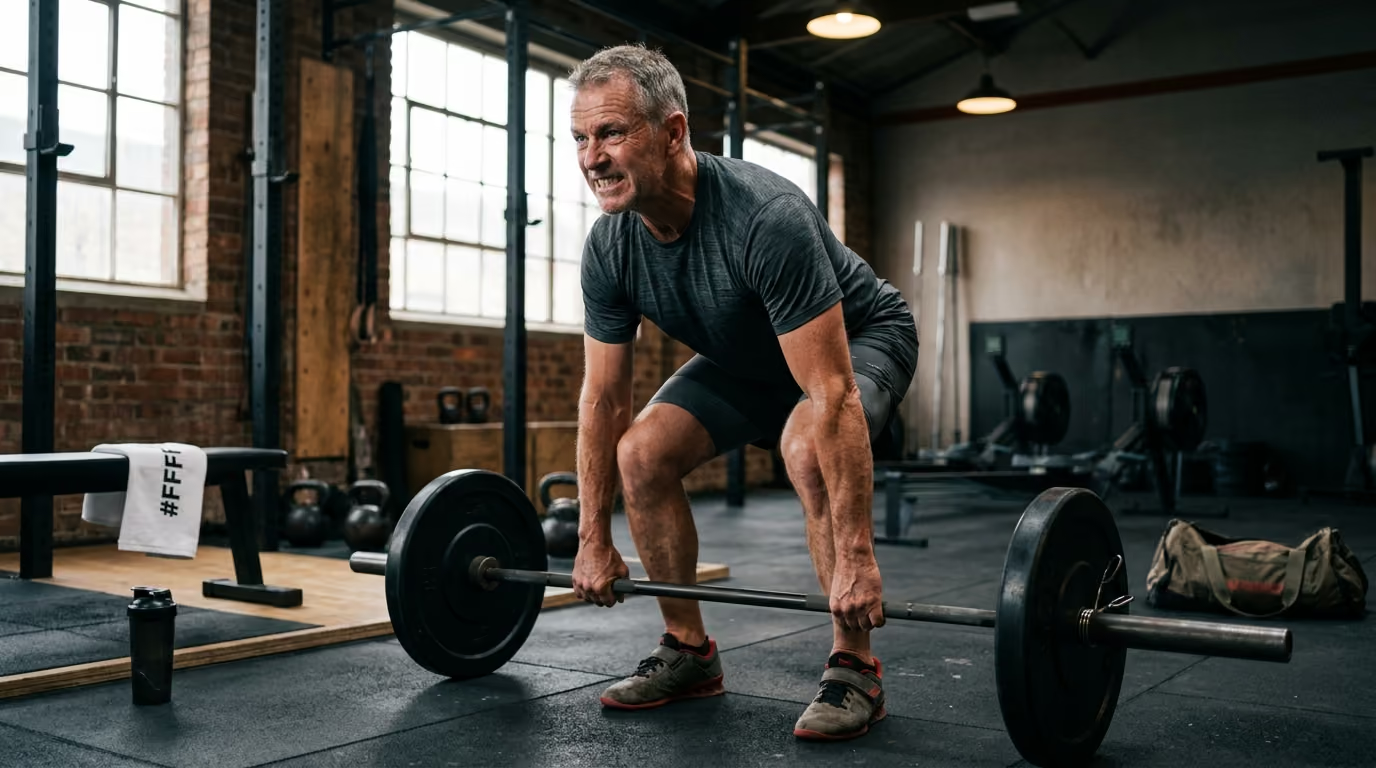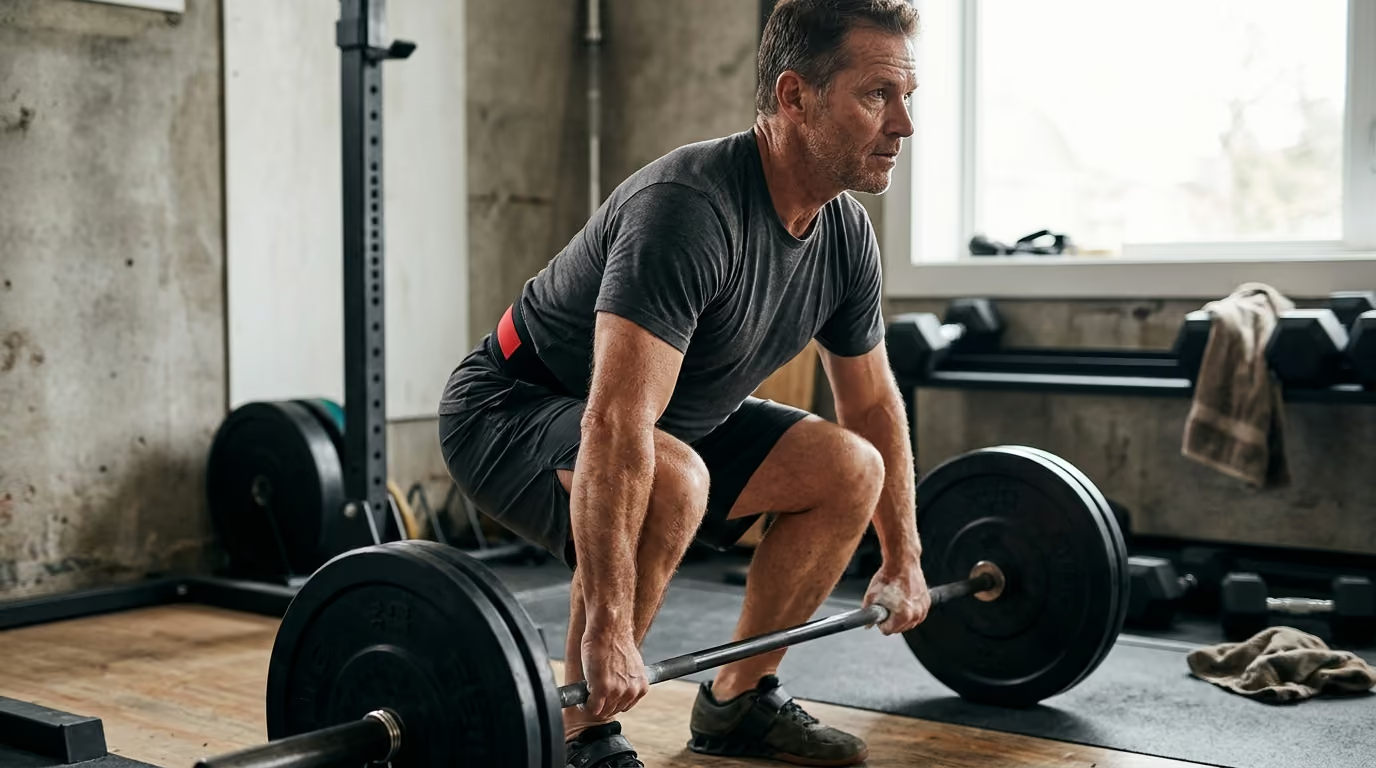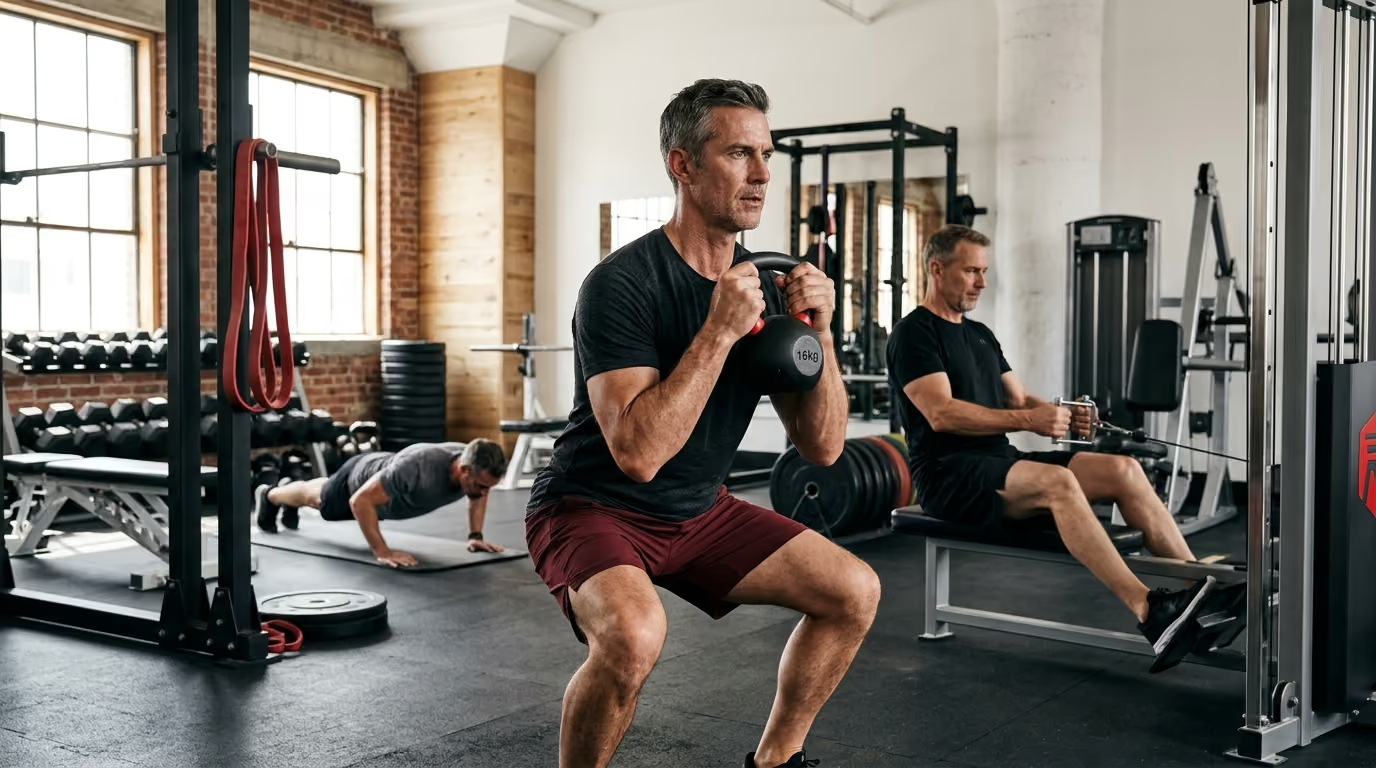
You walk into the gym on a Tuesday morning. In one corner, a group of younger men is loading heavy iron plates onto a barbell for back squats. Along the back wall stands a row of gleaming selectorized weight machines. Near the turf area, someone is anchoring a heavy elastic loop band to a post, while another person finishes a set of strict bodyweight chin-ups.
If you are past the age of 45, you might wonder which of these tools actually deserves your time and energy. You may have heard that barbells are the only way to build real strength. You may have also heard that free weights are too hard on midlife joints, or that machines do not build real-world capability.
The reality is far more practical. Every resistance tool has distinct mechanical traits, strengths, and limitations. Choosing the right tool comes down to matching the equipment to your specific goals, your joint health, your environment, and your training history.
What the research shows about resistance training tools
Scientific research on resistance training offers clear guidance on how different tools compare. When programs are matched for effort and volume, the differences between equipment categories are often smaller than popular gym culture suggests.
Muscle growth across equipment types
Systematic reviews comparing free weights and machines find no meaningful difference in muscle hypertrophy. A major meta-analysis analyzing strength training modalities reported that muscle growth was nearly identical whether lifters used barbells and dumbbells or guided machines. The mechanical tension experienced by the muscle fibers drives the growth response. As long as a muscle works close to fatigue through a productive range of motion, both tools stimulate hypertrophy effectively.
Research examining elastic resistance bands shows a similar pattern. When elastic resistance creates high internal muscular tension, it produces muscle growth comparable to conventional weights over short to moderate training cycles. Bodyweight training also stimulates muscle development when the movement is challenging enough to bring the target muscle near its working limit.
Strength and the principle of specificity
Where equipment types diverge most clearly is in exercise-specific strength. Research consistently demonstrates that strength adaptations follow the principle of specificity.
When researchers test strength using a barbell squat or bench press, participants who trained with free weights perform better than those who trained with machines. When strength is tested on a seated chest press or leg press machine, participants who trained on machines gain more strength on those tests. When testing occurs on a neutral testing device, the strength differences between groups largely disappear.
Strength is a motor skill as much as a muscular trait. Your nervous system learns the exact balance, bar path, and joint angles of the movement you practice. If your goal is to lift heavy loose objects, free weights provide direct transfer. If your goal is general physical robustness and muscle maintenance, machines, cables, bands, and bodyweight movements all build usable force capacity.
Elastic resistance and functional capacity
Systematic reviews on elastic resistance in adults over 45 show large improvements in physical performance. Research evaluating older populations found that band training reliably improves grip strength, walking speed, and lower-body power compared to remaining inactive. Elastic bands offer a practical way to apply resistance without requiring heavy iron.
The research also indicates that elastic resistance is not superior to free weights or machines for healthy adults. It is simply an effective, accessible alternative. The primary limitation of elastic bands in clinical research is not their ability to challenge muscle tissue, but the difficulty of measuring exact changes in external load across months of training.
Load, repetitions, and muscular effort
For decades, conventional wisdom claimed that building muscle required lifting heavy loads between 8 and 12 repetitions. Current exercise science paints a different picture.
Systematic reviews show that muscle hypertrophy is similar across low, moderate, and higher repetition ranges. A set of 25 repetitions taken close to failure can produce comparable muscle growth to a set of 8 repetitions taken close to failure. Maximal voluntary strength, however, improves more when training includes heavier loads of at least 80 percent of your one-repetition maximum. This finding means men over 45 can choose lighter loads on days when joints feel sensitive while still maintaining muscle mass.
Why muscle, joint and recovery demands change after 45
Resistance training after 45 is fundamentally about maintaining capability, protecting tissue, and managing recovery. The biology of midlife changes how your body responds to mechanical loading. These shifts are normal adaptations rather than medical conditions, but they alter how you should select your tools.
Connective tissue remodeling and tendon stiffness
Tendons and ligaments change their cellular structure as the decades pass. Collagen turnover slows down, and connective tissues gradually lose water content and elasticity. Tendons become less compliant, which reduces their ability to absorb sudden spikes in force.
When you lift a barbell in an unstable position, your tendons and joint capsules must work hard to stabilize the load. If you apply high stress to a stiff tendon too quickly, irritation can develop. Machines and guided cables control the movement path, reducing unpredictable lateral forces on tendons that need more time to adapt.
Joint cartilage and synovial fluid circulation
Articular cartilage covers the ends of your bones, allowing joints to glide smoothly. Cartilage has no direct blood supply. It receives nutrients through the compression and decompression of joint movement, which circulates synovial fluid.
Heavy axial loading from standing barbell exercises compresses the spinal discs and lower-body joints under high peak forces. For a healthy joint, this load encourages resilience. For a joint with existing wear or reduced cartilage thickness, heavy free-weight loading at extreme joint angles can cause discomfort. Using cables or machines allows you to train the surrounding muscle through a pain-free range of motion without loading the spine directly.
Motor unit recruitment and neural efficiency
Aging affects the nervous system's connection to muscle fibers. The body naturally loses some fast-twitch motor units over time if they are not actively trained. Fast-twitch fibers produce rapid force, which helps you catch your balance if you slip on ice or step off a curb awkwardly.
Maintaining these fast-twitch fibers requires high-effort muscle contractions. You do not need to lift dangerous loads to recruit these fibers. You can recruit them by lifting moderate loads with deliberate speed, or by carrying a moderate set close to muscular fatigue. Free weights, machines, bands, and bodyweight exercises can all recruit high-threshold motor units when you apply sufficient effort.
Systemic recovery and sleep architecture
Systemic recovery capacity changes after 45. Deep sleep cycles shorten slightly, protein synthesis rates become less sensitive to small protein meals, and metabolic clearance takes longer. High-volume free-weight sessions create significant central nervous system fatigue because your brain must constantly coordinate multiple balance systems and core stability.
Machines and cables create less overall nervous system fatigue for the same amount of local muscle stimulation. If you are sleeping poorly or dealing with high professional stress, choosing stable machines allows you to train your muscles hard without draining your central energy reserves.
What free weights mean for midlife capability
Free weights include barbells, dumbbells, kettlebells, and weight plates. They are the most traditional tools in the gym, and they offer distinct benefits along with clear physical demands.
Advantages of free weight training
Free weights force your body to control an implement in three dimensions. When you perform a dumbbell overhead press or a goblet squat, no tracks or pulleys guide your movement. Your deep stabilizing muscles, joint capsules, and core musculature must work together to maintain balance.
This requirement creates high physical coordination. Lifting a heavy box in your garage or hauling bags of soil in the garden requires multi-planar control. Free weights teach your brain and body how to brace your torso, manage balance shifts, and move your hips independently.
Dumbbells and kettlebells also allow for excellent unilateral training. Many men develop subtle side-to-side strength imbalances over decades of life. Single-arm dumbbell rows and single-leg split squats identify these discrepancies and correct them before they cause movement compensations.
Practical challenges and limitations
The primary limitation of free weights is their unforgiving strength curve. A dumbbell or barbell relies entirely on gravity, meaning the resistance always pulls straight down toward the floor.
During a dumbbell lateral raise, for example, there is almost no resistance at the bottom of the movement. At the top of the raise, when your arm is parallel to the floor, the leverage creates maximum resistance at the exact point where the shoulder joint is mechanically weakest. This mismatch can irritate sensitive joints.
Free weights also carry higher risk when training close to muscular failure. If your muscles give out during a barbell bench press or a back squat, the weight can pin you unless you have safety bars or a reliable spotter. For men training alone at home, pushing free weights to high levels of fatigue requires strict caution.
Best applications for men over 45
Free weights are ideal for building general athletic capacity, grip strength, bone density, and whole-body coordination. A sensible approach emphasizes compound dumbbell movements, kettlebell carries, and conservative barbell lifts.
- Goblet squats with a kettlebell or dumbbell to build leg strength with minimal spinal compression.
- Romanian deadlifts with dumbbells to strengthen the hamstrings, glutes, and lower back safely.
- Farmer carries to build formidable grip strength, core stability, and shoulder posture.
- Neutral-grip dumbbell bench presses to build chest and tricep strength while sparing the shoulder capsule.
To maintain joint health while pursuing strength and muscle development, keep most free-weight compound sets two to three repetitions away from complete failure. This preserve good movement form and prevents unnecessary joint strain.
What machines offer for joint comfort and targeted loading
Weight machines use fixed tracks, levers, and selectorized weight stacks. While some functional training purists dismiss machines, modern exercise science shows they are exceptionally valuable tools for men over 45.
Advantages of machine training
The biggest advantage of a machine is the reduction in balance and stabilization requirements. Because the machine supports and guides the weight, you do not need to spend energy balancing the load. You can direct your full physical and mental effort into contracting the target muscle group.
This stability makes machines remarkably efficient for muscle growth. If you want to train your quadriceps to high levels of fatigue, a leg press allows you to push hard without worrying about your balance failing or your lower back rounding.
Machines also permit safe training close to muscular failure. If you reach muscular failure on a chest press machine or a seated row, you simply release the handles and let the weight stack rest on the pins. There is no danger of being pinned under an iron bar, making machines ideal for solo gym sessions.
Selectorized pin-loaded machines also allow for precise, micro-adjustable loading. You can change resistance in seconds, making double-progression schemes simple to execute.
Practical challenges and limitations
Machines are designed around average human proportions. If you are unusually tall, short, or have unique limb lengths, a fixed-path machine may force your joints into an unnatural path. A chest press machine that does not align with your natural shoulder width can cause joint grinding.
Machine strength also transfers less directly to dynamic, unguided movements. A 300-pound leg press demonstrates excellent leg power, but it does not mean your core and hips can automatically stabilize a 300-pound barbell squat. Machines build raw muscular capacity, but they do not train spatial balance.
Best applications for men over 45
Machines shine when you want to accumulate training volume without beating up your joints or exhausting your nervous system. They are especially useful for:
- Training around acute or chronic joint issues, such as knee or shoulder osteoarthritis.
- Safe, solo training when you want to challenge your muscles with high effort.
- Isolating specific muscles that are hard to overload with compound free weights, such as the hamstrings using a seated leg curl machine.
- Rebuilding strength after a long layoff from physical activity.
Using a machine leg press or chest-supported row allows you to build dense, resilient muscle tissue without loading your spine or stressing your rotator cuff.
Cable systems as the middle ground for midlife training
Cable systems use steel cables, pulleys, and weight stacks to deliver adjustable resistance. They combine the best elements of free weights and machines, making them one of the most versatile tools for men over 45.
Advantages of cable training
Unlike free weights, which only pull straight down, cables allow you to adjust the line of pull in any direction. You can set a pulley high, low, or at chest height. This versatility allows you to align the direction of resistance perfectly with the natural angle of your joints and muscle fibers.
Cables also provide continuous tension throughout the entire movement. During a dumbbell chest fly, tension drops to zero at the top when the weights are balanced over your chest. During a cable crossover, the tension remains constant from the deep stretch all the way to peak contraction.
Cable machines also allow you to adjust your stability requirements. You can perform a standing single-arm cable press to challenge your core and balance, or you can perform a seated cable row to focus entirely on upper-back strength.
Practical challenges and limitations
Cable stations require more knowledge to set up correctly. Small changes in handle height, elbow position, or stance angle can dramatically alter how the exercise feels on your joints.
The weight numbers printed on cable stacks are also not standardized across gym brands. A 50-pound setting on a 2-to-1 pulley system feels completely different from a 50-pound setting on a direct 1-to-1 system. You must track your progression based on the specific machine you use rather than assuming stack numbers transfer between gyms.
Best applications for men over 45
Cables are outstanding for preserving shoulder, elbow, and hip health while maintaining continuous muscular tension. They are exceptionally useful for:
- Face pulls and rear delt flies to strengthen the rotator cuff and upper back.
- Standing anti-rotation presses (Pallof presses) to build core stability without spinal flexion.
- Single-arm lat pulldowns and rows that allow your wrists to rotate naturally.
- Cable woodchoppers and rotational pulls that build usable torso power for golf, tennis, and daily tasks.
For comprehensive ideas on supporting your body through intelligent exercise selection, explore our guides on mobility, joints and functional movement.
Elastic resistance bands for travel and joint-friendly training
Elastic resistance bands have evolved far beyond basic physical therapy tools. Modern heavy-duty loop bands and tube sets provide serious, variable resistance for home gyms and traveling professionals.
Advantages of elastic resistance
The defining feature of an elastic band is variable ascending resistance. As you stretch the band, the resistance increases. The farther you move into the repetition, the harder the band pulls back.
This resistance curve matches human strength curves in many pressing and squatting movements. When you squat, your mechanical leverage is weakest at the very bottom and strongest near the top. An elastic band provides lighter tension at the bottom of the squat where your knees are vulnerable, and maximum tension at the top where your hips and quads are mechanically strongest.
Bands are also unmatched in portability and cost. A set of loop bands fits into a carry-on bag, weighs under three pounds, and allows you to perform a full-body workout in a hotel room. They also place minimal compressive load on resting joints, making them exceptional for warm-ups and active recovery sessions.
Practical challenges and limitations
The primary drawback of elastic resistance is the difficulty of quantifying precise progression. When you lift a 40-pound dumbbell, you know the exact external load. When you stretch a purple loop band, the actual resistance varies based on how tall you are, where you anchor the band, and how far you stretch it.
Bands also provide very little resistance at the beginning of a movement when the band is slack. This means the deep stretched position of an exercise, which is known to be a powerful trigger for muscle growth, receives less mechanical tension compared to free weights or cables.
Bands can also wear out, dry out, or snap over time. You must regularly inspect your bands for small tears or discoloration to prevent painful snapping during a set.
Best applications for men over 45
Elastic bands are the ultimate tool for consistency when access to a gym is impossible. They are also unmatched for joint preparation and targeted muscle activation.
- Anchored band face pulls and pull-aparts before pressing sessions to warm up the rotator cuff.
- Banded glute bridges and lateral band walks to wake up hip stabilizers before walking or lifting.
- Full-body travel workouts combining band squats, band push-ups, band rows, and overhead presses.
- Adding band tension to bodyweight movements, such as looping a band over your back during push-ups.
When using bands as your primary muscle-building tool, focus on slowing down the eccentric phase (the lowering portion) and holding the peak contraction for a full second to maximize muscle fiber recruitment.
Bodyweight training for movement skill and spatial control
Bodyweight exercise, often called calisthenics, uses your own body mass acting against gravity. From standard push-ups to advanced single-leg squats, calisthenics forms the foundation of all physical capability.
Advantages of bodyweight exercise
Bodyweight training builds relative strength, which is the amount of force you can produce in relation to your own body weight. Moving your own frame through space builds spatial awareness, wrist and shoulder stability, and core coordination.
Calisthenics also requires virtually zero equipment. You can drop down and perform push-ups, lunges, and planks anywhere, eliminating any logistical excuses for skipping a workout.
Bodyweight exercises are also easy to modify for any fitness level through leverage adjustments. If a standard floor push-up is too stressful on your shoulders, you can elevate your hands onto a sturdy bench or wall. If standard split squats feel easy, you can elevate your rear foot onto a chair to place more load on the working leg.
Practical challenges and limitations
Progression in bodyweight training can be awkward. With a barbell, you simply add two small plates to increase the challenge by five pounds. With bodyweight training, making an exercise harder requires changing your body angle, shifting leverage, or moving to unilateral variations.
Once you can easily perform 20 strict push-ups, continuing to add repetitions builds muscular endurance rather than maximal strength or significant muscle mass. Moving to a harder progression, such as a decline push-up or a one-arm push-up progression, demands significant skill and joint stability.
Bodyweight training also makes pulling exercises difficult without equipment. You cannot effectively train your lats, rhomboids, and rear deltoids using gravity alone without a pull-up bar, suspension trainer, or sturdy horizontal surface to pull against.
Best applications for men over 45
Bodyweight movements should serve as the movement baseline for every man over 45. If you cannot control your own body mass through a full range of motion, adding heavy external iron can increase your risk of injury.
- Push-up variations to maintain chest, shoulder, and tricep strength while teaching your core to stay rigid.
- Bodyweight box squats and step-ups to build lower-body strength and balance for climbing stairs and hiking.
- Inverted rows using a suspension trainer or bar to build upper-back posture and spinal alignment.
- Dead bugs and side planks to develop isometric trunk stability without loading the lumbar spine.
Integrating bodyweight work into your regular routine helps maintain joint mobility and functional balance. You can read more about sustainable physical longevity on our healthy aging hub.
Comparing resistance tools across key performance factors
To help you decide which tool fits your specific training needs, consider how each modality performs across critical functional criteria.
Muscle hypertrophy potential
- Free weights: Excellent. Provides high mechanical tension and deep muscle stretching.
- Machines: Excellent. Delivers high tension with minimal stabilization limits, allowing safe, high-effort sets.
- Cables: Excellent. Offers continuous tension across the entire range of motion.
- Bands: Good to effective. Stimulates muscle growth well if sets are taken close to muscular fatigue.
- Bodyweight: Good. Effective for upper body and single-leg patterns, but harder to overload for the posterior chain.
Maximal strength development
- Free weights: Superior. The gold standard for developing total-body voluntary force and bone loading.
- Machines: High for machine tests. Builds strong muscles, but strength does not fully transfer to unguided loads.
- Cables: Moderate to high. Great for rotational and unilateral strength, but limited for heavy compound loading.
- Bands: Moderate. Increases strength well compared to inactivity, but lacks precise heavy loading.
- Bodyweight: Moderate. Builds high relative strength, but limited for absolute maximal force production.
Joint comfort and rehabilitation
- Free weights: Moderate. Requires sound technique and natural joint alignment to avoid overuse strain.
- Machines: High. Guided paths reduce balance demands and allow stable movement around cranky joints.
- Cables: Superior. Highly customizable lines of pull accommodate natural joint paths and reduce painful friction.
- Bands: Superior. Ascending resistance spares joint capsules in deep positions and warms up connective tissue.
- Bodyweight: High. Allows natural movement arcs, though high-leverage variations can stress wrists and shoulders.
Convenience and portability
- Free weights: Low to moderate. Dumbbells and kettlebells work well at home, but barbells require substantial space and cost.
- Machines: Very low. Requires a commercial gym membership or large, expensive home gym equipment.
- Cables: Low to moderate. Requires gym access or a dedicated home functional trainer unit.
- Bands: Superior. Inexpensive, compact, and fits easily into any travel bag.
- Bodyweight: Superior. Requires zero equipment and can be performed anywhere at any time.
How to build a balanced training routine after 45
The most effective training program for a man over 45 does not choose one tool over the others. It combines the unique strengths of each modality into an intelligent, sustainable system.
Step 1: Anchor the workout with stable compound movements
Begin your workout when your physical and mental energy is highest. Choose one or two multi-joint compound exercises that build foundational strength.
If your joints feel great and you enjoy free weights, use a dumbbell goblet squat, a trap bar deadlift, or a dumbbell floor press. If your lower back or shoulders feel cranky, use a seated chest press machine, a leg press, or a chest-supported row. Perform these movements with moderate loads, keeping 2 to 3 repetitions in reserve on every set.
Step 2: Accumulate muscle volume with cables and machines
Once your primary compound strength work is complete, shift to tools that provide high muscular stimulation with low joint strain. This is where cables and selectorized machines excel.
Use cables for single-arm rows, lat pulldowns, chest flyes, and tricep pushdowns. Use machines for seated hamstring curls or leg extensions. Because these tools require minimal balance, you can safely bring these sets closer to technical fatigue (1 to 2 repetitions in reserve) to stimulate muscle retention and growth.
Step 3: Integrate unilateral balance and core control
Finish your session with movements that challenge coordination, balance, and core stability. Bodyweight exercises and light free weights are ideal here.
Incorporate bodyweight walking lunges, step-ups onto a low box, single-leg calf raises, or side planks. You can also add light resistance band rotations to challenge your trunk. These exercises reinforce mobility, balance, and spatial awareness, protecting you against accidental falls and daily movement hitches.
Step 4: Keep travel and recovery simple
When work travel interrupts your gym schedule, do not abandon your routine. Switch entirely to a bodyweight and elastic band circuit.
Perform a continuous circuit of band-resisted push-ups, bodyweight split squats, anchored band rows, and band pull-aparts. Perform three to four rounds of 12 to 15 repetitions per exercise. This maintains your muscle mass, keeps your joints lubricated, and preserves your training consistency until you return home.
To learn more about optimizing your recovery periods and managing fatigue, visit our mobility and recovery resources.
Common misunderstandings about equipment selection
Several pervasive fitness myths cause men over 45 to make poor equipment choices. Clearing up these misconceptions helps you train smarter and avoid unnecessary frustration.
Claim 1: Free weights are always superior for building muscle
Gym culture often insists that barbells and dumbbells are mandatory for building muscle size. The scientific evidence directly refutes this. Systematic reviews show that muscle hypertrophy is virtually identical between free weights and machines when effort and volume are equated.
Your muscle fibers do not have eyes. They cannot see whether you are holding a rusty cast-iron dumbbell or pushing the handles of a modern selectorized machine. They only perceive tension, fatigue, and range of motion. If a machine allows you to train a muscle harder without joint pain, it is just as effective for building muscle as a free weight.
Claim 2: Machines are completely safe and prevent all injuries
Many lifters assume that because a machine moves on a fixed track, it is impossible to get hurt. This is incorrect.
A machine that is improperly adjusted can force your joints through an unnatural movement path under heavy load. If you set a leg extension seat too far forward, or adjust a shoulder press machine so your elbows are flared aggressively, you can create significant joint irritation. Machines reduce balance demands, but they still require proper setup, controlled speed, and sensible load progression.
Claim 3: Bands and bodyweight are only for beginners or rehabilitation
Some experienced lifters view elastic bands and bodyweight movements as basic warm-up tools that cannot build real capability. This belief ignores the law of progressive overload.
A strict bodyweight dip, an elevated single-leg split squat, or a heavy band-resisted push-up creates significant mechanical tension. Research in older adults demonstrates robust gains in muscle strength, functional walking speed, and balance from structured elastic band training. When programmed with progressive leverage and controlled tempos, bands and calisthenics challenge intermediate and advanced lifters effectively.
Where the current evidence is limited
While sports science provides robust guidance on resistance training, certain gaps remain in the research literature regarding midlife men and equipment modalities.
Long-term comparative trials in older athletic populations
Most comparative studies evaluating free weights versus machines or bands last between 8 and 16 weeks. Furthermore, many studies use previously untrained college-aged students or frail elderly individuals over age 75.
There are fewer long-term studies lasting multiple years that specifically track recreationally active men between the ages of 45 and 65. How different equipment combinations affect joint degeneration, connective tissue remodeling, and athletic performance across decades of continuous midlife lifting remains an area of ongoing observation rather than definitive proof.
Material degradation and tension variability in bands
In laboratory settings, researchers use pristine, calibrated elastic bands with precise elongation measurements. In real-world home gyms, resistance bands degrade due to exposure to sunlight, temperature changes, and repeated stretching.
There is limited scientific data tracking how band degradation alters real-world training load over time. Lifters using bands must understand that visual band color is an approximation, and tracking true progression with elastic resistance is inherently less precise than using calibrated steel weights.
Variable resistance equipment and neural fatigue
Commercial systems that combine bands with barbells, or computerized motorized resistance machines that alter eccentric loading, claim superior neuromuscular benefits. While the physiological concepts are sound, long-term independent evidence proving these advanced variable resistance machines produce superior real-world functional outcomes for men over 45 compared to basic dumbbells and cables is still early and mixed.
The takeaway on resistance training after 45
The best resistance training program for men over 45 does not rely on a single piece of equipment. Using free weights for whole-body coordination, machines for joint-friendly muscular volume, cables for continuous tension, and bands or bodyweight for mobility and convenience gives you the most effective path to staying strong, mobile, and capable for decades to come.
When to revisit this resource
Revisit this guide whenever you experience joint discomfort from your current routine, when your strength progress plateaus, or when changes in your travel schedule demand a shift in your training environment. Reassessing your equipment mix ensures your workouts remain productive, sustainable, and joint-friendly. Explore our complete library on vitality, strength and healthy aging for more practical, evidence-led training guides.
Sources
- 漸進式的阻力訓
- Progression Models in Resistance Training for Healthy Adults
- Influence of Resistance Training Proximity-to-Failure on Skeletal ...
- Resistance Training Load Effects on Muscle Hypertrophy and ...
- American College of Sports Medicine Position Stand. Resistance ...
- 渐进式的阻力训
- Resistance Training for Older Adults: Position Statement... : The Journal of Strength & Conditioning Research
- Physiological Responses and Adaptations to Lower Load ...
- ACSM Releases New Position Stand on Resistance Training
- Effects of Resistance Training on Sarcopenia Risk Among ...
Stay sharp
Get the word
Join our newsletter for the best writing advice and stories from the field.