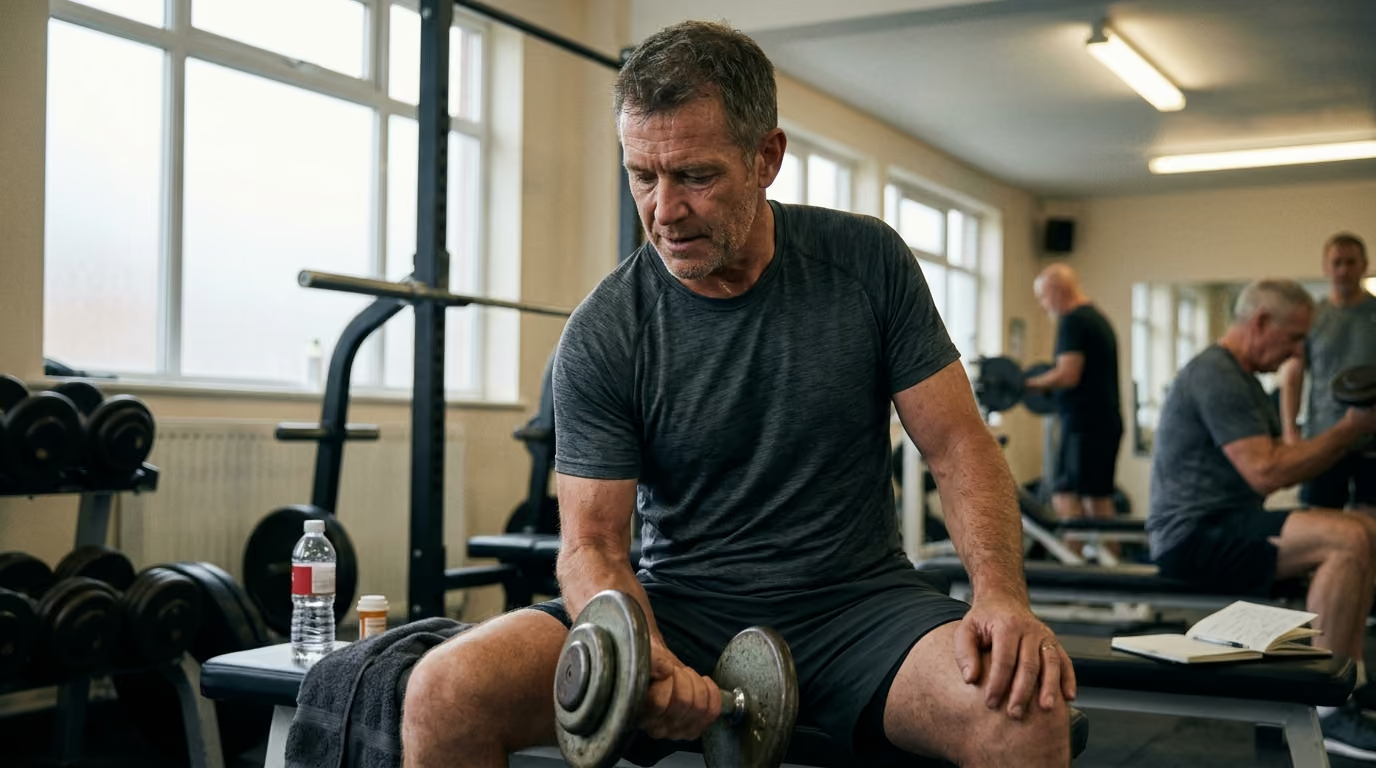
Power training is the deliberate practice of producing useful force quickly. It is not reckless, uncontrolled exercise, nor is it jumping as high as possible until your knees ache. Strength measures the total amount of force your muscles can produce. Speed measures how fast your limbs or body can move. Power sits right at the intersection of both qualities, representing the product of force and contraction velocity.
Many men spend decades lifting weights slowly and steadily. While that work builds a valuable base of muscle mass and joint stability, it overlooks how fast those muscles can fire. As the years pass, the capacity to generate sudden force declines faster than maximal strength.
Developing power after midlife requires a structured system. It uses medicine balls, kettlebells, controlled jumps, and brisk resistance exercises to restore speed safely. This guide outlines what the research demonstrates, why your neuromuscular system changes, and how you can apply these methods without risking unnecessary injury.
- CORE QUALITIES DEFINED
- • Strength: The total amount of mechanical force your muscles can produce against resistance.
- • Speed: The maximum velocity at which a limb or the entire body can travel.
- • Power: Force multiplied by velocity, representing work performed per unit of time.
- • Rate of Force Development: How quickly muscular force rises from the onset of contraction.
- • Reactive Ability: The capacity to absorb, organize, and reverse force in rapid movements.
What Does the Science Say About Power Training After 45?
The evidence supporting power training for older adults has grown substantially over recent decades. Clinical trials show that training focused on movement speed produces distinct adaptations compared to traditional, slow resistance exercise.
A systematic review and meta-analysis of 20 randomized clinical trials involving 566 older adults examined these differences. The researchers found low-certainty evidence that power training improved physical function and self-reported performance compared to traditional strength training. Another systematic review evaluated activity-based tests and reported statistically significant benefits for power interventions across muscle-power outcomes, generic movement tests, and speed-based physical tasks.
- EVIDENCE SNAPSHOT: POWER TRAINING VS TRADITIONAL STRENGTH
- Outcome Measured Standardized Mean Difference (Effect Size)
- • Muscle-Power Outcomes: 0.99 (Large positive effect)
- • Speed-Emphasized Activity Tests: 0.43 (Moderate positive effect)
- • Generic Functional Tests: 0.37 (Small to moderate positive effect)
- Source: Systematic review data on power training interventions in older populations.
A broader review of 19 clinical trials with 1,055 participants found that high-velocity power training yielded results similar to standard resistance training for general physical function. It produced small additional benefits on specific functional measures, such as the Short Physical Performance Battery and the Timed Up-and-Go test. The evidence quality across these trials is low to moderate, meaning future research could refine our understanding of optimal exercise dosing.
Power training also supports muscle size. A systematic review and meta-analysis confirmed that power training can stimulate muscle hypertrophy in older adults at levels comparable to moderate-velocity resistance training. Moving lighter weights quickly does not force you to abandon your goals for strength and muscle development.
Research on jumping exercises shows a similar safety profile when programs are designed with care. A meta-analysis concluded that jump training is an effective method for improving muscular power in older populations. A systematic review of lower-limb plyometric training found no increased rate of injuries or adverse events across the included studies. These trials relied on structured, progressive coaching, which highlights the need for sensible progression rather than unsupervised, maximal impacts.
Why Do Speed and Explosive Force Decline With Age?
The loss of physical capability in midlife and beyond is rarely just a loss of muscle mass. It is primarily driven by changes in muscle quality, nervous system recruitment, and movement velocity.
- ANNUAL RATE OF MUSCLE POWER LOSS
- Middle-Aged Adults (Roughly 45 to 65): 1.1% to 1.4% decline per year
- Older Adults (65 and Older): 2.2% to 2.4% decline per year
- Key Finding: Muscle power declines significantly faster than maximal isometric or slow strength.
Longitudinal research tracking adults over time shows that peak muscle power declines between 1.1% and 1.4% per year in middle-aged men and women. In older adults, that decline accelerates to approximately 2.2% to 2.4% per year. These losses outpace the annual decline of maximal muscle strength.
Longitudinal studies tracking leg performance confirm that strength and power drop much faster than total leg lean mass. You can keep most of your muscle volume while still losing the rapid neural drive required to fire that muscle instantly. A review examining aging populations noted power reductions of 16% at 40% of one-repetition maximum, alongside a 9% reduction at 70% of one-repetition maximum. This demonstrates that fast contractions suffer more than heavy, slow actions.
Several biological factors explain this divergence:
- Type II Fiber Atrophy: Fast-twitch muscle fibers produce rapid force, but they shrink faster than slow-twitch fibers when not challenged with speed or heavy loads.
- Motor Unit Remodeling: The nervous system gradually loses connection to individual fast-twitch motor units, reducing the total pool of rapid fibers available for sudden work.
- Reduced Motor Unit Discharge Rates: The speed at which the spinal cord sends electrical signals to active muscles slows down with age.
- Tendon Compliance Changes: Tendons lose some of their natural stiffness, which reduces their ability to store and return elastic energy efficiently.
- Coordination Adjustments: Antagonist muscles may contract more than necessary, creating internal resistance that slows down joint movement.
These physical shifts reflect normal biological aging, not a medical condition. When you introduce deliberate velocity into your training, you send a clear signal to your nervous system to preserve these high-threshold pathways.
How Does Muscle Power Affect Daily Capability and Mobility?
Lifting a heavy barbell from the floor demonstrates capacity, but real-world physical capability relies heavily on time constraints. Most daily movements require you to generate force within a fraction of a second.
Research highlights that muscle power is often a stronger predictor of physical performance and functional limitation than raw strength alone. In one published review, older adults with low muscle power faced a two- to threefold greater risk of significant mobility impairment compared to individuals who only had low muscle strength. When you need to climb a steep flight of stairs, step quickly over an obstacle, or get out of a deep car seat, contraction speed matters just as much as force.
- WHY POWER DICTATES REAL-WORLD CAPABILITY
- Real-World Task Physical Quality Required Why Power Is Crucial
- Balance Recovery (Tripping) Rapid Rate of Force Development Must place foot down in 200ms
- Chair Rise (Deep Seating) Concentric Power at Moderate Load Overcomes inertia quickly
- Stair Navigation Unilateral Power & Deceleration Propels body weight upward
- Carrying & Bracing Rotational & Core Force Transfer Stabilizes against sudden sway
Balance recovery provides a clear example of this dynamic. When you catch your foot on an uneven sidewalk, you have less than 200 milliseconds to swing your leg forward and plant it firmly. Once your foot touches the ground, your quadriceps, calves, and hip extensors must produce rapid braking force to halt your falling center of mass. A strong leg that contracts too slowly cannot complete this sequence in time.
Research into falls shows that lower-limb weakness creates a combined odds ratio of 1.76 for any fall and 3.06 for recurrent falls. Lower whole-limb power is also associated with prospective fall risk, particularly for injurious incidents. Training power does not guarantee that you will never slip, but it gives your body the mechanical tools to react swiftly when balance is challenged.
Maintaining rapid force production also supports functional movement and joint health. When muscles fire quickly and in the correct sequence, they absorb impact forces that would otherwise pass directly into passive joint structures. A capable neuromuscular system acts as an active suspension system for your hips, knees, and spine.
How Should You Structure Load, Velocity, and Volume?
Training for power requires a different mindset than training for muscle fatigue or bodybuilding pump. Power work targets the nervous system, so every repetition must remain fast, crisp, and technically sound.
- THE FORCE-VELOCITY SPECTRUM
- 1. High Force, Lower Velocity: Squats, deadlifts, heavy presses (80% to 90% 1RM)
- 2. Moderate Force, High Velocity: Kettlebell swings, jump squats, speed pulls (30% to 70% 1RM)
- 3. Low Load, Very High Velocity: Medicine-ball throws, band punches, bodyweight hops ( 30% 1RM)
- 4. Reactive / Elastic Actions: Pogo hops, snap-downs, catch-and-throw drills (Bodyweight)
The force-velocity continuum illustrates how load and speed interact. At one end sits heavy strength work, where force is high but movement speed is inherently slow. At the other end sits unloaded jumping or medicine-ball throwing, where movement speed is high but external resistance is low. A well-rounded program for men over 45 includes elements from across this spectrum.
Recommended Loading and Velocity Guidelines
Major strength organizations, including the American College of Sports Medicine, provide specific recommendations for power development:
- External Resistance: Use light to moderate loads, typically between 30% and 60% of your one-repetition maximum. Some general guidance permits loads up to 70% for multi-joint lower-body movements.
- Intentional Velocity: Move the resistance as fast as possible during the concentric (lifting) phase. Even if the weight moves at a moderate pace, your mental intent must be explosive.
- Eccentric Control: Lower the weight under control to protect joints and maintain proper alignment before the next repetition.
- Set and Repetition Ranges: Keep volume low, using 1 to 3 sets of 3 to 6 repetitions per exercise. Sets should never turn into endurance tests.
- Rest Periods: Rest between 2 and 3 minutes between standard power sets, extending to 3 to 5 minutes for demanding whole-body protocols.
- SAMPLE POWER DOSING PARAMETERS
- Exercise Type Load (% 1RM or Weight) Sets Reps Rest Period
- Fast Resistance 30% to 60% 1RM 2 - 3 3 - 5 2 to 3 minutes
- Medicine-Ball Throws 3 to 5 kg Ball 3 - 4 3 - 4 90 to 120 seconds
- Jumps and Hops Bodyweight / Low Box 2 - 3 3 - 5 2 minutes
- Kettlebell Swings Moderate Weight (Crisp Snap) 3 - 4 5 - 6 2 minutes
Autoregulation and Quality Control
Because power relies on peak nervous system output, fatigue is your main constraint. You should end every set while the movement still looks and feels fast.
Use these practical rules to manage your sessions:
- Reps in Reserve: Always leave 2 to 3 clean repetitions in the tank. Do not train to muscular failure during explosive sets.
- Velocity Drops: If you notice your movement slowing down or your feet dragging, end the set immediately.
- Landing Quality: If your jump landings become loud, stiff, or off-balance, stop the exercise and rest.
- Implement Weight: If a medicine ball or kettlebell forces you to strain, grind, or lose posture, switch to a lighter option.
What Are the Best Power Exercises for Mature Trainees?
Power exercises for men over 45 should prioritize high acceleration with minimal joint strain. The following categories provide a complete toolkit for building speed, rotational force, and landing capability.
- CORE EXERCISE CATEGORIES FOR POWER
- • Medicine-Ball Throws: Accelerate freely without joint deceleration stress at terminal range.
- • Jumps and Deceleration: Develop rate of force development and elastic landing mechanics.
- • Kettlebell Ballistics: Train powerful posterior chain hip extension through rhythmic hinges.
- • Fast Resistance Lifts: Apply explosive concentric intent to traditional compound movements.
1. Medicine-Ball Throws
Medicine balls allow you to release the implement at maximum speed. When you lift a barbell or dumbbell quickly, your nervous system naturally slows down near the top of the movement to protect your joints. Releasing a medicine ball removes that braking phase entirely.
- MEDICINE-BALL PROGRESSION
- Phase 1: Stable Base Seated Chest Pass, Standing Overhead Slam
- Phase 2: Stance Variations Split-Stance Chest Pass, Half-Kneeling Rotational Throw
- Phase 3: Dynamic Rotation Standing Rotational Wall Throw, Overhead Backward Scoop Toss
- Overhead Slam: Stand with feet shoulder-width apart. Bring a non-bouncing medicine ball overhead, extending your hips, knees, and ankles. Drive your hips back and throw the ball downward into the floor with full effort, catching it on the rebound or resetting cleanly.
- Rotational Wall Throw: Stand perpendicular to a solid concrete wall, roughly three feet away. Hold the ball near your back hip, rotate your hips rapidly toward the wall, and release the ball forcefully. Catch the ball and reset your stance before the next throw.
- Chest Pass: Stand in an athletic stance or split stance facing a wall. Hold the ball at your sternum and extend your arms explosively to throw the ball directly forward into the wall.
2. Jumps, Hops, and Deceleration Drills
Jumping teaches your lower body to generate rapid upward force, while landing trains your muscles and tendons to absorb impact smoothly. Research confirms that instruction focused on soft landings reduces biomechanical stress on the knees and hips.
- JUMP AND LANDING PROGRESSION
- Step 1: Low-Impact Loading Rapid Supported Heel Raises
- Step 2: Deceleration Pattern Snap-Down to Athletic Landing Position
- Step 3: Low-Impact Jumping Low Box Jump with Step-Down (Minimizes landing impact)
- Step 4: Full Elastic Action Countermovement Jump to Stick, Low Pogo Hops
- Snap-Down: Stand tall on your toes with arms overhead. Quickly pull your arms down and drop your hips into a quarter-squat athletic stance, absorbing your own bodyweight quietly. Hold that landing position for two seconds to demonstrate stability.
- Low Box Jump with Step-Down: Stand in front of a sturdy 6- to 12-inch box. Swing your arms, hinge at your hips, and jump onto the center of the platform, landing softly in a partial squat. Step down one foot at a time rather than jumping backward off the box.
- Countermovement Jump to Stick: Stand with feet hip-width apart. Dip quickly into a quarter squat while swinging your arms back, then reverse direction and jump upward. Land softly on both feet, bending your knees and hips to absorb the force quietly, and freeze for two seconds.
3. Kettlebell Ballistics
Kettlebells train explosive hip extension, which directly supports walking speed, sprinting, and lifting objects from the ground. Because the weight swings between your legs, it emphasizes the posterior chain rather than placing heavy compressive loads across your spine.
- KETTLEBELL TECHNIQUE CHECKLIST
- • Movement Pattern: Pure hip hinge, not a squat. Knees bend slightly while hips travel backward.
- • Lumbar Spine: Remains neutral throughout the swing; do not lean backward at the top.
- • Arm Action: Arms act like ropes or guides; the hips drive the kettlebell upward.
- • Termination Cue: Stop the set immediately if the bell pulls your lower back into flexion.
- Two-Hand Kettlebell Swing: Set a kettlebell on the floor one pace in front of you. Hinge at your hips, grab the handle, and hike the bell backward between your thighs. Snap your hips forward to stand tall, letting the bell float to chest height before guiding it back into the next hinge.
- Kettlebell Clean: Hike the bell between your legs and extend your hips rapidly, keeping the bell close to your torso as it rotates smoothly around your forearm into the rack position at your shoulder.
- Push Press: Hold a kettlebell in the rack position. Dip your hips two to three inches, then drive upward through your heels to launch the bell overhead, locking it out with a crisp arm extension.
4. Fast Resistance Movements
You can adapt standard gym exercises for power by lowering the weight and focusing entirely on lifting speed. ACSM guidelines recommend moving light to moderate loads with maximal concentric intent to recruit fast-twitch motor units.
- Fast Leg Press with Controlled Return: Set a leg press machine to roughly 40% of your working weight. Lower the sled smoothly, pause for half a second at the bottom, and press the weight upward as fast as possible without letting your knees snap into hyper-extension.
- Explosive Incline Push-Up: Place your hands on an elevated bar or sturdy bench. Lower your chest under control, then press away forcefully so your hands momentarily leave the surface, landing softly back on the bar.
- Speed Cable Row: Set a cable pulley at mid-torso height. Pull the handle rapidly toward your ribcage with an explosive contraction, pause briefly, and return the weight under control over two to three seconds.
How Do You Progress Based on Your Fitness Background?
Power training is not one-size-fits-all. A man returning to the gym after a long break needs a different starting point than someone who has lifted heavy weights for thirty years. Choose the track below that matches your current background.
- TRAINING TRACK SELECTOR
- 1. Sedentary or Deconditioned: Focus on base strength, balance, and low-impact movement speed.
- 2. Recreationally Active: Introduce medicine-ball throws, box jumps, and kettlebell swings.
- 3. Experienced Lifter: Add loaded jump squats, speed pulls, and contrast pairings.
- 4. Returning Athlete: Rebuild deceleration control and landing tolerance before speed.
Track 1: Sedentary or Deconditioned Trainee
If you are new to structured exercise or returning after years of inactivity, your priorities are joint stability, tissue tolerance, and balance. High-impact jumping is inappropriate at this stage. Instead, use simple bodyweight movements performed with crisp intent.
- ENTRY-LEVEL POWER ROUTINE (2 Days Per Week)
- 1. Dynamic Warm-Up: Ankle circles, hip hinges, arm swings (5 minutes)
- 2. Fast Sit-to-Stand: 3 sets of 4 reps (Explode up from chair, lower slowly)
- 3. Seated Medicine-Ball Pass: 3 sets of 4 reps (2 to 3 kg ball thrown to wall)
- 4. Low Step-Up Drive: 2 sets of 5 reps per leg (Step up briskly, hold balance)
- 5. Supported Quick Calf Raise: 2 sets of 6 reps (Rapid rise, controlled lowering)
- 6. General Strength Work: 2 to 3 controlled compound lifts for general conditioning
Track 2: Recreationally Active Trainee
If you already walk, hike, cycle, or perform basic gym workouts, you have the baseline tissue tolerance needed for moderate power exercises. Focus on medicine-ball throws, low box jumps, and kettlebell ballistics.
- RECREATIONALLY ACTIVE ROUTINE (2 Days Per Week)
- 1. Movement Prep: Thoracic rotations, leg swings, snap-downs (5 to 8 minutes)
- 2. Low Box Jump to Stick: 3 sets of 3 reps (Step down carefully between reps)
- 3. Rotational Wall Throw: 3 sets of 4 reps per side (3 to 4 kg ball)
- 4. Kettlebell Swing: 3 sets of 6 reps (Crisp hip snap, moderate weight)
- 5. Explosive Incline Push-Up: 3 sets of 4 reps (Hands on bench)
- 6. Primary Strength Work: Goblet squats, rows, and overhead carries
Track 3: Experienced Strength Trainee
If you have a solid foundation of barbell and dumbbell lifting, you are already strong, but your movements may be slow. Your goal is to convert that raw strength into high-velocity output using submaximal loads and contrast methods.
- EXPERIENCED LIFTER POWER ROUTINE (2 Days Per Week)
- 1. Dynamic Activation: Pogo hops, ankle stiffness drills, hip openers
- 2. Trap-Bar Jump or Speed Pull:4 sets of 3 reps (30% to 40% 1RM, focus on pure velocity)
- 3. Overhead Backward Scoop: 3 sets of 3 reps (Explosive triple extension with heavy ball)
- 4. Heavy Strength Anchor: Work up to a solid set of squats or deadlifts
- 5. Kettlebell Clean & Press: 3 sets of 4 reps per side
- 6. Unilateral Deceleration: 2 sets of 4 lateral bounds to stick per side
Track 4: Returning Athlete After a Layoff
Former athletes often retain high competitive intent, but their joints, tendons, and connective tissues need time to readapt to sudden force. The biggest risk is doing too much too soon based on memories of past performance.
Follow this systematic ramp-up over your first eight weeks:
- Weeks 1 to 2: Rebuild landing mechanics and braking strength using snap-downs and slow eccentric squats.
- Weeks 3 to 4: Introduce upper-body medicine-ball throws and supported heel raises.
- Weeks 5 to 6: Add low box jumps with step-downs and two-hand kettlebell swings.
- Weeks 7 to 8: Introduce low-amplitude hops, light push presses, and multiplanar medicine-ball throws.
When Is Medical Screening or Program Modification Needed?
Before adding high-velocity training to your routine, review your health history and current physical condition. While power training is safe for most healthy adults, sudden spikes in blood pressure and joint forces require sensible precautions.
- SCREENING AND SAFETY PROTOCOLS
- Factor Status / Condition Recommended Action
- Blood Pressure Resting 180/110 mmHg Obtain clearance; delay power work
- Cardiovascular Disease Unstable Angina or Aortic Stenosis Medical supervision required
- Joint Health Active Inflammatory Flare-Up Pause impact; use seated throws
- Bone Density Severe Osteoporosis / Fragility Fix Avoid jumping; use seated drills
- Cardiac Devices Recent Pacemaker or Defibrillator Consult physician on upper-body
Cardiovascular Considerations
Clinical exercise guidelines for older adults identify clear conditions where high-velocity exercise should be modified or delayed until cleared by a physician:
- Decompensated heart failure or severe symptomatic aortic stenosis.
- Uncontrolled resting hypertension at or above 180/110 mmHg.
- Unstable coronary artery disease or recent unmanaged cardiac events.
- Enlarging aortic aneurysms or severe pulmonary hypertension.
- Recent sternotomy or device implantation (pacemaker or defibrillator), which requires delaying explosive upper-body loading during initial tissue healing.
Orthopedic and Joint Adjustments
If you manage existing joint issues, modify the exercises rather than abandoning speed entirely:
- Osteoarthritis: Avoid high-impact jumping during active joint flare-ups. Substitute seated medicine-ball chest passes, cable punches, and fast machine presses that provide external support.
- Tendinopathy: Tendons require gradual adaptation to rapid stretch-shortening cycles. Replace bouncing drills with controlled concentric speed work, such as fast leg presses with slow lowering phases.
- Osteoporosis: High-impact landings and aggressive spinal rotation with heavy loads should be avoided. Replace them with low box jumps onto soft platforms, standing chest passes, and controlled step-up drives.
- Balance Concerns: If you experience dizziness, neuropathy, or inner-ear issues, perform all power movements while seated, half-kneeling, or holding onto a stable support beam.
Reviewing evidence-based healthy aging strategies can help you coordinate your exercise program with sensible joint management.
What Are the Most Common Misconceptions About Training Fast?
Several persistent myths prevent mature lifters from incorporating speed into their weekly training. Examining these claims against current exercise science brings clarity to your programming.
- COMMON MYTHS VS EVIDENCE-BASED REALITY
- Common Myth Scientific Reality
- "Power training means maximal exhaustion." Power targets neural speed; keep reps low & fresh.
- "Older adults should never jump." Low-impact jumping is safe when properly scaled.
- "Heavy lifting preserves all your speed." Power declines faster than raw strength with age.
- "Moving fast will wreck your joints." Controlled acceleration trains active shock absorb.
Myth 1: Power Training Requires Maximal Effort Until Exhaustion
A common mistake is treating power work like high-intensity interval training, doing continuous jumps or kettlebell swings until out of breath. Power development requires maximum movement velocity, which drops rapidly once metabolic fatigue sets in. If a set makes you breathe so heavily that your technique breaks down, you are building metabolic conditioning, not power. Keep sets short and rest long.
Myth 2: Older Trainees Must Avoid All Forms of Jumping
Some fitness advice warns anyone over 45 against leaving the ground. However, systematic reviews of plyometric training in older adults report no increase in injuries when programs follow proper progressions. Starting with low box jumps and emphasizing quiet landings allows your bones, tendons, and cartilage to adapt safely over time.
Myth 3: Heavy Strength Training Alone Is Sufficient
Heavy squats and presses build strong muscles, but they do not fully replicate the rapid firing rates required for fast movement. Research shows that peak power drops faster than isometric or slow dynamic strength across aging populations. To maintain fast motor unit recruitment, you must include exercises where movement velocity is the main goal.
Myth 4: Fast Repetitions Mean Uncontrolled Movement
Moving quickly does not mean throwing weights around carelessly. Power training requires strict control over joint alignment, posture, and core bracing. Acceleration happens with intent during the concentric phase, while the eccentric return remains controlled and balanced.
Where Are the Gaps in Current Research on Power Training?
While the benefits of power training are supported by clinical trials, several important questions remain open in the exercise literature.
- CURRENT SCIENTIFIC UNCERTAINTIES
- • Optimal Long-Term Dosing: Exact percentage ranges (% 1RM) vary widely across published trials.
- • Fall Prevention Specificity: Power correlates with balance, but direct fall reduction varies.
- • Non-Supervised Feasibility: Most safety data come from tightly supervised clinical environments.
- • Connective Tissue Adaptations: Long-term tendon remodeling data in mature lifters remain limited.
First, the certainty of evidence comparing power training to traditional strength training is currently graded as low to moderate. Many published trials have small sample sizes or run for only 8 to 12 weeks. Long-term studies tracking lifters over several years are limited.
Second, the optimal loading prescription is still debated. While major guidelines recommend loads between 30% and 60% of one-repetition maximum, some trials report comparable benefits with higher loads moved with explosive intent. The ideal mix of light ballistic work versus moderate-load speed work has not been settled.
Third, while lower-extremity power correlates strongly with balance recovery and mobility, power training alone should not be labeled a guaranteed fall prevention cure. Fall risk involves multiple factors, including vision, inner-ear balance, medication use, joint health, and environmental hazards. Power training is a valuable component of physical capability, but it works best alongside balance work and mobility and joint recovery practices.
- THE CORE TAKEAWAY
- Muscle power declines faster than raw strength after midlife, but it responds remarkably well
- to consistent, high-velocity training. Moving light to moderate loads with explosive intent and
- sound landing mechanics keeps you fast, reactive, and physically capable for decades to come.
Frequently Asked Questions About Power Training After Midlife
How many days per week should I train for power?
Two sessions per week provide an effective stimulus for most adults over 45. Power exercises place high demands on the central nervous system and connective tissues, making recovery between sessions essential. You can perform power drills at the start of your regular strength workouts, right after your warm-up while your nervous system is fresh.
Can I do power training if I have bad knees or lower back stiffness?
Yes, provided you choose exercises that eliminate joint impact. Medicine-ball chest passes from a seated position, rotational wall throws, and cable punches train rapid core and upper-body power without compressing the knees. For the lower body, fast machine leg presses or seated chair rises allow you to train velocity while keeping joint stress low.
How heavy should my medicine ball or kettlebell be?
For power development, lighter is almost always better than heavier. Most men over 45 see excellent results with medicine balls weighing between 6 and 10 pounds (3 to 5 kilograms). For kettlebell swings, select a weight that allows you to snap your hips forward forcefully without rounding your back or pulling with your arms.
Is power training the same as high-intensity interval training?
No. High-intensity interval training (HIIT) uses short rest periods to challenge cardiovascular capacity and muscular endurance. Power training uses short sets of 3 to 6 repetitions paired with long rest periods of 2 to 3 minutes. The goal of power work is maximum movement speed on every single repetition, not cardiovascular exhaustion.
Sources
- Resistance Training for Older Adults: Position ... - NSCA
- The Efficacy and Safety of Lower-Limb Plyometric Training ...
- Therapeutic validity and replicability of power training interventions in older adults: A review using the TIDieR checklist and CONTENT scale00393-1)
- International Exercise Recommendations in Older Adults (ICFSR)
- An age-adapted plyometric exercise program improves dynamic ...
- Resistance Training for Older Adults
- White Paper: Strength Training for the Older Adult : Journal of Geriatric Physical Therapy
- Resistance Training for Older Adults in Cardiac Rehabilitation
- Practical guidelines for exercise prescription in different ... - PMC
- Training interventions to reduce the risk of injury ...
- How To Dose Strength Training For Older Adults - Physio Network
Stay sharp
Get the word
Join our newsletter for the best writing advice and stories from the field.