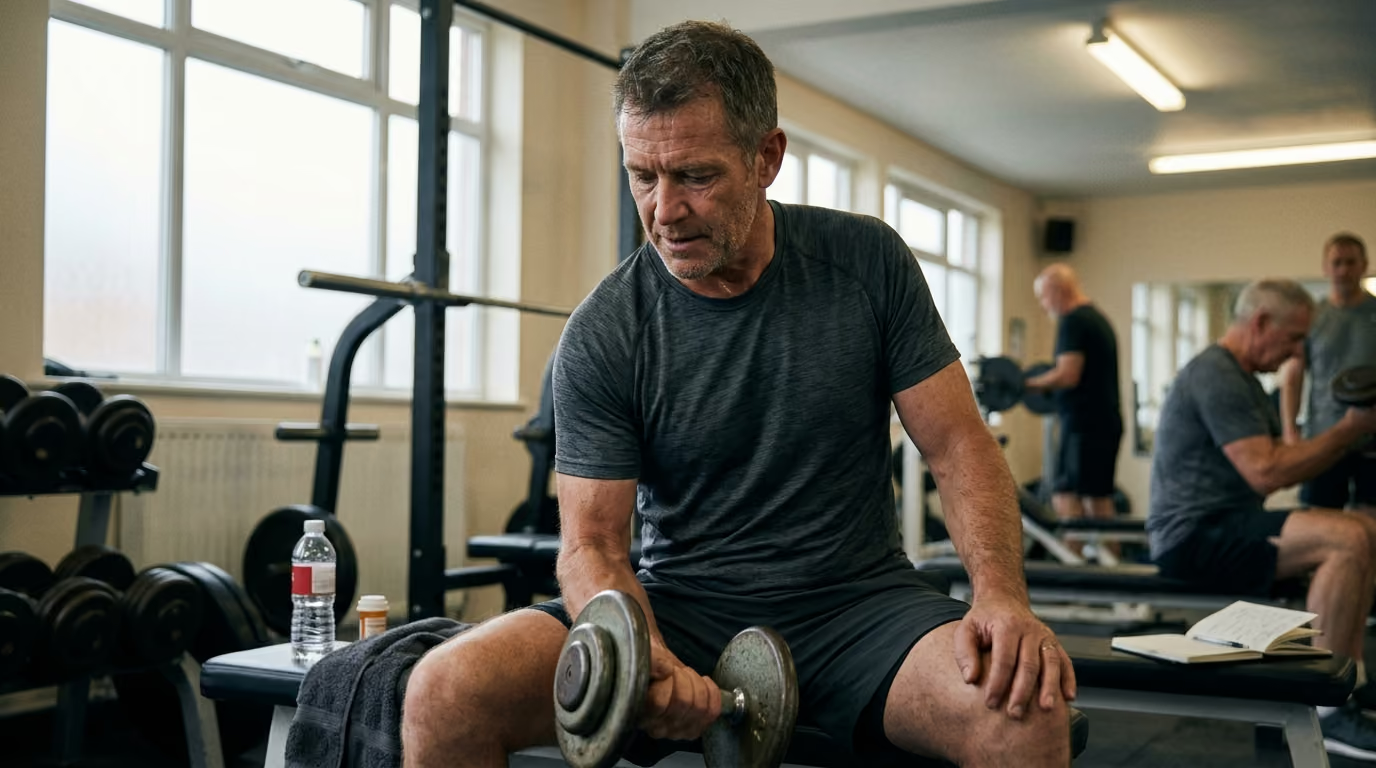
You walk into the weight room on a Tuesday afternoon. Your lower back feels tight from sitting in meetings all morning, and your left shoulder aches from sleeping awkwardly. You look at your training log and see a plan calling for five sets of five heavy squats. Ten years ago, you would have loaded the bar, ground through the sets, and recovered by Friday. Today, you wonder whether grinding through heavy reps is building your body up or breaking your joints down.
Many men over 45 face this exact dilemma. Conflicting advice makes the decision harder. One camp claims that men in midlife must lift heavy weights to preserve testosterone and bone density. Another camp insists that heavy lifting ruins older joints and that light weights with high repetitions are the only safe path.
The scientific literature shows that both extremes miss the mark. A clear operating model helps you cut through the confusion. You choose the load and repetition range from your primary goal. You choose the number of sets from your recoverable volume. You choose the effort of the day from your current readiness.
What the research shows about loading and repetitions
The scientific evidence on resistance training has expanded significantly over the past decade. A 2026 American College of Sports Medicine position stand examined outcomes across thousands of adult trainees. The data confirmed that resistance training produces improvements in strength, muscle hypertrophy, power, contraction velocity, balance, and daily physical function compared to no exercise.
The evidence also clarifies how different training variables drive specific adaptations. The three primary physical outcomes of resistance training are related, but they do not respond identically to every combination of sets, repetitions, and weights.
Muscle growth across a wide loading spectrum
For decades, fitness culture taught that muscle growth only occurs in a narrow zone of 8 to 12 repetitions. Modern research has thoroughly overturned this limitation. A comprehensive review by Schoenfeld and colleagues established that similar muscle growth can occur across a broad loading spectrum, starting from approximately 30 percent of one-repetition maximum and going up to heavy loads.
A 2021 meta-analysis of 28 studies by Refalo and colleagues examined 747 healthy adults. The researchers found no overall difference in muscle growth between low-load, moderate-load, and high-load training when sets were performed close to volitional failure. You can build muscle with sets of 6 repetitions, sets of 12 repetitions, or sets of 25 repetitions.
This broad flexibility has profound benefits for men managing joint discomfort. If heavy barbell work irritates your elbows or knees, you can achieve identical muscle growth using lighter loads on stable machines or cables. The work must simply be sufficiently challenging to recruit the target muscle fibers.
Heavy loads and maximal strength
Muscle hypertrophy may occur across many repetition ranges, but maximal strength follows a different rule. Maximal strength is the capacity of the nervous system and muscles to produce force against an external resistance.
The meta-analysis by Refalo and colleagues revealed that high-load and moderate-load training produce greater strength gains than low-load training. High-load work also showed a clear trend toward superiority over moderate-load training. The 2026 ACSM position stand reported that voluntary strength development improves when trainees use loads of at least 80 percent of one-repetition maximum, perform two to three sets per exercise, and train at least twice weekly.
Strength is a specific neurological skill. Lifting heavy weights teaches your central nervous system to recruit high-threshold motor units rapidly and coordinate multiple muscle groups under tension. A lifter who relies entirely on light weights and high repetitions may build muscle size, but they will not develop the same maximal force output as someone who lifts heavier loads.
Proximity to failure and repetitions in reserve
Effort within a set is commonly measured using repetitions in reserve, or RIR. An RIR of 3 means you completed the set with three good repetitions left before technical failure. An RIR of 0 means you could not complete another technically sound repetition.
A 2024 meta-regression by Robinson and colleagues found a critical distinction between strength and muscle growth. Strength gains remained consistent across a wide range of RIR values, meaning you do not need to train to failure to get stronger. Hypertrophy, however, increased as sets were terminated closer to failure.
A separate 2024 trial demonstrated that trained individuals achieved similar thigh hypertrophy when stopping sets at 1 to 2 RIR compared to going to absolute failure over eight weeks. Training to complete failure causes disproportionate fatigue and joint strain without providing extra muscle growth. For most lifts, finishing a set with 1 to 3 repetitions in reserve provides the optimal stimulus.
Rest intervals between sets
The time you rest between sets affects both workout quality and muscular adaptations. A 2024 systematic review and Bayesian meta-analysis evaluated the effects of rest intervals on muscle hypertrophy. The analysis revealed a small benefit for resting longer than 60 seconds, with benefits plateauing around 90 seconds in the general literature.
Compound exercises like squats, deadlifts, and presses require more time for cardiovascular and neuromuscular recovery. Rushing between heavy sets reduces force output and compromises lifting technique on subsequent sets. Resting two to three minutes on major compound lifts maintains high performance, while resting 60 to 90 seconds is practical for isolation movements.
Why training variables change after 45
Aging is a normal physiological process rather than a disease state. As men move past age 45, several biological changes influence how the body tolerates and recovers from physical stress.
Connective tissue remodeling
Tendons and ligaments change their structural properties over time. Collagen turnover slows down, and connective tissues gradually lose some of their water content and elasticity.
These changes mean that tendons and joint capsules require more time to adapt to heavy mechanical loading than muscular tissue. Muscle tissue receives rich blood supply and repairs rapidly after training. Tendons have lower vascularity and remodel at a slower pace. Sudden spikes in training load or excessive volume can trigger tendon irritation that takes weeks to calm down.
Neuromuscular and motor unit changes
Age-related changes in the neuromuscular system include a gradual reduction in the size and speed of high-threshold motor units. These type II muscle fibers produce rapid, high-force contractions.
When high-threshold motor units are underused, functional power and quickness decline faster than basic endurance. Preserving these motor units requires intentional training. Lifting moderate-to-heavy loads or moving moderate loads with high concentric velocity keeps these fast motor units active and responsive.
Systemic recovery capacity
Recovery after 45 is heavily influenced by non-training lifestyle factors. Sleep architecture changes with age, frequently reducing the duration of deep, restorative sleep. Work responsibilities, family commitments, and mental stress also draw upon systemic energy reserves.
Training creates a localized muscular stimulus and a systemic stress response. While a young lifter might easily handle 20 hard sets in a single afternoon, an older lifter often achieves better progress by spreading that same volume across multiple shorter sessions. Managing overall systemic fatigue prevents chronic exhaustion and supports consistent training over decades.
What the numbers mean in real life
Translating scientific findings into weekly training requires defining three distinct outcomes. Understanding these outcomes helps you structure your sessions based on what you want to achieve.
Defining strength, hypertrophy, and physical performance
Strength is the capacity to produce force against an external resistance in a specific movement. In daily life, strength helps you lift a heavy suitcase into an overhead bin, hoist a bag of concrete in the yard, or pull a heavy object without straining your back.
Hypertrophy is the physical expansion of muscle fiber cross-sectional area. Maintaining muscle mass past 45 provides metabolic protection, supports insulin sensitivity, and creates a physical buffer against injury. For deeper insights on building and retaining lean tissue, explore our evidence-based strength and muscle training resources.
Physical performance includes power, contraction speed, balance, and movement capacity. The National Strength and Conditioning Association position statement on older adults notes that power declines faster than strength. Power allows you to step forward quickly to catch your balance during a slip or climb stairs with ease.
Functional capabilities and longevity
The World Health Organization physical activity guidelines recommend muscle-strengthening activities involving all major muscle groups on two or more days per week. For older adults, the WHO specifically recommends varied multicomponent physical activity that emphasizes functional balance and strength training on three or more days per week to enhance functional capacity and prevent falls.
Practical training after 45 should support everyday independence. Success is not measured purely by your gym PRs. Success means having the strength to carry heavy groceries, the mobility to get up from the floor effortlessly, and the stamina to enjoy active travel.
How to choose your training loads and repetition ranges
Selecting the correct load and repetition target depends on your current training experience, your joint tolerance, and your primary goal.
The beginner or returning lifter
If you are new to lifting or returning after a multi-year break, your primary focus is developing motor control, tendon durability, and technique.
The ACSM progression models recommend an 8 to 12 repetition maximum loading range for novices. Starting with moderate loads allows you to practice lifting mechanics without excessive joint strain.
A practical starting template for beginners:
- Perform 1 to 2 working sets per exercise.
- Select a weight that allows 8 to 12 controlled repetitions.
- Stop each set with 3 to 4 repetitions in reserve.
- Train all major muscle groups across two weekly full-body sessions.
- Use stable exercise variations like dumbbell presses, chest-supported rows, and goblet squats.
The intermediate trainee
An intermediate trainee has built consistent movement patterns and developed baseline tissue conditioning. Intermediate lifters benefit from using a wider variety of repetition ranges to target different adaptations.
A practical repetition breakdown for intermediate lifters:
- Primary compound lifts: 5 to 8 repetitions for strength and motor skill.
- Secondary multi-joint exercises: 8 to 12 repetitions for muscle growth and work capacity.
- Isolation and machine movements: 12 to 20 repetitions for metabolic stress with low joint impact.
The advanced lifter
An advanced lifter possesses high levels of strength and substantial training experience. Advanced trainees must balance the high mechanical tension needed to stimulate new adaptations against the fatigue that heavy loads create.
Advanced lifters often benefit from periodizing their training into dedicated phases. A four-week block focusing on strength using 3 to 6 repetitions can be followed by a six-week block focusing on hypertrophy using 8 to 15 repetitions. This variation keeps joints healthy while continuing to challenge neuromuscular pathways.
Determining weekly set volume and frequency
Training volume represents the total amount of productive work performed. While volume can be tracked as total tonnage, tracking weekly hard sets per muscle group is the most practical method for men over 45.
A hard set is defined as a working set taken within 1 to 3 repetitions of technical failure. Warm-up sets and light preparation sets do not count toward this total.
Minimum effective starting volume
For novices or men returning from an injury layoff, a starting volume of 4 to 8 hard sets per muscle group per week provides a robust stimulus for growth and strength.
Starting at the lower end of the volume spectrum allows your joints and recovery systems to adapt gradually. It also leaves room to add volume later when progress slows down.
Productive working volume
The 2026 ACSM position stand reported that muscle hypertrophy is enhanced by higher volumes of at least 10 sets per muscle group per week in experienced trainees. For many men between 45 and 65, an intake of 8 to 12 weekly hard sets per muscle group represents a reliable sweet spot for consistent progress.
Distributing these sets across two or three sessions per week is significantly more productive than performing all sets in a single workout. Performing six sets of chest training on Monday and six sets on Thursday maintains higher lifting quality and reduces post-workout muscle soreness.
The base-plus-optional set method
Life demands fluctuate constantly. A rigid plan that demands four heavy sets every workout can lead to burnout when sleep or work schedules become disrupted.
The base-plus-optional set method solves this problem:
- Program two base sets for each exercise that you must complete.
- Program one or two optional sets for each exercise.
- Perform the optional sets only if your energy, joint comfort, and movement quality are high.
- Skip the optional sets and finish the workout if you feel run down or tight.
This flexible approach keeps you consistent over months and years without forcing unproductive fatigue onto an already stressed system.
Autoregulation and progression models
Fixed percentage-based programs assume your recovery and strength are identical every single week. In reality, a weight that feels manageable after eight hours of sleep can feel dangerously heavy after a night of poor sleep. Autoregulation allows you to adjust loads based on daily performance.
The traffic light readiness system
Before loading your working weights, use a simple three-tier assessment during your general warm-up:
Green light conditions:
- Movement feels smooth and pain-free.
- Warm-up weights feel light and move quickly.
- Energy and mental focus are high.
- Action: Complete all planned sets, use the top of your target rep range, and add optional volume if desired.
Yellow light conditions:
- Movement feels slightly stiff but warms up over time.
- Warm-up weights feel average or slightly heavy.
- Moderate fatigue from daily life stress.
- Action: Complete your base sets with the planned weight, leave 2 to 3 reps in reserve, and skip optional sets.
Red light conditions:
- Persistent joint pain or sharp discomfort during warm-ups.
- Marked lack of coordination or extreme physical exhaustion.
- Symptoms of acute illness.
- Action: Reduce the load by 20 to 30 percent, switch to pain-free movement variations, or replace the lifting session with gentle mobility work. For strategies on managing stiffness and joint comfort, see our guide to protecting joints and functional movement.
The double progression method
Double progression is an exceptional method for building strength and muscle safely. Instead of adding weight to the bar every session, you increase repetitions first before adding load.
How double progression works:
- Select a repetition target range, such as 8 to 12 repetitions.
- Pick a load you can lift for 8 controlled repetitions with 2 RIR across all planned sets.
- In subsequent workouts, aim to add one repetition to each set while keeping the load identical.
- Once you can perform 12 clean repetitions on all sets, increase the weight by 2 to 5 percent.
- With the new heavier weight, your repetitions will drop back toward 8.
- Rebuild your repetitions back to 12 before increasing the weight again.
Double progression eliminates the pressure to make large jumps in poundage. It prioritizes movement mastery and clean execution over ego lifting.
Small percentage load progression
When you are ready to increase resistance on compound lifts, small incremental jumps are far safer than large additions. The ACSM progression model suggests increasing loads by 2 to 10 percent when an individual can perform one to two repetitions beyond their target number across two consecutive workouts.
For smaller isolation exercises like lateral raises or biceps curls, a 10 percent jump is often too large. Adding small 1.25-pound or 2.5-pound plates allows smooth progression without compromising your lifting posture.
Practical training templates for common scenarios
Different life situations call for different training adjustments. Here is how to apply these evidence-based principles across five distinct scenarios.
Scenario 1: The returning lifter after a long layoff
A 48-year-old man who has not lifted consistently in ten years wants to regain functional capability and muscle tone.
Recommended structure:
- Frequency: 2 full-body sessions per week on non-consecutive days.
- Exercises per session: 4 to 5 multi-joint movements.
- Working sets: 1 to 2 sets per exercise.
- Repetitions: 8 to 12 repetitions per set.
- Effort target: 3 RIR on all movements.
- Rest intervals: 90 to 120 seconds between sets.
Sample session:
- Leg press: 2 sets of 10 to 12 reps at 3 RIR.
- Dumbbell flat bench press: 2 sets of 8 to 10 reps at 3 RIR.
- Chest-supported dumbbell row: 2 sets of 10 to 12 reps at 3 RIR.
- Standing dumbbell overhead press: 2 sets of 10 to 12 reps at 3 RIR.
- Cable core pallof press: 2 sets of 12 reps per side.
Scenario 2: The experienced lifter prioritizing strength
A 52-year-old lifter with decades of training experience wants to maintain strong squat and deadlift mechanics without beating up his spine.
Recommended structure:
- Frequency: 3 sessions per week using an upper, lower, full-body split.
- Primary lift loading: 4 to 6 repetitions using 80 to 85 percent 1RM.
- Working sets on primary lifts: 2 to 3 sets.
- Effort target: 2 to 3 RIR on heavy compounds, stopping well short of technical failure.
- Rest intervals: 3 to 4 minutes on primary lifts.
- Assistance work: 8 to 12 repetitions to accumulate muscle volume without spinal loading.
Sample lower body session:
- Trap bar deadlift: 3 sets of 5 reps at 2 to 3 RIR, resting 3 minutes.
- Bulgarian split squat: 2 sets of 8 reps per leg at 2 RIR, resting 2 minutes.
- Seated leg curl: 3 sets of 10 to 12 reps at 1 to 2 RIR, resting 90 seconds.
- Standing calf raise: 3 sets of 12 reps at 1 RIR, resting 60 seconds.
Scenario 3: Hypertrophy focus with variable sleep
A 57-year-old business executive wants to maintain muscle mass while managing frequent travel, irregular sleep, and high mental stress.
Recommended structure:
- Frequency: 3 half-hour sessions per week.
- Weekly volume: 8 to 10 hard sets per major muscle group.
- Repetitions: 10 to 15 repetitions on stable machine and cable variations.
- Effort target: 1 to 2 RIR on machines, using the base-plus-optional set method.
- Rest intervals: 60 to 90 seconds.
Sample push session:
- Seated machine chest press: 2 base sets plus 1 optional set of 10 to 12 reps at 2 RIR.
- Seated dumbbell shoulder press: 2 base sets of 10 to 12 reps at 2 RIR.
- Incline dumbbell fly: 2 base sets of 12 to 15 reps at 1 RIR.
- Triceps rope pushdown: 2 base sets plus 1 optional set of 12 to 15 reps at 1 RIR.
Scenario 4: Rebuilding strength with knee discomfort
A 63-year-old trainee wants to strengthen his lower body to climb stairs comfortably, but experiences occasional mild knee pain during deep squats.
The NSCA position statement on older adults recommends gradual progression from very light to moderate intensities. It also emphasizes using supported or seated variations when joint changes limit standing tolerance.
Recommended structure:
- Frequency: 2 lower-body sessions per week.
- Repetitions: 12 to 15 controlled repetitions with a slow eccentric tempo.
- Working sets: 2 sets per movement.
- Range of motion: Work within pain-free joint angles.
- Focus: Strengthen the posterior chain and hips to support knee stability.
Sample knee-friendly lower body session:
- Box squat to a comfortable bench height: 2 sets of 10 to 12 reps at 3 RIR.
- Romanian deadlift with dumbbells: 2 sets of 10 to 12 reps at 2 RIR.
- Seated leg extension with light load and slow tempo: 2 sets of 15 reps at 2 RIR.
- Glute bridge on mat: 2 sets of 15 reps with a 2-second hold at the top.
Scenario 5: High-stress work weeks and maintenance
A 50-year-old lifter experiencing a demanding work crunch needs a maintenance plan to preserve strength without exhausting his recovery bandwidth.
Recommended structure:
- Frequency: 2 brief full-body sessions per week.
- Working sets: 2 hard sets per movement.
- Repetitions: 6 to 8 repetitions on multi-joint lifts.
- Effort target: 2 to 3 RIR.
- Volume: Approximately 4 to 6 weekly sets per muscle group.
Research shows that muscle mass and baseline strength can be preserved for months on roughly one-third of your normal training volume. Lowering your weekly sets during stressful seasons keeps you consistent while giving your central nervous system a well-deserved break.
Managing recovery and avoiding burnout
Managing physical fatigue is the cornerstone of sustainable training past 45. Fatigue manifests in distinct ways, and recognizing the difference between local and systemic fatigue helps you make smart programming adjustments.
Local fatigue versus systemic fatigue
Local fatigue occurs in the specific muscles you just trained. Your quadriceps may feel weak after four sets of leg presses, or your grip may feel tired after heavy rows. Local fatigue is normal, expected, and resolves within 48 to 72 hours.
Systemic fatigue affects your entire central nervous system and body. Signs of systemic fatigue include:
- Disrupted sleep patterns or waking up unrefreshed.
- Declining motivation to train over several consecutive weeks.
- Lingering joint ache in multiple areas.
- Drops in lifting performance across all exercises.
When systemic fatigue appears, adding more sets or pushing through the exhaustion is counterproductive. You need to reduce total training volume or implement a planned deload.
Practical deload strategies
A deload is a temporary reduction in training stress that allows accumulated fatigue to dissipate while maintaining movement skill. You do not need to follow a rigid calendar deload every fourth week. Instead, insert a deload week when systemic fatigue rises or performance plateaus.
Effective ways to structure a deload week:
- Option A: Keep your normal lifting weights, but cut the number of working sets in half.
- Option B: Keep your normal sets and reps, but reduce all loads by 20 percent.
- Option C: Perform your standard exercises, but increase your target effort to 4 to 5 RIR.
After a week of reduced stress, connective tissues recover, nervous system readiness returns, and you can resume normal progressive overload with fresh energy. To learn more about balancing workouts with bodily repair, read our comprehensive guide on improving joint mobility and recovery.
Common mistakes and misreadings
Fitness information is filled with extreme rules that do not align with scientific evidence. Avoiding these common misinterpretations will save your joints and improve your results.
Misreading 1: Heavy weights are inherently dangerous after 45
One common claim is that men over 45 should completely avoid lifting heavy weights because of injury risk.
The NSCA position statement on older adults explicitly states that properly designed resistance training with appropriate progression and technique is safe for healthy older adults. Heavy lifting is not inherently dangerous. The danger comes from jumping into heavy weights without adequate technical preparation or ignoring poor readiness.
Misreading 2: Hypertrophy strictly requires 8 to 12 repetitions
Many lifters believe that sets outside the 8 to 12 repetition range are completely wasted for muscle building.
The meta-analytic data from Refalo and colleagues confirms that muscle growth is similar across high, moderate, and low loads when sets are taken close to failure. If your shoulders ache from heavy dumbbell presses, you can drop the weight and perform sets of 15 to 20 repetitions with identical muscle-building results.
Misreading 3: Light weights are always easier on the body
Some trainees assume that performing sets of 25 to 30 repetitions is always the safest option for longevity.
While light weights reduce peak joint loads, high-repetition sets generate substantial cardiovascular fatigue and deep muscular burning. As fatigue sets in during the final 10 repetitions of a long set, lifting form often breaks down, which can increase injury risk. Moderate repetition ranges of 8 to 15 reps often provide the cleanest balance of joint comfort and technical control.
Misreading 4: Every working set must reach muscular failure
The belief that a set only counts if you reach complete failure remains common in gym culture.
The 2024 meta-regression by Robinson and colleagues showed that strength gains do not require training to failure. Furthermore, stopping sets at 1 to 2 RIR produces muscle growth equivalent to complete failure while generating significantly less fatigue. Saving complete failure for safe, isolated machine exercises is far more sustainable over time.
Misreading 5: More sets are always better
Trainees often assume that if 10 sets build muscle, 20 sets must build twice as much.
Training volume follows a curve of diminishing returns. The first few hard sets provide the majority of the growth stimulus. Excessive volume beyond your body's ability to recover leads to chronic inflammation, poor sleep, and stalled strength gains. Focus on making fewer sets truly high in quality rather than simply collecting junk volume.
Where the evidence is thin or mixed
A responsible field guide must be transparent about the limitations of current scientific research. Several common training practices are based on coaching experience rather than definitive clinical trials.
Universal deload timing
While periodization and recovery management are strongly supported by sports science, no clinical trial has established a universal deload schedule for older adults. The standard recommendation to deload every four to six weeks is a practical coaching rule rather than a scientifically proven timeline. Deloads should be individualized based on recovery markers and performance data.
Hormonal shifts and specific repetition schemes
Popular media often claims that specific repetition schemes optimize testosterone or growth hormone levels in men over 45.
Current endocrine research shows that transient hormonal spikes during a workout have minimal impact on long-term muscle growth or fat loss. Designing a program around supposed hormonal boosts is unsupported by evidence. Structure your training around progressive mechanical overload and movement quality instead.
Upper volume limits in master athletes
Most high-volume resistance training studies have been conducted on young, college-aged men. High-quality data investigating the absolute upper limits of weekly set volume in men over 60 remains limited. While older adults clearly benefit from 8 to 12 weekly sets, whether master lifters benefit from 16 or more weekly sets remains unproven and warrants a conservative approach. For a broader perspective on sustainable training through midlife, explore our long term strategies for healthy aging.
Edge cases requiring special attention
Certain physical conditions require adjustments that go beyond standard training templates. Safety and medical oversight must always take priority over gym progression.
Medical conditions and high cardiovascular strain
The NSCA position statement identifies several medical conditions where high-intensity resistance training requires medical supervision or modified programming. These conditions include unstable coronary artery disease, decompensated heart failure, uncontrolled arrhythmias, severe aortic stenosis, and uncontrolled hypertension.
If you have a history of cardiovascular disease or take blood pressure medications, avoid prolonged breath-holding during heavy lifts. Using moderate loads with continuous, rhythmic breathing maintains safe blood pressure responses during exercise.
Navigating joint pain
Pain during exercise should never be ignored, but it does not mean you must stop lifting altogether. Distinguish between different types of discomfort:
- Mild muscular burning: Normal and harmless.
- Mild, stable tendon warmth that fades after warming up: Common, but requires monitoring.
- Sharp, stabbing pain or pain that alters your lifting technique: Stop the movement immediately.
When a specific lift causes joint discomfort, modify the movement before abandoning it entirely. Adjusting your grip width, altering foot placement, reducing range of motion, or switching from free weights to cables often eliminates joint pain while keeping the target muscle working hard.
The core takeaway for men after 45
Sustainable strength and muscle development after 45 do not require extreme heavy lifting or endless light repetitions. Choose your load and repetition range based on your specific goal, accumulate 8 to 12 hard sets per muscle group each week, and adjust your daily effort based on your recovery readiness.
When to revisit this resource
Return to this guide whenever you experience a change in your physical capability, such as recovering from an injury layoff, noticing persistent joint irritation, or entering a demanding work season where recovery is compromised. Reviewing these principles will help you reset your volume, adjust your effort targets, and keep your training productive for decades to come.
Consistency and intelligent load selection will always deliver better long-term results than short bursts of unsustainable intensity.
Sources
- World Health Organization 2020 guidelines on physical ... - PMC
- 2020 WHO guidelines on physical activity and sedentary behavior - PMC
- RECOMMENDATIONS - WHO Guidelines on Physical Activity ...
- World Health Organization 2020 guidelines on physical ...
- Resistance Training for Older Adults: Position Statement From the National Strength and Conditioning Association
Stay sharp
Get the word
Join our newsletter for the best writing advice and stories from the field.