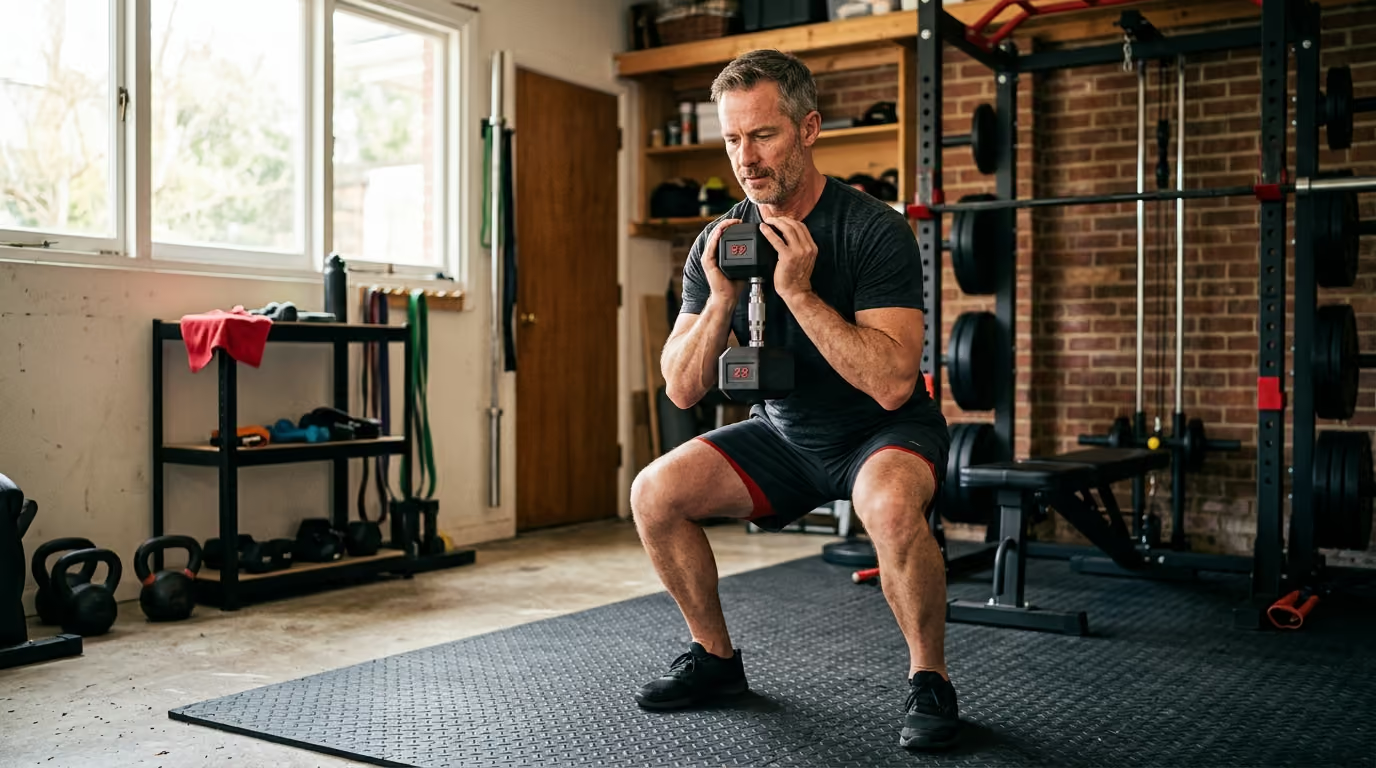
Home strength training is not an endless collection of complex machines. It is not an intense boot camp designed to leave you exhausted on the floor.
Proper home resistance training is a structured method of applying mechanical tension to your muscles using simple tools or your own bodyweight. It is a reliable system for building physical capacity, protecting joint function, and staying independent.
This guide provides a thorough blueprint for training at home after age 45. You will learn what the science says about training outside a commercial gym, how your body changes in midlife, how to set up your space, and how to build a lasting routine.
What Does the Research Show About Strength Training at Home?
Scientific evidence shows that structured resistance exercise improves physical capacity at any age. Public health guidelines from the World Health Organization recommend that adults perform muscle-strengthening activities that involve all major muscle groups at least two days per week. For mature adults, these guidelines highlight multicomponent training that combines strength and balance work to support functional independence and lower fall risk.
You do not need a commercial gym membership to achieve these adaptations. Systematic reviews of home-based resistance training programs show clear improvements in muscular strength, physical function, and balance in community-dwelling adults. Research examining unsupervised home training found significant gains in lower-body strength compared to inactive control groups. Supervised and guided home routines show even larger improvements in functional performance.
The biological stimulus for building and maintaining lean muscle is mechanical tension. Muscle tissue responds to force production and fatigue, not the brand name on a piece of equipment. Studies confirm that free weights, resistance bands, and bodyweight movements can stimulate muscle protein synthesis and neural adaptations when sets are performed with adequate effort.
The evidence also clarifies how training volume affects outcomes. A 2024 systematic review demonstrated that low-volume resistance training provides substantial improvements in physical function, lean body mass, and muscle size in older populations. Higher weekly training volumes may offer additional benefits for maximal strength, but low-to-moderate volume routines produce the vast majority of health and functional benefits.
Research from the American College of Sports Medicine highlights that lifting heavier loads of at least 80 percent of one-repetition maximum can enhance maximal force production. Moderate loads lifted close to technical fatigue produce comparable muscle growth while placing less acute stress on joints. This gives home lifters broad flexibility in choosing equipment and loading strategies.
Why Do Strength and Muscle Change After 45?
Physical changes after age 45 are driven by normal physiological shifts rather than disease. Understanding these mechanisms helps you plan smarter workouts and avoid unnecessary setbacks.
The first major shift is a gradual reduction in muscle mass and muscle cross-sectional area. This process involves the preferential loss and shrinkage of fast-twitch motor units. Fast-twitch muscle fibers produce rapid, high-intensity force. When physical activity drops, these fibers are the first to decline, which reduces your power output and reaction speed.
Connective tissues also change over time. Tendons and ligaments lose some water content and tissue compliance. Collagen turnover slows down, which means tendons take longer to adapt to new mechanical stresses than active muscle fibers. If you increase training loads too fast, your muscles may handle the weight while your tendons become irritated.
Recovery capacity shifts across midlife. Muscle protein synthesis rates after a meal can decline without adequate protein intake and physical activity. Systemic inflammation may increase slightly with age, while baseline circulation to connective tissues decreases. These changes mean you need more time between hard sessions to repair tissue and replenish energy stores.
Hormonal levels also shift gradually. Testosterone in men declines at a steady rate of roughly one percent per year after age thirty. This modest shift does not prevent muscle growth or strength gains, but it does reduce your margin for recovery error. Poor sleep, chronic psychological stress, and improper workout volume will stall your progress faster than they did decades ago.
Joint cartilage undergoes routine structural remodeling throughout life. Decades of sports, physical work, or old injuries leave unique wear patterns on hips, knees, and shoulders. Successful strength training after 45 adapts to these mechanical variations rather than forcing your body into rigid exercise standards.
What Does This Mean for Daily Capability and Longevity?
Translating research into daily practice means focusing on real-world movement and lasting resilience. Strength is the primary physical asset that protects your independence and quality of life.
Everyday physical tasks require force production. Climbing stairs requires knee extension and hip power. Carrying heavy bags requires grip strength, core stability, and upper back endurance. Lifting objects from the floor requires a sound hip hinge and spine control. By strengthening these fundamental patterns at home, daily tasks feel lighter and cause less physical fatigue.
Joint stability and fall prevention depend directly on lower-body strength. Balance is not simply a neurological skill; it requires rapid force output from your hips, calves, and ankles. Stronger muscles give you the physical capacity to catch yourself if you stumble on uneven terrain or trip over an obstacle.
Strength training plays a direct role in supporting energy and metabolic health. Muscle tissue acts as the primary site for glucose disposal in the human body. Contracting your muscles regularly improves insulin sensitivity and helps manage body composition without requiring extreme dietary restrictions.
A well-designed home routine also builds structural durability for outdoor recreation. Whether you enjoy hiking, cycling, golf, or traveling, stronger connective tissues and muscles protect you from overuse strains. Resistance training lets you stay active in your favorite hobbies without chronic aches.
How Should You Build Your Home Training Space?
Setting up a home training area requires clear decisions about space, budget, and safety. You can build an effective training environment in an apartment living room, a garage, or a dedicated spare bedroom.
Equipment Tier 1: The Minimalist Setup
A minimalist setup requires minimal floor space and a modest budget. It is ideal for beginners, frequent travelers, or anyone with limited room.
Key items for this setup include:
- One set of adjustable dumbbells or two pairs of moderate-weight fixed dumbbells.
- A set of looped resistance bands with various resistance levels.
- A reliable door anchor for band exercises.
- A firm, non-slip exercise mat.
- A sturdy household chair or low step.
This basic setup allows you to train every major movement pattern. You can perform goblet squats, Romanian deadlifts, floor presses, band rows, overhead presses, and core stability drills. When space is clear, everything stores neatly in a closet or under a bed.
Equipment Tier 2: The Intermediate Home Setup
An intermediate home gym expands your loading range and exercise selection. It works well in a dedicated corner of a basement, garage, or spare room.
Helpful additions include:
- Heavy adjustable dumbbells that reach 50 to 80 pounds per hand.
- An adjustable weight bench that supports flat and incline angles.
- A secure wall-mounted or doorway pull-up bar.
- Two or three kettlebells for carries and dynamic hinge work.
- High-density rubber floor tiles to protect your flooring and reduce noise.
This setup supports higher training loads for lower-body movements and provides more pressing angles for upper-body development. It accommodates progressive loading for years without requiring massive pieces of machinery.
Equipment Tier 3: The Dedicated Strength Setup
A dedicated home gym provides maximum loading versatility if you have the space and budget. This setup is usually placed in a garage or large basement with adequate ceiling height.
Components of a full setup include:
- A sturdy power rack or half rack with reliable safety spotter arms.
- An Olympic barbell with rotating sleeves and a selection of weight plates.
- A plate-loaded cable pulley system or functional trainer.
- An adjustable bench with a high weight capacity.
- Dedicated dumbbell racks and plate storage trees to keep the floor clear.
This setup provides total freedom for heavy squats, deadlifts, bench presses, and cable accessory movements. It requires careful attention to room dimensions, ceiling clearance, and floor weight limits.
Home Space and Safety Considerations
Safety in a home environment is entirely your responsibility. Training alone means you must avoid preventable hazards before you pick up a weight.
Review this safety checklist for your home training area:
- Clear a minimum floor area of six feet by six feet free of clutter, loose rugs, and furniture corners.
- Keep pets and young children out of the training zone during workouts.
- Verify that your pull-up bar and band door anchors are securely locked in place before applying body weight.
- Wear supportive, closed-toe athletic shoes with flat, non-slip soles.
- Maintain clear airflow and lighting to prevent overheating and missteps.
- Keep your mobile phone within reach in case you need assistance while training alone.
- Set mechanical safety pins on a power rack whenever you perform barbell bench presses or squats without a partner.
Which Movement Patterns Matter Most for Home Training?
Human movement can be organized into foundational movement patterns. Designing your home workouts around patterns rather than individual muscles ensures complete physical development and balanced joint stress.
1. The Knee-Dominant Pattern
Knee-dominant exercises train the quadriceps, glutes, and calves. They build the lower-body power needed for standing up, climbing stairs, and walking uphill.
Movement progression ladder:
- Assisted sit-to-stand from a high chair.
- Bodyweight box squat to parallel.
- Dumbbell goblet squat to a box.
- Free-standing dumbbell goblet squat.
- Dumbbell Bulgarian split squat or walking lunges.
Beginners should master the sit-to-stand with upright posture before adding external load. Use a steady tempo, lowering yourself under control for two to three seconds on each repetition.
2. The Hip Hinge Pattern
The hip hinge targets the posterior chain, including the hamstrings, glutes, and spinal erectors. This movement teaches you to lift heavy loads with your hips rather than rounding your lower back.
Movement progression ladder:
- Bodyweight hip hinge with hands on hips against a wall.
- Light resistance band good morning.
- Kettlebell deadlift from an elevated block.
- Dumbbell Romanian deadlift to mid-shin.
- Conventional barbell or heavy dumbbell deadlift.
Keep your spine neutral, unlock your knees slightly, and push your hips backward as if touching a wall behind you. Stop the downward range when your hips stop moving back.
3. The Horizontal Push Pattern
Horizontal pressing strengthens the chest, anterior deltoids, and triceps. It develops upper-body pushing power and shoulder girdle stability.
Movement progression ladder:
- Wall push-up.
- Incline push-up with hands on a sturdy bench or countertop.
- Floor push-up with hands flat on an exercise mat.
- Dumbbell floor press with a neutral grip.
- Flat or incline dumbbell bench press.
The dumbbell floor press is an exceptional home variation for men with shoulder irritation. The floor creates a natural depth stop that limits excessive shoulder extension while keeping tension on the chest and triceps.
4. The Horizontal Pull Pattern
Horizontal pulling builds the latissimus dorsi, rhomboids, rear deltoids, and biceps. It balances out forward-rounded postures caused by long hours of desk work or driving.
Movement progression ladder:
- Standing resistance band row with a door anchor.
- Chest-supported dumbbell row on an incline bench.
- Single-arm dumbbell row with one hand braced on a bench.
- Inverted bodyweight row using a secure bar or suspension straps.
- Heavy two-arm dumbbell row.
Focus on driving your elbows back toward your hips rather than pulling with your hands. Pause for one second at full contraction to reinforce upper-back engagement.
5. The Vertical Push and Pull Patterns
Vertical movements build complete shoulder mobility, upper back width, and overhead pressing strength.
For vertical pushing, progress from a seated neutral-grip dumbbell press to a standing single-arm overhead press. If overhead pressing causes shoulder discomfort, switch to an incline press or a half-kneeling landmine press.
For vertical pulling, progress from a seated resistance band pulldown to an eccentric-only pull-up, and finally a full bodyweight pull-up. Bands can be looped around your foot or knee to provide assistance on a pull-up bar.
6. Loaded Carries and Core Stability
Loaded carries develop functional grip strength, shoulder stability, and lateral core control. Core training should prioritize resisting unwanted spinal motion over excessive flexion or twisting.
Valuable home carry and core variations include:
- Suitcase carry: hold a heavy dumbbell in one hand while walking with an upright, level torso.
- Farmer carry: walk with heavy weights held in both hands for time or distance.
- Dead bug: lie on your back and alternate extending opposite arm and leg while keeping your lower back flat.
- Side plank: hold a straight body line from ankles to shoulders while resting on one forearm.
- Bird dog: extend opposite arm and leg from a hands-and-knees position while maintaining a stable pelvis.
Carries and stability drills provide high functional return with very low joint wear. They train your trunk to remain rigid while your limbs produce movement.
How Should You Structure Your Weekly Training Program?
A practical training program matches your schedule, current fitness level, and recovery capacity. Consistency across months matters far more than workout complexity.
The Full-Body Framework (2 to 3 Days Per Week)
A full-body routine is the most efficient structure for men over 45 training at home. It trains every major movement pattern multiple times per week while leaving ample rest days for joint recovery and active recreation.
Sample 3-Day Full-Body Schedule:
- Monday: Full Body Session A
- Tuesday: Rest or light walking
- Wednesday: Full Body Session B
- Thursday: Rest or light mobility work
- Friday: Full Body Session A
- Saturday: Rest, hiking, or leisure activity
- Sunday: Rest and recovery
Structure each session with four to six exercises:
- One knee-dominant or hinge movement (3 sets of 6 to 10 reps).
- One upper-body push (3 sets of 8 to 12 reps).
- One upper-body pull (3 sets of 8 to 12 reps).
- One single-leg or secondary compound movement (2 to 3 sets of 10 to 12 reps).
- One core stability drill or loaded carry (3 rounds).
The Upper/Lower Split (4 Days Per Week)
An upper/lower split works well for trainees who prefer shorter workouts or want higher training volume for specific muscle groups.
Sample 4-Day Schedule:
- Monday: Upper Body Focus
- Tuesday: Lower Body and Core
- Wednesday: Rest
- Thursday: Upper Body Focus
- Friday: Lower Body and Core
- Saturday: Rest or outdoor recreation
- Sunday: Rest
This split allows you to perform more sets per muscle group per workout while giving upper and lower body structures a full 72 hours of recovery between sessions.
Managing Sets, Repetitions, and Intensity
Dosing your training correctly prevents chronic fatigue and overuse injuries while driving steady adaptation.
Key variables for home programming include:
- Weekly Volume: Aim for 6 to 10 working sets per major muscle group per week to start. Research demonstrates that low-to-moderate volume delivers significant improvements in muscle size and function.
- Repetition Range: Use a broad repetition range between 6 and 15 repetitions for most movements. Heavy sets of 6 to 8 reps build force output, while sets of 10 to 15 reps stimulate hypertrophy with lower joint strain.
- Proximity to Failure: Finish most working sets with one to three repetitions in reserve. That means stopping the set when you could still perform one to three more reps with clean technique.
- Rest Periods: Rest two to three minutes between compound sets. Adequate rest allows your nervous system and local muscle energy stores to recover, maintaining workout quality.
You can learn more about managing fatigue and connective tissue tolerance through structured joint mobility and recovery protocols.
How Do You Progress Without an Endless Supply of Heavy Weights?
Progressive overload is the fundamental law of strength training. It means gradually increasing the demands placed on your muscular system over time. Adding heavy iron plates to a barbell is only one way to achieve progressive overload.
1. The Double Progression Method
Double progression is a straightforward, reliable method for home lifters using dumbbells, kettlebells, or bodyweight exercises.
Here is how to apply double progression:
- Pick a target repetition range, such as 8 to 12 repetitions.
- Select a weight that allows you to complete 8 clean repetitions with good form.
- Stay with that exact weight in future workouts, adding repetitions over time.
- When you can complete 12 clean repetitions on all assigned sets, increase the weight by a small increment.
- With the new heavier weight, your repetitions will drop back toward 8. Repeat the process.
This method ensures you earn the right to lift heavier loads by demonstrating control at higher repetition ranges first.
2. Increasing Time Under Tension
You can make an exercise substantially more challenging without adding a single pound of external load by changing the movement tempo.
Try using a three-second lowering phase on squats or push-ups. Adding a two-second pause at the bottom of a goblet squat removes momentum and forces your muscles to generate force from a dead stop. This creates strong mechanical tension and improves joint stability while keeping joint loading modest.
3. Increasing Movement Complexity and Range of Motion
Progressing along an exercise ladder increases difficulty naturally. Moving from a standard push-up to a deficit push-up with hands elevated on books increases the active range of motion. Moving from a bilateral squat to a split squat doubles the relative load on the working leg and challenges your balance.
These adjustments let you continue building strength and muscle mass even if you only own a modest set of adjustable weights.
4. Planning Deload Weeks
Fatigue accumulates in muscles, tendons, and the central nervous system over weeks of consistent training. A deload is a planned reduction in training stress that allows your body to complete long-term tissue repair.
Schedule a deload week every six to eight weeks of hard training. During a deload:
- Reduce the number of sets per exercise by 30 to 50 percent.
- Use slightly lighter weights or leave three to four repetitions in reserve on every set.
- Focus on movement quality, joint mobility, and mental refreshment.
Taking a regular deload prevents overuse injuries and prepares your body for future strength gains.
What Are the Most Common Strength Training Myths After 45?
Several common misconceptions prevent mature men from starting or sustaining an effective home strength routine. Looking at what the research actually says helps clear up these misunderstandings.
Myth 1: You Need Heavy Barbells and Commercial Gym Machines
Many men assume that real strength training requires access to large commercial facilities with heavy barbells and dedicated machines. Scientific reviews confirm that home-based resistance training with dumbbells, resistance bands, and bodyweight exercises delivers meaningful improvements in strength, functional capacity, and lean mass. Muscle tissue responds to internal tension and fatigue, regardless of whether that tension comes from an expensive machine or an adjustable dumbbell.
Myth 2: Men Over 45 Should Only Lift Light Weights for High Reps
An overly cautious approach suggests that mature lifters must stick exclusively to very light weights to protect their joints. While high-repetition light-load training has a place in warm-ups and joint conditioning, avoiding all challenging resistance limits your results. Research from the American College of Sports Medicine confirms that lifting moderate-to-heavy loads is necessary to maintain high-threshold motor units and maximal strength. The key is to progress gradually with strict form, not to eliminate challenging resistance entirely.
Myth 3: Every Set Must Be Taken to Complete Muscle Failure
The belief that a workout is wasted unless you train to absolute failure on every set is incorrect and counterproductive. Training to complete muscular failure generates high levels of central nervous system fatigue and increases your risk of technical breakdown. Research shows that stopping one to three repetitions short of failure produces comparable muscle growth and strength adaptations with significantly less fatigue and joint strain.
Myth 4: Soreness Is the Best Indicator of a Great Workout
Delayed onset muscle soreness simply indicates that your body was exposed to a novel movement, unaccustomed volume, or a slow eccentric tempo. Soreness is not a reliable measure of muscle growth or progressive overload. Evaluating your workouts based on performance, clean execution, and gradual strength progression is far more productive than chasing soreness.
Where Is the Scientific Evidence Still Thin or Mixed?
Honest, evidence-based training requires acknowledging the boundaries of current scientific knowledge. While the general benefits of resistance exercise are clear, specific areas lack definitive data.
First, optimal weekly volume thresholds for men between 45 and 64 remain an area of ongoing study. Much of the clinical literature groups adults into either young college-aged cohorts or older populations aged 65 and above. Guidelines for healthy middle-aged men are often extrapolated from these two groups. Individual recovery capacity during midlife varies widely based on training background, occupational stress, and sleep quality.
Second, long-term comparative trials comparing home-based training directly against commercial gym training over several years are limited. Most home training studies run for 8 to 24 weeks. These trials prove that home routines work well for strength, balance, and muscle retention, but they provide less data on elite long-term strength limits.
Third, the optimal prescription for power training at home remains mixed. While research highlights the importance of power for preventing falls, studies use varied methods ranging from high-speed band drills to medicine ball throws and jump training. There is no single consensus on the safest, most effective power protocol for home trainees with preexisting joint wear.
Finally, commercial fitness equipment manufacturers often claim that specific tools, such as specialized vibrating platforms or unique cable designs, produce superior muscular adaptations. High-quality independent evidence supporting these commercial claims over standard free weights and bands remains very thin.
Real-World Case Models for Home Lifters
The following illustrative models show how home training principles adapt to different backgrounds, physical capabilities, and space constraints.
Model 1: The Busy Professional Starting from Scratch
A 48-year-old man with a sedentary office job wants to start strength training at home. He has no prior lifting background, limited free time, and a set of basic resistance bands and light dumbbells.
Training strategy:
- Frequency: Two full-body sessions per week, 35 minutes per session.
- Movements: Chair sit-to-stands, standing band rows, incline push-ups on a desk, dumbbell Romanian deadlifts, and dead bugs.
- Progression: Focuses on double progression, starting with 8 reps and building to 12 reps before making bands tighter or picking up slightly heavier dumbbells.
- Focus: Building consistent workout habits, mastering safe movement mechanics, and learning how to brace the core properly.
Model 2: The Returning Lifter Rebuilding Capacity
A 53-year-old man lifted weights consistently in his twenties and thirties but stopped training for over a decade. He has an adjustable bench and a set of adjustable dumbbells up to 50 pounds in his garage.
Training strategy:
- Frequency: Three nonconsecutive full-body sessions per week.
- Movements: Dumbbell goblet squats, single-arm dumbbell rows, flat dumbbell floor presses, dumbbell Romanian deadlifts, and suitcase carries.
- Risk Management: His neural familiarity with lifting allows him to recruit muscle fibers quickly, which could overload his tendons. He enforces a strict three-repetitions-in-reserve rule and avoids heavy singles or doubles.
- Focus: Rebuilding connective tissue strength, practicing controlled lowering tempos, and steadily regaining physical work capacity.
Model 3: The Apartment Trainee with Limited Space
A 62-year-old man lives in an upper-floor apartment where dropping weights or jumping is not an option. He wants to maintain joint mobility, build functional strength, and support his weekend hiking.
Training strategy:
- Equipment: Looped resistance bands, a doorway pull-up bar with assistance bands, and two moderate kettlebells.
- Movements: Kettlebell split squats, band-assisted pull-ups, tempo push-ups, kettlebell suitcase deadlifts, and standing anti-rotation band presses.
- Noise Control: Emphasizes slow eccentric tempos, isometric holds, and controlled floor work without dropping weights.
- Focus: Single-leg balance, trunk stability, and joint control for hiking stability and healthy aging strategies.
Model 4: The Experienced Lifter Focused on Muscle Retention
A 50-year-old experienced lifter has a full power rack, barbell, and plates in a dedicated basement gym. He wants to maintain muscle mass and upper-body strength while protecting his lower back and shoulders.
Training strategy:
- Structure: Four-day upper/lower split.
- Exercise Selection: Substitutes standard barbell back squats with front squats or barbell Bulgarian split squats to reduce lumbar compressive load. Uses neutral-grip dumbbell presses instead of wide-grip barbell bench presses.
- Volume: Performs 8 to 12 hard working sets per muscle group per week, cycling intensity through six-week blocks followed by planned deloads.
- Focus: Muscle retention, joint preservation, and improving physical performance across midlife without accumulating chronic fatigue.
Practical Steps for Long-Term Training Success
Establishing a home training habit requires simple systems that remove friction from your daily schedule.
1. Set Up Your Workout Space in Advance
Friction kills consistency. If you have to move furniture, locate missing equipment, and clean a room before every session, you will skip workouts when work or family demands rise.
Keep your training area clean and ready to use. Lay out your mat, set your adjustable dumbbells to your starting weights, and keep your logbook visible. The easier it is to begin, the more likely you are to complete the session.
2. Track Your Workouts Methodically
Progress in home strength training is built on small, measurable improvements. Relying on memory makes it impossible to apply progressive overload reliably.
Use a simple notebook or a phone app to track every session:
- Date and session type.
- Exercises performed.
- Weight lifted on each set.
- Repetitions completed.
- Notes on joint comfort or movement quality.
Before each workout, check your previous numbers. Your primary goal is simply to match or slightly exceed past performance through an extra repetition, cleaner form, or a modest load increase.
3. Warm Up with Specific Purpose
A warm-up should prepare your joints, elevate core body temperature, and rehearse movement mechanics without causing fatigue.
A five-to-eight-minute routine works well:
- Two minutes of light calisthenics, marching in place, or easy cycling.
- Arm circles, hip openers, and thoracic spine rotations.
- One set of bodyweight squats and hip hinges.
- One or two light warm-up sets of your first planned exercise before handling working weights.
Never skip warm-up sets when performing compound lifts. Rehearsing the movement pattern with light resistance prepares your nervous system and reinforces safe technique.
4. Support Training with Basic Nutrition and Sleep
Strength training provides the biological stimulus for adaptation, but your body rebuilds during recovery. Without adequate protein, hydration, and sleep, your progress will stall.
Consume adequate daily dietary protein distributed evenly across your meals. Aim for balanced meals containing high-quality whole protein sources, vegetables, and complex carbohydrates to support energy levels. Prioritize seven to eight hours of restful sleep each night, as tissue repair and growth hormone release peak during deep sleep cycles.
Frequently Asked Questions About Home Strength Training
What should I do if an exercise causes joint discomfort?
Never work through sharp, pinching, or worsening joint pain. Modify the movement immediately by adjusting your grip, stance width, or range of motion. For example, switch from a standard floor push-up to an incline push-up or a neutral-grip dumbbell floor press. If discomfort continues, substitute the movement with an alternative that trains the same pattern pain-free, such as replacing squats with step-ups.
Can I build meaningful strength training only two days per week?
Yes. Research clearly demonstrates that two full-body strength sessions per week provide the vast majority of health, strength, and functional benefits. A two-day routine is sustainable, fits easily into busy schedules, and allows full recovery between sessions. Ensure each session includes a knee-dominant, hinge, push, pull, and core movement performed with adequate effort.
How do I know when it is time to buy heavier equipment?
You need heavier equipment when you can comfortably complete the top of your target repetition range on all working sets with strict form and zero momentum. If you can perform 15 clean reps on your heaviest dumbbell goblet squats with several reps left in reserve, your body has adapted. At that point, buying heavier weights or moving to more challenging single-leg variations is necessary to maintain progressive overload.
Is it safe to lift weights at home if I have high blood pressure?
Regular resistance training helps support long-term cardiovascular health and healthy resting blood pressure. You must avoid holding your breath under strain, known as the Valsalva maneuver, which causes acute spikes in blood pressure. Practice continuous breathing by exhaling during exertion and inhaling during the lowering phase. If you have unmanaged cardiovascular conditions, consult your physician before starting a new program.
The Takeaway
Building lasting strength and physical independence after 45 does not require an expensive gym membership or complicated machines. A consistent home program built on fundamental movement patterns, progressive overload, and intelligent recovery will keep you strong, capable, and resilient for decades to come.
Sources
- Effects of Resistance Training Volume on Physical ...
- Lower extremity muscle hypertrophy in response to ...
- American College of Sports Medicine Position Stand. Resistance ...
- Review Different resistance training volumes on strength ...
- Dose–Response Relationships of Resistance Training in Healthy Old Adults: A Systematic Review and Meta-Analysis
- Different resistance training volumes on strength, functional fitness, and body composition of older people: A systematic review with meta-analysis
- Influence of Resistance Training Variables to Improve Muscle ...
- How Many Sets Are Best for Older Lifters?
Stay sharp
Get the word
Join our newsletter for the best writing advice and stories from the field.