Weekly Exercise Blueprint Outlines Essential Workout Routines to Help Men Over 50 Stay Healthy
On September 11, 2026, men’s-health coach Dr. John Spencer Ellis issued a press release in Las Vegas outlining five weekly practices intended to extend healthy lifespan for men over 50. The publication argues that consistent weekly behaviors support aging better than isolated medical interventions.
The framework draws on several major population surveys and clinical observations rather than a single new controlled trial. To support the physical training recommendations, the release cites the observational PURE cohort, which tracked 139,691 participants across 17 countries. The social recommendations rely on a 2010 meta-analysis led by Julianne Holt-Lunstad that pooled 148 studies involving more than 300,000 participants. Additional physical guidelines reference a Cleveland Clinic analysis of 122,007 patients published in JAMA Network Open.
How Much Strength Training Do Older Men Actually Need?
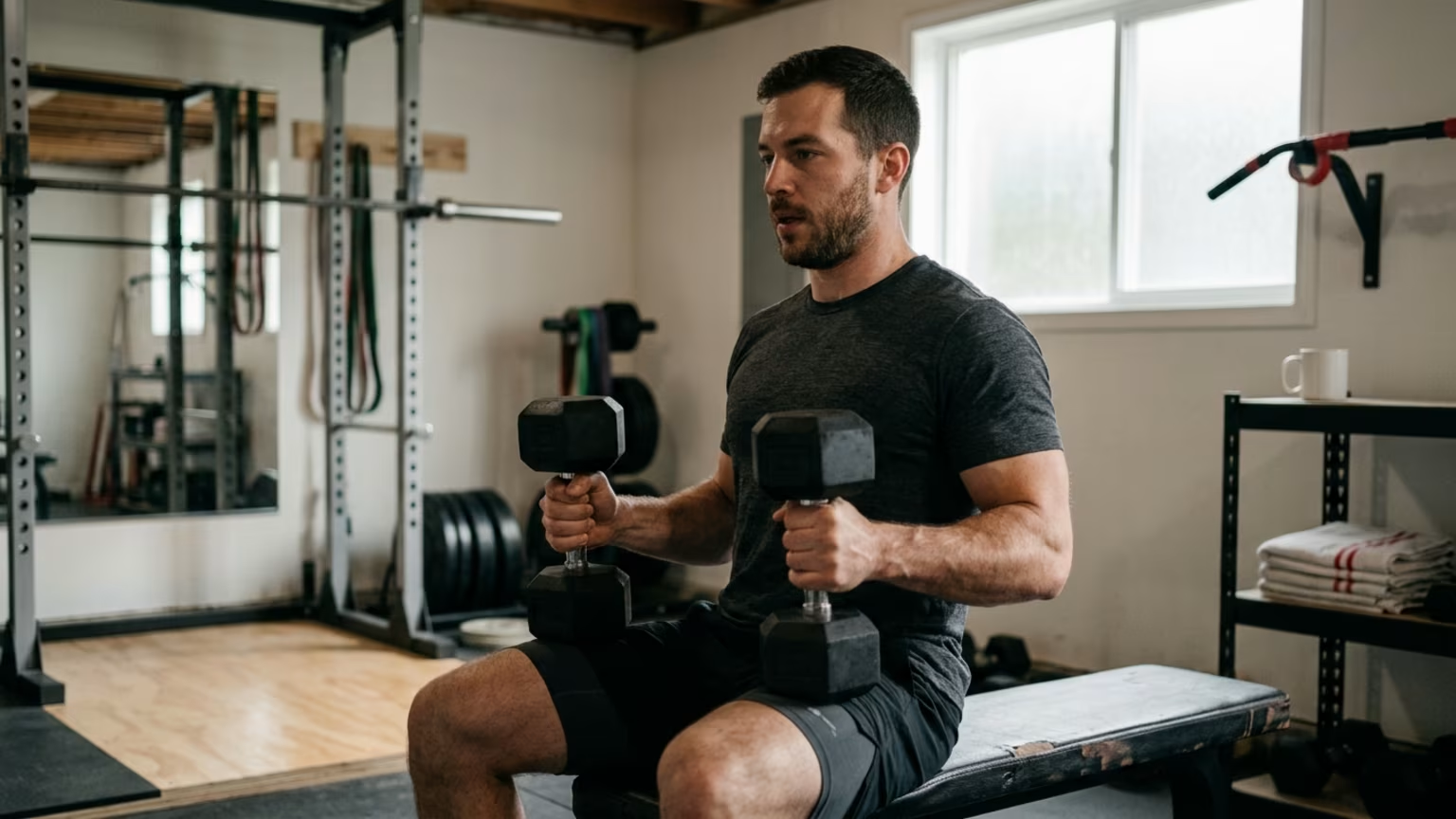
The release identifies five specific lifestyle interventions that correlate with maintained physical capacity and lower mortality risk. When deciding on how much strength training older men need, the first and most prominent practice is completing two to four resistance sessions each week. The author recommends organizing these workouts around five foundational movement patterns. These include a squat or press, a hip hinge, an upper-body push, an upper-body pull, and a loaded carry.
According to the synthesis, structured resistance work targets the exact physical qualities that older men lose most rapidly. The cited PURE cohort data revealed that every five-kilogram reduction in a participant's grip strength was associated with a 16% higher all-cause mortality hazard. The author uses this finding to argue that muscular force serves as a practical proxy for broader physical capability. Progressive loading helps preserve the power required for daily tasks like climbing stairs, carrying luggage, and recovering balance.
The author specifically advises older adults to progress their training at the adaptation speed of their connective tissues rather than their muscle tissue. Ligaments and tendons adapt to physical stress at a different rate than muscle bellies do. This pacing recommendation aims to prevent the joint injuries that often occur when older men return to heavy lifting too quickly. The program focuses heavily on functional outcomes rather than isolated visual changes.
Those interested in training for functional longevity after 45 should note how the five patterns apply practically. A properly structured session involves a knee-dominant pattern like a squat to build lower-body power alongside hip hinge movements for the posterior chain. Upper-body pushing and pulling exercises maintain the force necessary for daily manual tasks. Finally, the program requires loaded carries, which train trunk bracing, grip capacity, and walking stability simultaneously.
What Is The Right Balance Between Cardio And Strength?
The second practice focuses on cardiorespiratory fitness through consistent aerobic work. The framework calls for 150 to 200 minutes of conversational-pace aerobic activity each week. The release presents this aerobic recommendation as a direct method for supporting cardiorespiratory fitness, which the Cleveland Clinic analysis found was inversely associated with all-cause mortality. The author advises establishing a solid aerobic base with activities like walking or cycling before introducing higher intensities.
Only after this base is secure should men add one or two interval sessions per week. This complementary approach to combining strength and cardiovascular work stops the common mistake of choosing between muscle and endurance. Resistance work maintains force and function, while steady aerobic activity secures cardiorespiratory fitness. This base phase conditions the heart and lungs without placing excessive stress on aging joints.
How Do Nutrition And Sleep Impact Aging Muscle?
The third pillar addresses age-related anabolic resistance through strategic nutritional timing. Older muscle requires a stronger stimulus to trigger muscle protein synthesis compared to younger tissue. The release notes that men over 50 may require approximately 0.40 grams of protein per kilogram of body weight per meal, compared with 0.24 grams per kilogram for younger men. To hit this target, the framework suggests consuming roughly 30 to 40 grams of protein at each of three daily meals.
Spreading intake evenly across the day prevents the common error of consuming minimal protein early and a massive amount at dinner. Consuming a large amount of protein in a single sitting leaves the body without adequate repair materials during the rest of the day. Distributing protein evenly provides a steady supply of amino acids. This distribution strategy drives muscle repair and aids the recovery required by heavy resistance sessions.
The fourth recommendation targets recovery through rigorous sleep consistency. The framework requires seven to nine hours of sleep per night alongside a fixed wake time seven days a week. To support this, the author referenced a Stanford study where athletes who spent 10 hours in bed for five to seven weeks saw skilled-performance measures improve by roughly 9%. The release uses this to argue that consistent rest allows the body to clear accumulated fatigue before it manifests as physical injury.
Why Are Social Connections Linked To Physical Survival?
The fifth practice prioritizes structured social connection as a health imperative. The release advises making weekly contact with two close male friends and participating in a recurring in-person activity. The cited Holt-Lunstad meta-analysis found that people with stronger social relationships had a 50% greater likelihood of survival. Independent coverage describes this same 2010 meta-analysis as involving more than 300,000 people and reports the exact same 50% survival advantage.
The WHO Commission on Social Connection also estimated that loneliness is associated with approximately 871,000 deaths annually. Treating relationships as a literal health intervention turns isolation from an emotional issue into a physiological risk factor. The framework makes social interaction a measurable task by recommending specific weekly contact. While scheduling friendships might seem rigid, it guarantees that men actively maintain their support networks as they age.
What Are The Limitations Of This Longevity Framework?
The framework contains several structural limitations and commercial ties that readers should evaluate carefully. The release explicitly promotes Ellis’s commercial 90-day Health, Longevity and Aesthetic Optimization Program for Men 40+. This paid program includes intake assessments, physician-coordinated bloodwork guidance, functional testing, individualized training, and 12 weekly coaching sessions. No independent outcome data were provided to prove this specific commercial offering outperforms self-directed training or standard clinical exercise programs.
Furthermore, much of the supporting evidence is purely observational. The PURE study links lower grip strength with higher mortality risk, but it does not prove that grip training alone will extend life. Grip strength often simply reflects a person's general neurological health, nutritional status, and baseline physical activity. Likewise, the WHO estimate of 871,000 deaths associated with loneliness describes a population-level association rather than a direct causal mechanism.
Other metrics presented in the release require individual context before application. The Stanford sleep data involved young athletes tracking skilled performance, meaning those exact percentage improvements do not automatically translate to longevity outcomes for older adults. The protein targets should also be treated as a general baseline rather than a universal rule. Exact dietary needs vary based on kidney health, total daily intake, body size, and specific medical contexts.
Men with cardiovascular disease, osteoporosis, uncontrolled hypertension, or significant joint pain should seek medical clearance before beginning intervals or heavy progressive loading.
What this changes is very little regarding clinical exercise science, but it strongly confirms existing knowledge that structured multi-pattern lifting and consistent lifestyle habits dictate healthy aging far more than isolated medical protocols.
How Everfitguys helps
Relying on isolated longevity interventions rather than structured progressive resistance training often leaves aging men without the physical resilience needed for daily independence. This loss of physical reserve frequently accelerates declining focus, memory and mental sharpness, so Everfitguys analyzes complex gerontology data to help you build practical habits that protect both your body and your brain. Read the research
Sources
- Strength as the Longevity Keystone — Longevity Ladder
- Five Weekly Practices Can Extend a Man's Life After 50 ...
- Grip Strength: Why Scientists Call It a Window Into How You Are Aging
- How to Calculate Your Optimal Protein Distribution Across Meals: Maximizing Muscle Protein Synthesis Throughout the Day | Unreliant
- Association of Physical Activity With All-Cause and CVD Mortality Across Metabolic and Obesity Phenotypes
- This Simple Habit Could Help You Live Longer. But Does It Actually Work?
Stay sharp
Get stories
The best writing on craft and life, delivered once a week. No noise, just the good stuff.