Reports Claim Mongolia's 58-Year-Old President Bench Pressed 100kg: Why Strength Matters After 45
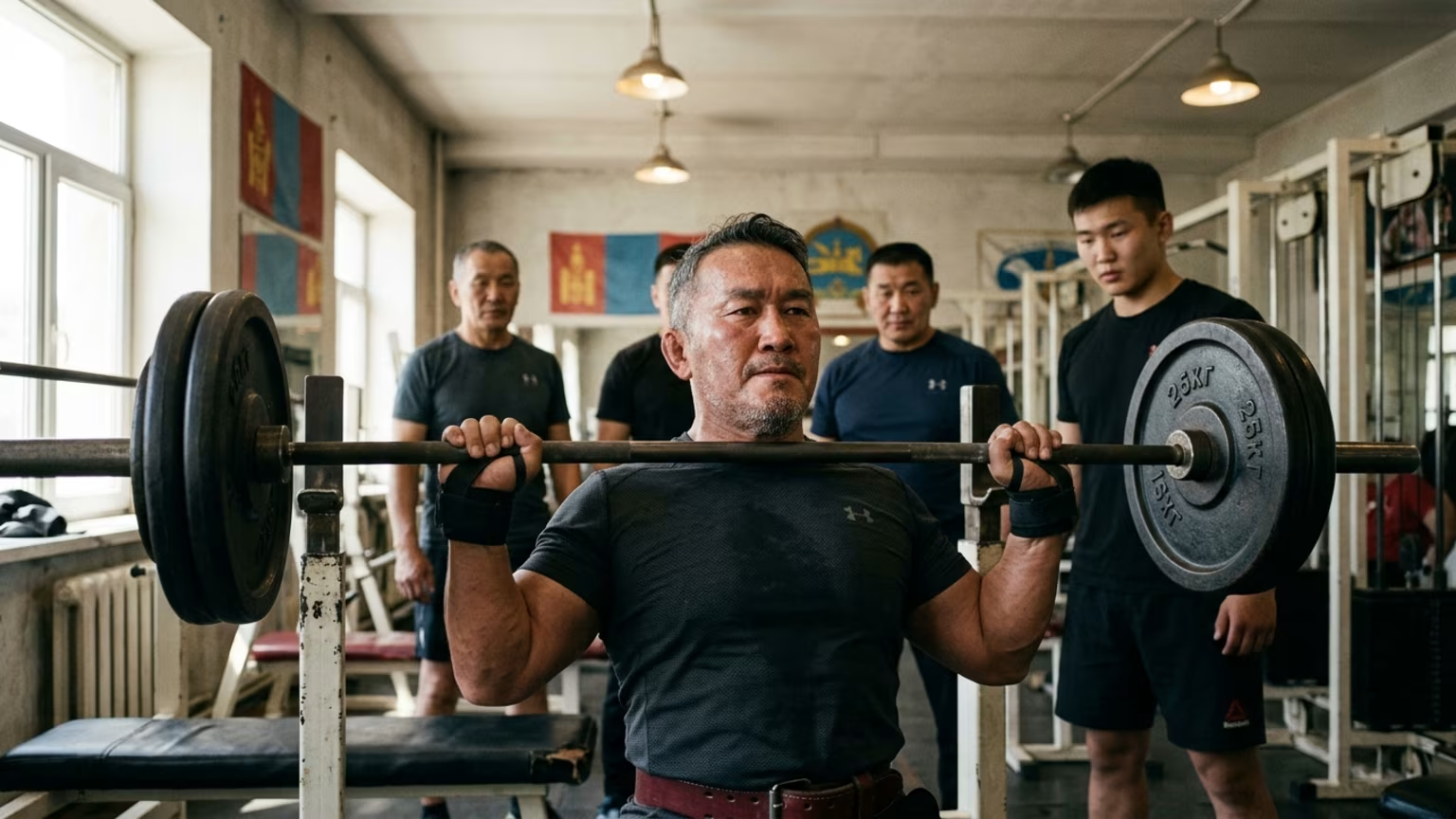
Reports published in September 2026 said Mongolia’s 58-year-old president, Ukhnaagiin Khürelsükh, completed 20 bench press repetitions with a reported 100-kilogram load. The event occurred during a military unit visit. The president removed his jacket to perform the set in front of soldiers.
How Do Researchers Evaluate Strength Training In Older Adults?
While viral videos generate immediate attention, clinical research offers a more reliable foundation for men managing their physical health. Researchers evaluate older adult physical capacity through systematic reviews and meta analyses of controlled trials. These studies isolate the specific effects of resistance training across different populations. The evidence base includes robust sample sizes and focuses on participants spanning midlife to very late life.
One major review analyzed 124 trials involving 18,429 participants to evaluate combined aerobic and resistance exercise. Another meta analysis examined 11 randomized controlled trials to measure the physiological effects of adding creatine to training programs. These systematic reviews specifically target older demographics, including adults diagnosed with sarcopenia and people aged 80 and older. Relying on controlled trials helps experts separate proven physiological adaptations from isolated physical feats.
The strongest expert level evidence assembled on this topic comes from established professional guidance rather than commentary about Khürelsükh specifically. This clinical literature includes an American College of Sports Medicine position stand summarizing how exercise impacts aging bodies. By analyzing large groups of older adults, researchers can identify which training methods consistently produce measurable health improvements. This structured research provides a realistic blueprint for maintaining physical independence late in life.
What Specific Physical Outcomes Does Resistance Training Produce?
Systematic reviews consistently support progressive resistance training for improving strength and physical function in older adults. Resistance training has been associated with measurable improvements in muscle size, power, balance and broad physical function. In older adults with sarcopenia, resistance training studies reported concrete improvements in handgrip strength, knee extension strength, gait speed and Timed Up and Go performance. These functional metrics are vital because stronger legs and hips directly support independent living.
The physical improvements translate directly to daily tasks like standing from a chair, climbing stairs, carrying luggage and getting up from the floor. The evidence demonstrates that meaningful adaptations remain possible late in life. A systematic review reported that resistance training improved overall muscle strength and whole muscle hypertrophy even in very elderly adults. This includes people aged 80 and older who participated in structured lifting programs.
Maintaining this physical reserve becomes highly relevant when facing unexpected health challenges or periods of enforced rest. Older adults who preserve their baseline strength have a wider safety margin during injury recovery. Without regular resistance training, the natural loss of muscle mass accelerates through midlife and late life. Preserving this tissue through consistent loading provides a metabolic sink for circulating nutrients and supports long term metabolic stability.
Bone health represents another critical finding in the current physiological literature. A large review found cautious evidence that combined aerobic and resistance exercise probably improves lumbar spine bone mineral density. A recent review of exercise and bone health also noted that brisk walking or jogging showed the clearest reported benefit for total hip bone density. Furthermore, weighted vest exercise improved bone mineral density and reduced body fat when compared with usual activity.
A separate meta analysis found that creatine might add a small strength benefit to resistance training for healthy older adults. Review authors specifically warned against extrapolating the small creatine strength benefits to frail or functionally limited adults. Home based exercise programs that feature resistance training have also shown improvements in strength and physical performance for older adults dealing with sarcopenia. These program dependent findings highlight the importance of matching the intervention to the individual's current capacity.
Supplementation cannot replace the structural stimulus provided by actual lifting. Focusing on fundamental training consistency yields more predictable results than hunting for novel nutritional combinations. Men should direct their primary attention toward building a sustainable weekly training schedule. Adding nutritional support represents a minor adjustment compared with the foundational necessity of moving heavy loads safely.
What Are The Limitations Behind These Strength Claims?
The reported 100-kilogram bench press must be treated cautiously by anyone building a physical routine. Kursiv reported that observers questioned the advertised load after examining the visible plate markings on the bar. Some observers estimated the actual weight at 80 or 90 kilograms instead of the reported 100 kilograms. This discrepancy highlights why chasing specific numerical benchmarks often distracts from the true purpose of healthy aging.
The exact weight on the bar matters far less than the consistent effort applied over consecutive weeks. Attempting to match a disputed social media claim can quickly lead to joint strain or significant injury. The viral video does not show a standardized lifting environment, making it impossible to verify the exact range of motion, spotter involvement or plate accuracy.
Media portrayals of extreme strength often ignore the unseen preparation required for such physical displays. Viewers rarely see the warm up sequences, joint mobility routines or careful load progressions that precede a heavy set. Assuming that any older man can safely attempt maximal lifts without this preparation ignores basic physical mechanics. The gap between a viral social media clip and sensible daily training remains massive.
A single impressive lift cannot demonstrate that strength training caused a person’s health status, nor can it predict longevity. The president is described as a former army officer with a background in bodybuilding and martial arts. His performance reflects a long training history rather than a sudden midlife physical transformation. Headline numbers should never dictate exercise prescription for the general public.
Clinical research also carries documented structural limitations that require careful interpretation. The certainty of evidence for bone mineral density improvements varied by exercise type, with several estimates characterized as low to moderate certainty. In the creatine meta analysis, the additional effects on muscle mass and physical function remained uncertain. These details remind trainees to critically evaluate broad fitness claims.
Are There Risks With Adopting Advanced Training Methods?
Adding physical layers to an exercise program does not always guarantee better structural outcomes. While weighted vest exercise showed benefits compared with usual activity, adding a vest to an existing exercise program produced additional fat loss without a confirmed bone health benefit. Recovery claims also remain measured, as one review found no recovery modality clearly outperformed passive recovery across the examined outcomes. These findings emphasize that complex interventions do not always yield superior clinical results.
Age alone is not an adequate basis for choosing a training load. Training history and current physical capacity are more relevant to exercise prescription. Joint health, cardiovascular status, medications and recovery ability also dictate appropriate loads better than age alone.
People with significant joint pain, unstable medical conditions or long periods of inactivity need proper guidance. These individuals should obtain appropriate clinical or professional coaching before beginning vigorous training. A qualified professional can help modify movements for people with prior injuries or balance limitations. The objective is building enough strength to make ordinary life easier, not imitating a public figure.
How Should Men Modify Their Training Routines After 45?
The president’s reported performance represents an advanced feat rather than a universal starting point. Older trainees should begin with a resistance that allows controlled repetitions, stable positioning and consistent technique. Testing a one repetition maximum is unnecessary for building functional capacity and can increase the risk of joint irritation. A measured approach prioritizes steady adaptation over immediate performance testing.
For someone returning to exercise, practical entry points include bodyweight movements that can be easily scaled. Useful options include sit to stands from a chair, wall push ups and supported split squats. Trainees can also incorporate hip hinges with no external load, resistance band rows and carrying light objects. These movements can be adjusted by changing the range of motion, support, tempo or external resistance.
A practical progression framework involves increasing only one variable at a time to manage physical stress. First, focus on improving movement quality. Second, add repetitions within a comfortable range before making the exercise heavier. Third, increase the external resistance modestly and add sets only when recovery remains good.
What Role Do Recovery And Balance Play In Aging?
A balanced physical routine should include a leg movement, a hip dominant movement, a push, a pull and a carry exercise. This structure better reflects the goal of remaining capable in daily life. Trunk work and balance training can be integrated when appropriate to support overall physical stability. Focusing on comprehensive movement patterns protects against the imbalances caused by single joint specialization.
Older trainees often need more attention to sleep, nutrition, hydration and joint symptoms between demanding sessions. Recovery should be judged by performance, soreness, pain and daily energy rather than by age alone. Integrating this structured resistance work with aerobic activities like walking or cycling aligns with the evidence base for bone health. What this changes is the assumption that heavy training belongs exclusively to the young, confirming instead that properly scaled resistance exercise preserves long term physical independence.
How Everfitguys helps
Managing age related physical changes requires parsing dense clinical evidence rather than adopting the extreme training loads seen in viral social media feats. Confusion about hormonal changes and testosterone claims frequently complicates these physical transitions, and Everfitguys translates complex medical data to help you build reliable daily capacity. Read the research
Sources
- Watch: Mongolian President Takes Off Jacket, Then Bench Presses 100kg
- Mongolia’s president stuns social media with 20 bench presses
- Mongolian President, 58, bench presses 100kg for 20 reps
- Effects of resistance training combined with creatine ...
- Effect of exercise on bone health in middle aged and older ...
- Effects of Resistance Training on Muscle Size and Strength in Very Elderly Adults: A Systematic Review and Meta-Analysis of Randomized Controlled Trials.
- Effects of resistance training in healthy older people with sarcopenia: a systematic review and meta-analysis of randomized controlled trials.
Stay sharp
Get stories
The best writing on craft and life, delivered once a week. No noise, just the good stuff.