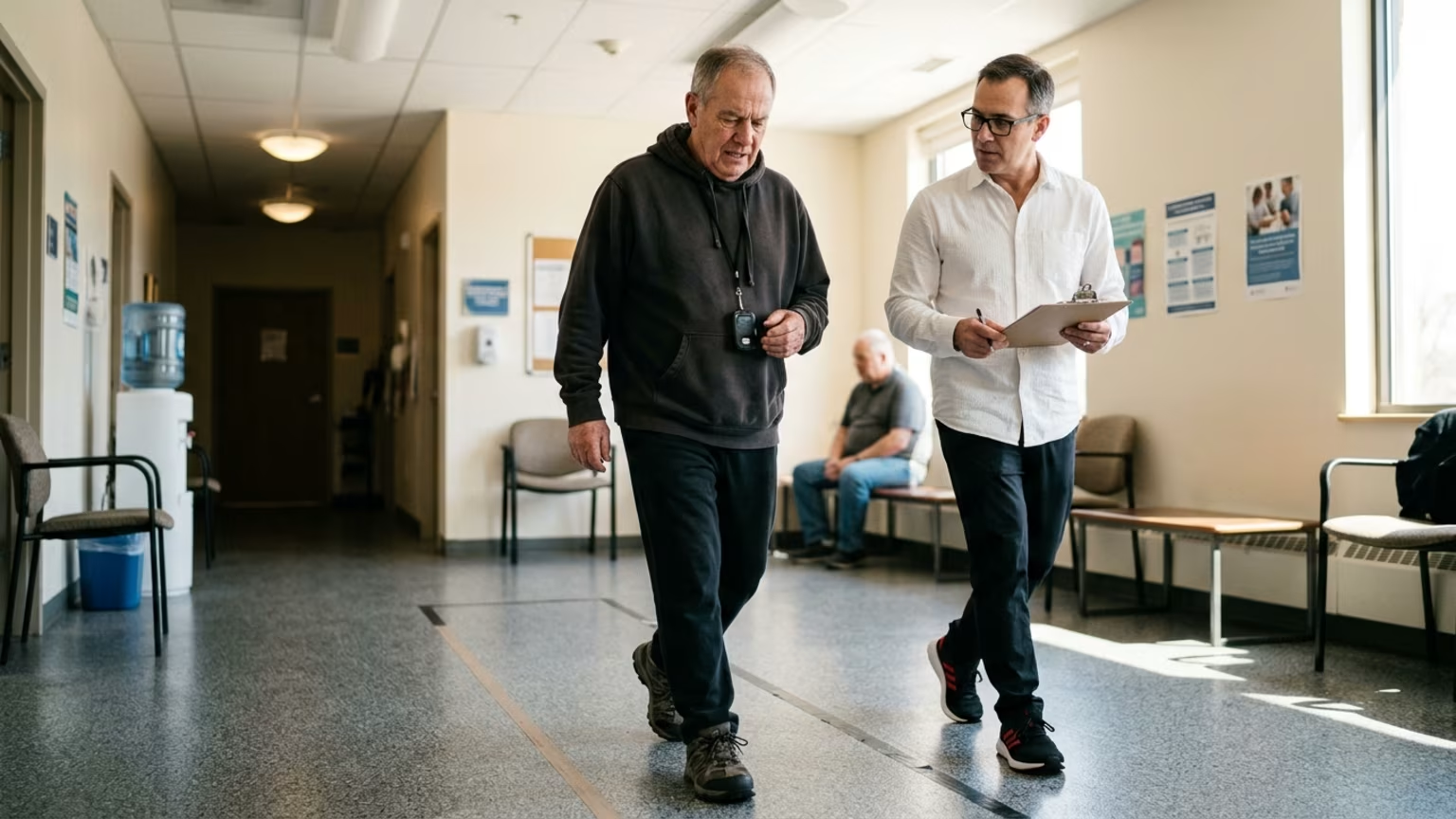
Sit-to-Stand Power Links to Physical Function and Longevity After 65

In September 2026, Exercise New Zealand highlighted new research on muscle power and healthy aging. Chief Executive Richard Beddie commented on the findings to clarify the practical importance of lower body force production.
Observational Cohorts and Measured Variables
The focal analysis was a 2026 study published in Experimental Gerontology. Researchers examined 2,134 adults aged 65 and older participating in the Toledo Study for Healthy Aging. The investigators compared sit-to-stand muscle power with handgrip strength to assess physical function. The available publication record does not specify the exact follow-up duration for this specific 2026 group.
Exercise New Zealand also evaluated a separate 2025 study of 3,889 men and women aged 46 to 75. Researchers tracked this group for a median of 10.8 years to monitor mortality rates. A third research dataset published in the Journal of Sport and Health Science reviewed outcomes for 1,876 adults aged 65 and older. These distinct cohorts provide a broad perspective on how muscle performance changes across decades.
The Toledo Study for Healthy Aging provides crucial context for observing populations over 65. Assessing 2,134 older adults allowed researchers to track a substantial cross-section of aging men and women. The investigators focused specifically on how different physical tests correlate with real world decline. Choosing handgrip and sit-to-stand tests reflects a preference for practical clinical tools.
Primary Physiological Outcomes
The Experimental Gerontology study linked lower sit-to-stand power with poorer functional ability in both men and women. The data associated low lower body power with higher all-cause mortality across both sexes. Researchers noted a specific relationship regarding walking speed among the male participants. For men, lower sit-to-stand power had a stronger association with slow walking speed than low handgrip strength did.
The separate 2025 study quantified the mortality hazards tied to low muscle power. Men in the lowest muscle power group showed a reported mortality hazard 5.88 times higher than men in the highest group. Women in the lowest power group experienced a mortality hazard 6.90 times higher than their strongest peers. These hazard ratios remained significant after researchers adjusted for age and several other health factors.
Clinical Realities of Low Muscle Power
The Journal of Sport and Health Science data revealed further clinical outcomes linked to reduced power. Low sit-to-stand power correlated with a history of falls and fractures in men. Women with low power measurements showed associations with hip fractures and frequent hospitalization. The data tied low power to longer hospital stays and all-cause mortality for both sexes.
Hip fractures in women often precipitate a rapid decline in overall health and mobility. The correlation with longer hospital stays indicates that low muscle power complicates medical recovery. Patients with less physical reserve struggle to overcome periods of enforced bed rest following an injury. These severe hazard ratios apply specifically to the observed cohorts rather than serving as universal predictions.
Tracking thousands of men and women over extended periods offers robust longitudinal data. A decade of observation allows researchers to witness how early deficits in muscle power compound over time. Monitoring force production during middle age might help men identify negative physical trajectories early. Understanding these performance metrics helps men structure better routines when evaluating how to build a personal longevity plan after 45.
Handgrip Strength Versus Lower Body Power
Medical professionals frequently use handgrip strength as a proxy for total physical capability. A firm grip often signals a robust nervous system and adequate total muscle mass. The 2026 Toledo study suggests that lower body assessments might offer a more accurate picture of functional aging. This holds true primarily for tasks requiring weight bearing and locomotion.
Rising from a chair requires more than absolute muscle size. The movement demands rapid neural recruitment and coordinated force production from the legs. The body must accelerate mass against gravity from a dead stop. Evaluating lower body power helps older adults assess their physical reserve accurately.
You can read more about building this baseline by reviewing our guide on functional longevity after 45. The ability to produce force quickly translates directly to independent daily living. A slow chair rise often indicates that muscle fibers are losing their fast-twitch capabilities. These movements require minimal equipment and provide immediate feedback on a patient's functional status.
Real World Applications of Muscle Power
Exercise New Zealand Chief Executive Richard Beddie stressed the practical value of maintaining physical power. He argued that lower body power should be a central part of healthy aging conversations. Beddie noted that established advice to stay fit and build strength remains highly relevant. Rapid force production simply adds another layer of physical security for older adults.
Beddie used stumbling as a clear everyday example of why muscle power matters. "If you stumble, you need to react quickly," he stated. Catching a fall requires the nervous system to fire rapidly and the leg muscles to absorb force instantly. Slow absolute strength cannot prevent a fall if the body cannot deploy that strength in time.
Adding focused power training after 45 helps men preserve this crucial reactive ability. Exercise New Zealand notes that power requires a different physiological pathway than steady cardiovascular fitness or slow strength tasks. The medical community has long recognized aerobic capacity as a primary driver of longevity. This new focus on rapid force production does not diminish the value of a strong heart and lungs.
Exercise New Zealand carefully placed muscle power alongside cardiovascular fitness and total strength. It simply suggests that a healthy cardiovascular system cannot compensate for a weak lower body during a fall. Complete physical reserve requires multiple physiological systems working together efficiently.
Progressive Training for Rapid Force Production
The research summaries provided clear guidelines for developing power safely. Exercise New Zealand advises individuals to first build a strong foundation of basic strength and movement skills. Attempting rapid movements without adequate joint stability can increase the risk of injury. Men should master strict bodyweight squats and controlled resistance exercises before prioritizing speed.
Once basic movement competency is established, older adults can progress to faster execution. The objective is to move appropriate resistance faster while maintaining perfect technique. This progression trains the nervous system to recruit muscle fibers simultaneously. Men looking to maintain their speed can review our guide on power training and fast movement after 45.
Exercise New Zealand states that programming must reflect a person's age, ability, experience and health status. Men looking to implement these protocols should consider seeking help from a registered exercise professional. Sit-to-stand ability represents a tangible metric that men can discuss with a qualified health professional. A performance measure tied to specific health outcomes is not a standalone clinical diagnosis.
Observational Constraints and Clinical Context
The available coverage notes several structural limitations regarding these physical assessments. These findings represent observational associations rather than proven cause and effect mechanisms. The studies do not prove that low sit-to-stand power directly causes poor function or mortality. The data also cannot confirm that training to increase power will reliably reduce mortality risk for an individual.
The current evidence does not specify the exact sit-to-stand test protocol used in the 2026 study. The reports omit detailed definitions of what constitutes low power or the specific clinical thresholds applied. Exercise New Zealand explicitly notes that these findings do not establish whether muscle power outperforms cardiovascular fitness. The phrase regarding a stronger association is specific to the comparison with low handgrip strength among men.
This research confirms that traditional strength and cardiovascular training remain fundamental while altering current physical assessments to include lower-body power as a critical measure of functional aging.
How Everfitguys helps
Tracking physical markers like sit-to-stand power provides a measurable baseline for independent aging, and Everfitguys translates this clinical research to help men preserve their physical reserve. Declining focus, memory and mental sharpness often complicate a man's attempt to maintain a coordinated training routine, but our evidence-led approach provides the clarity needed to stay strong and capable over time. Read the research
Sources
Stay sharp
Get stories
The best writing on craft and life, delivered once a week. No noise, just the good stuff.