Most players assume court-sport injuries come from sudden bad luck or tight muscles. When an Achilles tendon flares or a shoulder begins to ache during a third set, the default reaction is to stretch more or buy a lighter paddle.
The evidence points in a very different direction. Court injuries after 45 are rarely flexibility problems. They are capacity problems, where the sharp mechanical demands of stopping, cutting, and rotating exceed what the athlete's tissues can absorb.
Tennis and pickleball require rapid deceleration, repeated rotational force, single-leg stability, and explosive changes of direction. Staying healthy on the court is not about avoiding intensity or accepting decline. It is about building physical capacity that matches the sport you want to play.
Examine What Court-Sport Research Actually Reveals
Surveillance data in older court-sport athletes shows a consistent pattern across both recreational and competitive levels. In studies examining older pickleball players, nearly one-third report sustaining an injury over a twelve-month period. Over half of these injuries involve the lower extremities, specifically affecting muscle and tendon tissue.
Tournament settings create an even higher concentration of acute issues. Observational data indicates that lower-extremity strains and sprains occur frequently during multi-day events. Factors associated with higher injury frequency include male sex, lower body mass index, and higher weekly playing hours.
Large-scale injury registry data reveals that the overwhelming majority of pickleball-related injuries occur in players aged 50 and older. Fractures and sprains make up the bulk of emergency department presentations. Senior men experience higher rates of sprains and strains, while senior women show higher rates of fractures, particularly wrist fractures from ground falls.
- Ground reaction force foot and ankle knee and hip pelvis trunk scapula shoulder arm
Achilles tendon injuries show a notable age profile in court sports. Research tracking tendon ruptures found that the median age for pickleball-related Achilles tears is approximately 60 years. In comparison, the median age for tennis-related tears is 45 years, while general sports ruptures occur at a median age of 37 years.
More than 80 percent of pickleball Achilles ruptures happen in adults over the age of 50. Clinical reports link these events directly to explosive, reactive movements. Lunging for a dropped shot, sprinting after a lob, or abruptly pushing off from a static stance create extreme peak loads.
Shoulder injuries show similar age-related patterns. The average age of presentation for acute court-sport shoulder pain is in the late sixties, with the vast majority occurring on the dominant playing side. Systematic reviews in racquet sports confirm that rotator cuff pathology and tendon irritation increase when overhead volume exceeds muscular endurance.
Guidelines from the World Health Organization highlight the value of structured strength and balance work for older adults. The guidelines recommend muscle-strengthening activities at least two days per week. They also recommend multicomponent physical activity emphasizing functional balance and strength at least three days per week to prevent falls and preserve capability.
Understand How Tissue Capacity Changes After Midlife
Aging is not a disease, but tissue properties shift over time. Tendons lose some of their resting water content and natural elasticity after midlife. This change makes tendons slightly stiffer and less forgiving when subjected to sudden, high-velocity stretch-shortening cycles.
Muscle mass and the proportion of fast-twitch muscle fibers decrease if they are not deliberately trained. Fast-twitch fibers produce rapid force, which is the primary physical quality needed to stop your body momentum on a hard court. When rapid force production declines, the body takes longer to decelerate, shifting mechanical stress onto passive structures like ligaments and joint surfaces.
- 1. Elastic energy absorption (Achilles, patellar tendon)
- 2. Muscular eccentric braking (quadriceps, calves, glutes)
- 3. Multi-directional force transfer (hips, core, spine)
Bone mineral density and joint cartilage also undergo natural remodeling. Cartilage becomes less hydrated, which reduces its ability to distribute peak impact forces smoothly. At the same time, changes in sensory feedback from the feet and inner ear can subtly slow reaction time.
These physical shifts do not mean court sports become dangerous. They mean that unconditioned tissues have a narrower safety margin. When a 50-year-old athlete sprints toward the kitchen line and plants a foot, the calf-Achilles complex must absorb several times body weight in milliseconds. If the tissue lacks the baseline capacity for that load, microtrauma accumulates rapidly.
The kinetic chain also becomes less forgiving of weak links. In younger players, extra joint laxity or raw power can mask poor technique. After 45, if the hips lack internal rotation or the thoracic spine cannot extend, the lower back and shoulder take on excessive mechanical stress. Maintaining healthy joints requires balancing mobility and strength throughout the entire movement chain.
Recognize Real-World Demands on the Court
Playing tennis or pickleball demands far more than steady aerobic endurance. A player may easily walk five miles on flat ground without issue, yet struggle after thirty minutes of doubles play. The distinct physical challenges of court sports explain why general cardiovascular fitness is not enough.
The True Cost of Deceleration
Most athletic injuries do not happen while speeding up. They happen while trying to stop. Deceleration requires muscles to lengthen under heavy load, which is known as eccentric contraction.
When you chase a wide forehand, your lead leg must absorb forward and lateral momentum simultaneously. If your quadriceps and calves cannot handle that eccentric load, your knee collapses inward or your foot rolls outward. Developing braking strength provides the foundation for safe, confident court movement.
The Demands of Lateral Shuffling
Court sports take place primarily in the frontal and transverse planes. Running on a treadmill or cycling prepares the body only for forward movement in the sagittal plane.
Lateral shuffling requires strong hip abductors, resilient adductors, and stable ankles. When moving sideways, the feet must grip the court surface while the pelvis stays level. Without lateral hip strength, the knee joint absorbs unwanted twisting forces during sudden direction changes.
Rotational Loading Across the Kinetic Chain
Every groundstroke, serve, and overhead smash relies on rotational power. Force begins at the feet against the court, travels up through the legs, rotates the pelvis, moves through the trunk, and finishes through the shoulder, arm, and paddle.
If the hips or upper back lack functional movement, rotation gets forced into the lumbar spine or the rotator cuff. A player who complains of a sore shoulder often has tight hips that restrict natural body turn. Addressing joint health means looking at how the whole body distributes load during a swing.
Reactive Balance Under Fatigue
Recreational play involves unpredictable visual cues, changing ball trajectories, and shifting court positions. Maintaining balance while tracking a moving object requires rapid sensory processing and immediate foot adjustments.
Fatigue degrades this coordination. Late in a match, footwork becomes sloppy, step frequency drops, and players rely on awkward reaches rather than moving their feet. This breakdown in reactive balance is precisely when ankle rolls and fall-related fractures take place.
Build Deceleration and Lateral Braking Capacity
Training for court resilience requires moving beyond static exercises. You must train the body to absorb force in multiple directions, progressing from controlled, predictable drills to fast, reactive movements. Exploring structured mobility and functional movement principles helps build this foundational base.
Foundational Eccentric Strength
Before you practice high-speed stops, your muscles must tolerate heavy, slow lowering. Eccentric strength forms the mechanical brake pads of your lower body.
- Split Squats with Slow Lowering: Step into a split stance. Lower your back knee toward the floor over a full three to four seconds, then drive back up smoothly.
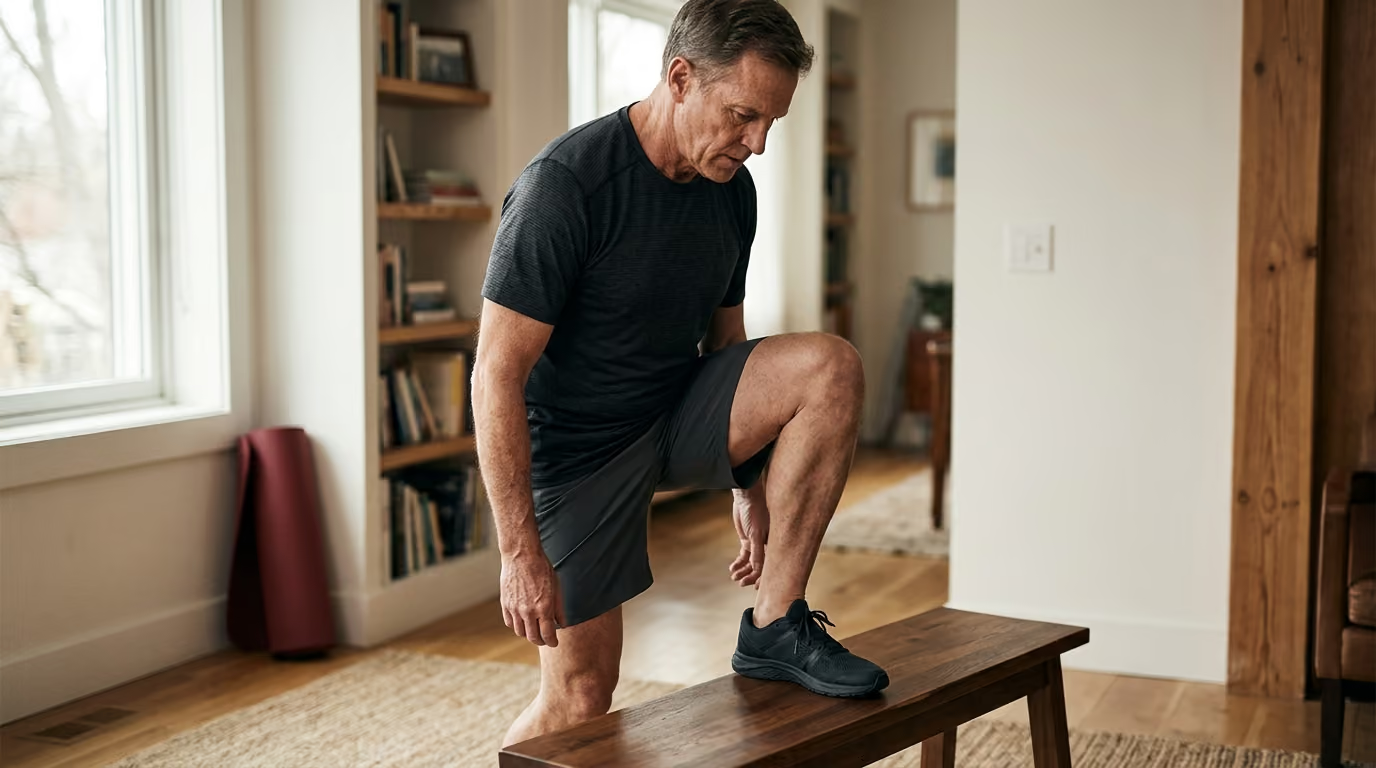
- Controlled Step-Downs: Stand on a low box or step. Lower one foot toward the floor by bending the supporting knee and hip, keeping the knee tracking over the second toe.
- Lateral Squats: Shift your weight to one side, sinking your hip down and back while keeping the opposite leg straight. Pause at the bottom before pushing back to center.
- Single-Leg Romanian Deadlifts: Hinge at your hips on one leg while extending the other leg behind you, keeping your spine neutral and pelvis level.
Perform these foundational movements with controlled tempos two to three times per week. Focus on joint alignment, smooth control, and even pressure across the entire foot.
- Step 1: Bilateral slow lowering (Squats, Hinges)
- Step 2: Unilateral eccentric control (Step-downs, Split squats)
- Step 3: Linear deceleration drills (Two-step stick and hold)
- Step 4: Lateral deceleration drills (Side shuffle to plant)
- Step 5: Reactive multidirectional stops (Visual partner cues)
Linear and Lateral Braking Drills
Once slow eccentric strength is established, you can introduce low-speed braking drills. These drills teach your body to use multiple short steps rather than one rigid, outstretched leg.
Begin with the Linear Two-Step Stick. Jog forward at half speed for three strides, then drop your hips and bring your feet to an athletic stop within two short steps. Hold the finished position for two seconds, checking that your chest is forward and your knees are bent.
Progress to the Lateral Shuffle and Stick. Shuffle three steps to the right, plant your outside foot firmly, and sink into your right hip to absorb momentum. Hold the position to confirm balance before shuffling back to the left. The goal is absorbing force through your hips and thighs without letting your ankle roll outward.
Reactive Multidirectional Movement
The final progression introduces uncertainty. Court sports do not allow you to plan your footwork in advance, so your nervous system must react to visual cues.
Set up four cones in a small diamond. Have a partner call out a cone color or point in a direction. Accelerate toward the target, plant your feet using short braking steps, touch the cone, and push back to the center position.
Keep drill intervals between six and ten seconds to match court rally lengths. Take full rest periods between repetitions to ensure movement quality does not break down due to exhaustion.
Strengthen the Calf-Achilles Complex and Shoulder Chain
Two anatomical zones face exceptional stress in court sports: the lower leg complex and the upper body rotational chain. Target these areas with direct, progressive conditioning to build tissue resilience. Prioritizing targeted strength and muscle conditioning protects these vulnerable areas from overload.
The Four-Stage Calf-Achilles Rebuilding Model
The calf-Achilles complex absorbs immense elastic energy during every split step, jump, and sprint. Building true tendon resilience requires a staged approach that moves from simple loading to elastic spring work.
- Stage 1: Isometric Holds Wall calf pushes, single-leg holds
- Stage 2: Heavy Slow Strength Straight-knee and bent-knee calf raises
- Stage 3: Elastic Energy Storage Low-amplitude pogos, marching skips
- Stage 4: Sport-Specific Loading Short court sprints, reactive split steps
Stage 1: Isometric Holds
Begin with static holds if your Achilles tendon feels sensitive or stiff in the mornings. Stand on one foot with your heel slightly elevated and hold the position for thirty to forty-five seconds. Isometric loading reduces pain signaling while maintaining tendon stiffness.
Stage 2: Heavy Slow Strength
Train both muscles of the calf complex: the gastrocnemius and the soleus. The gastrocnemius crosses the knee joint and works hardest when the knee is straight. The soleus sits underneath and handles massive loads when the knee is bent.
- Standing Calf Raises: Perform these with a straight knee on the edge of a step, lowering through a comfortable range and rising smoothly.
- Seated Calf Raises: Perform these with the knees bent to ninety degrees to target the soleus directly.
Use external resistance that allows eight to twelve challenging repetitions. Move slowly, taking three seconds to lower and two seconds to lift, three days per week.
Stage 3: Elastic Energy Storage
Once basic strength is established, reintroduce low-amplitude spring work. Start with basic ankle hops, commonly called pogo hops.
Keep your knees relatively straight and bounce gently off the balls of your feet, focusing on short ground contact times. Perform two to three sets of fifteen to twenty hops on grass or a forgiving surface. Progress to forward marching skips and low-speed skipping rope drills.
Stage 4: Sport-Specific Elasticity
Integrate explosive push-offs and reactive split steps. Practice dropping from an athletic ready position into a rapid lateral push. Monitor your lower legs for next-day stiffness, adjusting volume if the tissues feel tight or sore forty-eight hours later.
Shoulder and Scapular Conditioning
A durable court shoulder requires mobile thoracic extension, stable scapular control, and adequate rotator cuff endurance. Avoid the common mistake of simply pulling your shoulder blades back and down. Your shoulder blade must rotate upward naturally when your arm goes overhead.
- Thoracic Spine Foam Roller Extensions: Lie with a roller across your mid-back, supporting your head with your hands. Gently extend your upper back over the roller without arching your lower back.
- Serratus Wall Slides: Place your forearms against a wall with a light resistance band around your wrists. Slide your arms upward in a slight V-shape, feeling your shoulder blades wrap around your rib cage.
- Side-Lying External Rotations: Lie on your side with a towel roll under your upper elbow. Rotate a light dumbbell upward toward the ceiling, pausing at the top for one second.
- Prone Y-Lifts: Lie face down on an incline bench. Raise your arms at a forty-five-degree angle with thumbs pointing up, initiating movement from the lower shoulder blade muscles.
Integrate these exercises into your weekly routine to preserve healthy mechanics. Pairing upper body care with proper mobility and recovery strategies keeps your overhead swing fluid and powerful.
Execute a Structured Return-to-Play Progression
Returning to full court play after an injury, a long layoff, or a seasonal break requires a systematic process. Rushing directly into competitive games before tissues have adapted invites setback and reinjury. A criteria-based framework guides safe progression based on functional milestones rather than arbitrary calendar dates.
- Phase 1: Symptom Restoration (Daily walking, normal stairs, zero swelling)
- Phase 2: Capacity Rebuilding (Bilateral and unilateral gym strength)
- Phase 3: Movement Reintroduction (Low-speed drills, deceleration, hopping)
- Phase 4: Sport-Specific Practice (Shadow swings, feeding drills, half-court)
- Phase 5: Graded Match Competition (Doubles play, time limits, rest days)
Phase 1: Symptom and Function Restoration
The initial goal is restoring normal, pain-free daily movement. You must be able to walk comfortably, navigate stairs without a limp, and display full resting range of motion. Joint swelling must be completely resolved before moving to higher loads.
Phase 2: General Capacity Rebuilding
Rebuild foundational muscular strength across the lower body, core, and upper extremities. Achieve symmetrical single-leg strength in split squats, calf raises, and single-leg balance tasks. Establish consistent training frequency without experiencing symptom flare-ups.
Phase 3: Movement Reintroduction
Introduce controlled athletic movements in a predictable environment. Practice forward acceleration, structured deceleration, side-to-side shuffling, and low-impact hopping drills. Perform these movements at half speed initially, increasing velocity only when mechanics remain stable.
Phase 4: Sport-Specific Practice
Step back onto the court in a non-competitive setting. Progress through the following structured steps:
- Shadow Footwork: Move through stroke patterns and court positions without a ball, focusing on balance and recovery steps.
- Stationary Ball Hitting: Hit balls fed directly to you from across the net, eliminating aggressive running.
- Controlled Cooperative Drills: Rally back and forth along the center of the court with a partner, keeping ball placement predictable.
- Half-Court Movement: Play points within a restricted court boundary to limit maximum sprint distances.
Phase 5: Return to Graded Competition
Begin match play with deliberate constraints to manage cumulative load. Play doubles before singles to reduce total running volume. Limit sessions to forty-five minutes initially, and avoid playing on consecutive days.
Track your physical response using the twenty-four-hour rule. Mild discomfort during activity is acceptable if it rates below three on a ten-point scale. However, if joint stiffness, swelling, or aching persists into the following morning, you have exceeded your current capacity. Step back to the previous progression level for a week before testing higher volume again.
Manage Workload, Footwear, and Balance Variables
Staying resilient on the court involves managing external factors that influence physical stress. Controlling weekly playing volume, selecting proper equipment, and practicing balance drills create a strong buffer against overuse problems. Committing to healthy aging habits keeps you active across decades.
Practical Workload Management
Spikes in weekly playing hours are strongly linked to soft-tissue injuries. Avoid doubling your court time from one week to the next. If you plan to play in a weekend tournament, build your playing volume gradually over the preceding four to six weeks.
- • Total weekly playing hours
- • Match intensity (competitive singles vs casual doubles)
- • Playing surface (hard court, clay, indoor wood)
- • Recovery quality (sleep duration, consecutive playing days)
Singles play places roughly double the physical load on lower-extremity joints compared to doubles. If you are managing mild joint discomfort, switch to doubles play while maintaining your strength routine. Space your highest-intensity court sessions with at least one day of active recovery or strength training in between.
Choosing Court-Specific Footwear
Running shoes are designed entirely for straight-ahead movement. They feature thick, cushioned midsoles with elevated heels and flexible side walls. Wearing running shoes on a tennis or pickleball court significantly increases the risk of rolling an ankle or suffering a fall.
Court shoes feature a flat, durable outsole designed to grip hard surfaces while allowing controlled pivots. They include rigid lateral outriggers that prevent the foot from sliding over the shoe edge during hard lateral cuts. Replace your court shoes every six to nine months if you play multiple times per week, as midsole cushioning degrades long before the tread wears away.
Integrating Reactive Balance Training
Balance is a trainable skill that directly reduces fall risk. Incorporate these balance challenges into your weekly routine:
- Tandem Stance with Head Turns: Stand with one foot directly in front of the other, heel touching toe. Turn your head smoothly from left to right while maintaining balance for thirty seconds.
- Single-Leg Clock Reaches: Stand on your left leg. Reach your right foot forward to twelve o'clock, sideways to three o'clock, and backward to six o'clock without letting your right foot rest on the ground.
- Perturbation Balance: Stand on one leg while a partner gently tosses a light ball slightly to your left, right, or overhead, requiring you to catch and stabilize.
Avoid Common Training and Recovery Misconceptions
Several widespread myths cause court-sport players to misdirect their physical preparation. Recognizing these misunderstandings ensures you focus effort on methods supported by exercise science.
Myth 1: Pickleball Is Completely Low Impact and Requires No Conditioning
Because pickleball courts are smaller than tennis courts, many assume the sport carries little physical stress. While long-distance running is reduced, the short court creates rapid, explosive stops and starts. The high frequency of lunges, emergency reaches, and quick pivots places intense localized demands on the calves, knees, and shoulders.
Myth 2: Static Stretching Prevents Court Injuries
Holding static stretches before playing does not reduce the risk of acute muscle strains or tendon issues. Static stretching temporarily increases passive flexibility, but it does not improve braking power, reactive balance, or tissue capacity. A dynamic warm-up involving leg swings, bodyweight squats, lateral shuffles, and light jogging prepares muscles far more effectively for sport demands.
Myth 3: Complete Rest Is the Best Treatment for Tendon Pain
When an Achilles or patellar tendon aches, players often stop all physical activity for several weeks. While rest may temporarily relieve symptoms, it also weakens the surrounding muscle and lowers overall tendon load tolerance. When the player returns to the court, the deconditioned tendon flares up immediately.
Tendon rehabilitation requires relative load modification, not total inactivity. You should reduce explosive jumping and fast running while maintaining heavy, slow resistance training to rebuild tissue capacity.
Identify Where the Evidence Remains Thin
While clinical sports science provides strong guidance for athletic preparation, specific areas of court-sport research remain limited. Recognizing where data is early or observational helps maintain a balanced perspective on training claims.
Much of the published literature on pickleball injuries comes from retrospective surveillance registries and emergency room databases. These studies capture severe events like fractures and complete tendon ruptures, but they often miss mild overuse injuries managed in private clinics. Consequently, true injury incidence rates across recreational leagues remain estimated rather than definitively proven.
Return-to-play timelines in older athletes are largely adapted from research conducted on younger, professional athletic populations. Tissue healing rates, collagen synthesis, and neuromuscular adaptations differ across age brackets. High-quality randomized trials comparing specific rehabilitation timelines specifically in master athletes are still emerging.
Commercial claims regarding special supplements, specialized braces, or recovery gadgets often lack rigorous peer-reviewed support. Basic training variables like progressive resistance loading, adequate sleep, sensible playing schedules, and proper footwear remain the primary drivers of physical resilience.
Key Takeaways
- Court-sport injuries after 45 stem primarily from capacity mismatches and braking failures rather than a simple lack of flexibility.
- Deceleration and lateral stability require dedicated eccentric strength training for the quadriceps, calves, and hips.
- The calf-Achilles complex requires progressive loading that advances from slow strength to elastic energy storage.
- Rotational power must be distributed through mobile hips and a flexible thoracic spine to protect the shoulder and lower back.
- Return to sport should follow a graded, criteria-based progression monitored with the twenty-four-hour symptom rule.
Building physical capacity through structured strength and movement preparation ensures you stay durable, fast, and capable on the court for decades to come.
Sources
- 2020 WHO guidelines on physical activity and sedentary behavior - PMC
- World Health Organization 2020 guidelines on physical ... - PMC
- World Health Organization 2020 guidelines on physical ...
- Risk Factors and Prevention of Musculoskeletal Injuries in Adolescent and Adult High-Performance Tennis Players: A Systematic Review - PubMed
- RECOMMENDATIONS - WHO Guidelines on Physical Activity ...
- Rotator Cuff Injuries in Tennis Players - PMC
Stay sharp
Get the word
Join our newsletter for the best writing advice and stories from the field.