Many golfers search online for why their golf swing feels tight, short, or painful after age 45. They want to know how to get back lost turn without hurting their lower back. This guide provides clear, evidence-based answers on how rotational capacity changes with age and how to train for long-term capability on the course.
Research Findings on Rotational Capacity and Aging
Scientific research shows that the physical demands of golf change as the body matures. Golf requires rapid generation and transfer of rotational force across multiple joints. When researchers examine golfers across different age groups, they find distinct differences in movement patterns and force production.
Studies comparing younger golfers around age 25 to senior golfers around age 57 show differences in hip mechanics. Research reveals that younger golfers generate significantly greater external rotator torque in the trail hip during the swing. However, when researchers adjust these numbers for clubhead velocity, the differences in hip torque between younger and senior golfers largely disappear. The trail hip extensor consistently produces the highest torque across all age groups. Rapid acceleration and deceleration through 47 to 55 degrees of hip rotation at the top of the backswing create large physical demands on the joint complex.
The research also shows that equipment choices change joint loading in older players. In studies of skilled male golfers averaging 62 years of age, biomechanical analysis revealed that driver swings and six-iron swings create distinct mechanical profiles. Driver swings produce different ground reaction forces, joint support moments, and center of pressure shifts compared to iron swings. Older golfers demonstrate 7.3 degrees less trunk extension and 10.5 degrees less trunk flexion during driver swings. They also show 4.3 degrees less separation between the pelvis and shoulders, known as the X-factor, at the top of the backswing.
Epidemiological research on golf injuries consistently points to specific trouble spots. Across various studies, the lower back represents between 18.2 percent and 54 percent of all reported golf injuries. An Australian study of golfer injuries reported that the lower back accounted for 25.3 percent of problems, followed by the elbow at 15.3 percent and the shoulder at 9.4 percent. A systematic review of injury patterns found that professional golfers experience high rates of lower back, wrist, and hand injuries. Lifetime injury prevalence reaches 56.6 percent in amateur players and 73.5 percent in professionals.
A major systematic review and meta-analysis examined risk factors for golf-related back pain. The analysis confirmed that older age and higher body mass are associated with low back pain in golfers. The same review concluded that specific swing characteristics do not have a proven causal link to pain in the current literature. Movement patterns matter, but total workload, physical preparation, and general health play equal roles.
Understanding these findings requires looking at dedicated mobility and recovery resources to distinguish between usable joint range and passive flexibility. Passive range of motion is what a joint can reach with outside assistance. Active range of motion is what muscles can control independently. Dynamic range is what a golfer can access at high speeds during a swing. Senior golfers often maintain adequate passive range, but their ability to rapidly control that range under load declines if not maintained through targeted training.
Mechanics of Rotational Changes Across Midlife
The body undergoes normal, gradual changes in connective tissue, muscle architecture, and joint structures after age 45. These changes are natural biological processes rather than diseases. Recognizing these mechanisms helps golfers adapt their training without frustration.
Connective tissues, including tendons, ligaments, and joint capsules, lose water content and elasticity over time. Collagen fibers become cross-linked and less compliant. In the spine, intervertebral discs experience minor loss of height and hydration. These structural shifts reduce the passive glide between vertebral facet joints. When the thoracic spine loses some rotational compliance, the body must find movement elsewhere to complete a swing.
Muscle mass and rapid force production decline if resistance training is neglected. Fast-twitch muscle fibers, which provide the quick burst of power needed during the downswing, atrophy faster than slow-twitch endurance fibers. This shift affects deceleration capacity. Deceleration is the muscular strength required to slow down the club and body after impact. When lead-side muscles cannot rapidly brake rotational forces, stress shifts directly into passive joint restraints in the hips, spine, and shoulders.
Joint capsule changes in the hips also alter rotational freedom. The hip joint must tolerate internal rotation, external rotation, flexion, and extension during every swing. As the hip capsule tightens with age, internal rotation often decreases first. Because the pelvis rotates around the hip joints, restricted hip rotation forces the lumbar spine to twist more than it is anatomically designed to do. The lumbar spine possesses limited rotational capacity, usually around 10 to 15 degrees total, compared to the thoracic spine and hips.
Proprioception and balance systems change as well. The nervous system relies on sensory input from the feet, eyes, and inner ear to coordinate complex, high-speed movement. Sensory receptors in joint capsules provide less precise feedback as tissues stiffen. This change makes rapid weight transfers and balance recovery more challenging on uneven course lies.
Hormonal profiles also shift during midlife. Reductions in testosterone and growth hormone lower the rate of tissue repair following heavy play or aggressive practice sessions. Recovery takes longer than it did at age 25. An older golfer playing four rounds a week without adequate physical preparation exposes healing tissues to repetitive microtrauma, increasing the risk of overuse irritation in the elbows, shoulders, and lower back.
Real-World Swing Adjustments and Movement Redistribution
These biological shifts change how a golfer moves on the course and the driving range. Golfers who try to force their bodies into the positions they held in their twenties often encounter discomfort, fatigue, and inconsistent ball striking.
A primary adaptation seen in older golfers is the redistribution of rotational movement. When the thoracic spine and hips have less usable rotation, the body naturally compensates. Biomechanical studies show that older golfers often increase pelvic axial rotation at the top of the backswing. By allowing the pelvis to turn more freely, the golfer completes a functional backswing without forcing end-range motion through a stiff upper back.
This redistribution of movement is a practical solution. The body uses the entire kinetic chain to swing a club. The kinetic chain includes the feet, ankles, knees, hips, pelvis, lumbar spine, thoracic spine, scapulae, shoulders, forearms, and wrists. If one link in this chain offers less movement, neighboring links must contribute. Compensation only becomes problematic when it overloads a single tissue, creates sharp pain, or leads to total loss of balance.
Club selection also affects physical stress during a round. Because driver swings produce higher ground reaction forces and different pelvic angles than short irons, high-volume driver practice on artificial mats places greater stress on the lead hip and lumbar spine. Older golfers often notice that they can hit mid-irons comfortably for an hour, but their back feels fatigued after twenty consecutive drives. Recognizing this difference helps players structure their practice more effectively.
Real-world playing capability also depends on single-leg stability. During the downswing, weight shifts rapidly onto the lead leg while the pelvis rotates and clears. If the lead leg lacks strength and single-leg balance, the golfer will sway, slide, or stand up early through impact. This breakdown reduces clubhead speed and increases shearing forces across the lower back. Building robust single-leg control keeps the golfer grounded and stable through the finish.
Fatigue management on the course represents another practical consideration. Walking eighteen holes covers roughly five miles over varied terrain. As leg muscles tire on the back nine, balance declines and swing mechanics degrade. Golfers who lack general lower-body conditioning often suffer their worst mishits and back tightness during the final four holes.
Practical Elements of Rotational Conditioning
Maintaining swing performance and physical comfort after 45 requires a balanced approach. Golfers do not need complex gym equipment or extreme workout routines. They need consistent training across five core categories: mobility, strength, power, balance, and tissue capacity. Integrating principles from functional movement and joint health creates a strong foundation.
Mobility and Movement Quality
Mobility work should target the areas that lose movement fastest: the thoracic spine, the hips, and the ankles. The goal is usable range of motion under active muscular control, not loose flexibility.
- Thoracic Rotation: A study of 98 male golfers found that average thoracic rotation was 36.6 degrees to the left and 38.8 degrees to the right. The same study revealed that excessive thoracic flexion, or slumping, predicted limited thoracic extension. Golfers must train thoracic extension along with rotation. Simple exercises like quadruped thoracic rotations, open-book stretches, and seated rotations with a foam roller between the knees help restore upper-back rotation without stressing the lower back.
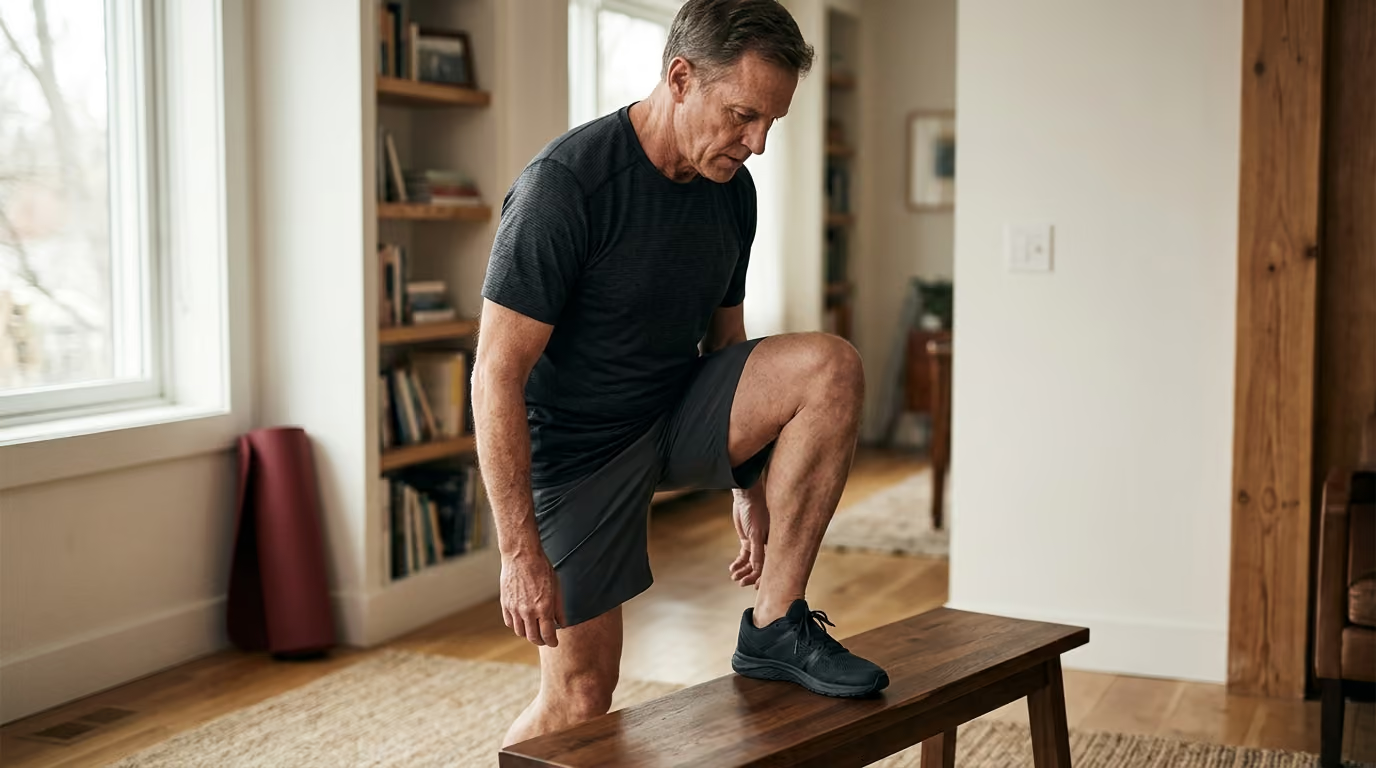
- Hip Internal and External Rotation: Maintaining rotation in both hips is vital for backswing depth and follow-through clearance. Seated 90-90 hip transitions, half-kneeling hip flexor mobilizations with rotation, and adductor rock-backs improve joint capsule freedom.
- Ankle Dorsiflexion: Stiff ankles restrict weight transfer and knee tracking during the swing. Wall ankle mobilizations and calf stretches maintain the lower-leg compliance needed for solid ground interaction on uneven lies.
Strength and Motor Control
Strength training creates the structure needed to protect joints and transmit rotational force. Incorporating fundamental strength and muscle maintenance protects connective tissues from repetitive swing stress.
- Lower-Body Support: Split squats, step-ups, single-leg Romanian deadlifts, and lateral lunges strengthen the quadriceps, gluteus medius, and hip rotators. These movements build the single-leg strength needed to resist sway and maintain posture.
- Trunk Stability and Anti-Rotation: Traditional sit-ups do little for golf performance. The trunk needs the ability to transfer force while resisting unwanted movement. Cable or resistance-band Paloff presses, side planks, bird-dogs, and controlled cable chops train the core to stabilize the spine during rapid rotation.
- Upper Body and Scapular Control: The shoulder complex requires stability to manage the club at the top of the swing and through impact. Face pulls, dumbbell rows, push-ups with scapular protraction, and external rotation drills build the rotator cuff and upper-back endurance needed to prevent shoulder impingement.
Balance and Force Transfer
Balance training connects joint mobility with functional stability. A golfer must be able to shift pressure smoothly between the feet while maintaining posture.
- Single-Leg Stance Drills: Standing on one leg while rotating the head or moving the arms challenges the vestibular and proprioceptive systems. Progressing to a slightly soft or uneven surface improves foot and ankle reactivity.
- Split-Stance Rotations: Holding a lunge or split-stance position while rotating a light medicine ball or resistance band trains the body to turn the torso over a stable lower base.
- Dynamic Step-and-Hold: Stepping laterally onto the lead leg and immediately freezing in balance mimics the deceleration and control required at the finish of a full swing.
Rotational Power and Speed
Power is the ability to exert force quickly. Power can be safely trained once basic movement quality and strength are established.
- Medicine Ball Throws: Rotational chest passes and side throws against a solid wall train the body to push through the floor, turn the hips, and release energy through the upper body. Light medicine balls weighing 4 to 8 pounds are ideal for older golfers.
- Band-Assisted Acceleration: Rapid band rotations focus on movement speed rather than heavy resistance. This trains the nervous system to recruit motor units quickly during the downswing.
- Controlled Deceleration Drills: Practicing fast swings that stop instantly at the finish trains the eccentric strength of the lead-side hip and trunk muscles, building joint protection during high-speed swings.
Illustrative Training Models
Consider three illustrative models demonstrating how golfers can structure their routines based on their primary physical needs.
Model 1: The Hip-Restricted Player
- Profile: An amateur golfer over 50 reports feeling tight at the top of the backswing. He compensates by lifting his arms and sliding his hips laterally.
- Program Focus: Hip internal rotation, pelvic control, and single-leg strength.
- Key Drills: Half-kneeling hip turns, 90-90 hip switches, split squats, and single-leg Romanian deadlifts.
- Intended Outcome: Improve usable hip clearance, reduce sway, and create a smoother turn without lumbar extension.
Model 2: The Thoracic-Stiff Player
- Profile: A golfer over 55 spends long hours at a desk. He exhibits rounded shoulders, reduced upper-body turn, and occasional lower back tightness after playing 18 holes.
- Program Focus: Thoracic extension, rotational mobility, and scapular strength.
- Key Drills: Foam roller thoracic extensions, quadruped reach-and-rotates, face pulls, and cable anti-rotation presses.
- Intended Outcome: Restore chest and mid-back rotation, allowing the golfer to maintain posture through the swing.
Model 3: The Unstable High-Speed Player
- Profile: A seasoned golfer retains good swing speed but loses balance during the follow-through, often falling backward or finishing off-target.
- Program Focus: Deceleration capacity, foot pressure transfer, and single-leg stability.
- Key Drills: Lateral step-and-stick jumps, rotational medicine ball throws with held finishes, and single-leg balance reaches.
- Intended Outcome: Improve braking mechanics, stabilize the finish position, and increase ball-striking consistency.
Common Misreadings in Golf Fitness
Several widespread ideas regarding golf training after 45 are not supported by the evidence. Clearing up these misconceptions helps golfers focus on what truly works.
Misreading 1: A Bigger Turn Always Generates More Speed
A common belief is that increasing the size of the backswing will automatically produce longer drives. Golfers often force their shoulders and hips into extreme ranges to copy younger touring professionals.
Research indicates that excessive backswing length often leads to compensatory movements. When players exceed their controlled range of motion, they frequently lose spinal posture, extend the lower back, or flare their ribs. These compensations disrupt swing sequencing, reduce clubhead speed, and increase shearing stress on the spine. A compact, controlled backswing with solid sequencing and balance almost always produces better energy transfer and fewer injuries.
Misreading 2: Hip Tightness Requires Only Static Stretching
When golfers feel tightness in their hips, their immediate reaction is often aggressive static stretching. They spend twenty minutes holding pigeon poses or quad stretches before playing.
Passive stretching alone does not build the dynamic stability required during a golf swing. A golfer may have adequate passive range while lying on the floor, yet completely lack the strength to stabilize that range when standing. Hip tightness is often a protective response by the nervous system when surrounding muscles lack strength. Combining mobility work with active strengthening exercises, such as split squats and glute bridges, provides lasting joint control.
Misreading 3: Specific Swing Flaws Directly Cause Back Pain
Instructional media often claims that specific swing flaws, such as a reverse spine angle or early extension, are the sole cause of lower back pain.
A comprehensive systematic review of risk factors for golf-related back pain found no definitive evidence linking specific swing mechanics directly to injury. Pain is multifactorial. Age, body mass index, overall training volume, sleep quality, prior injuries, and general conditioning play massive roles. Improving swing mechanics is valuable for ball striking, but reducing pain requires managing total playing load and building general tissue capacity alongside technique work.
Misreading 4: The Spine Should Remain Rigid During the Swing
Many core workouts for golfers focus entirely on rigid stability, encouraging players to lock their torso to protect their back.
The spine is designed to move, rotate, and absorb force. Golf requires a combination of controlled movement and selective resistance to movement. The thoracic spine must rotate and extend, while the lumbar spine stabilizes and transfers force. Locking the trunk into a rigid block prevents natural movement distribution, placing unnatural stress on the hips, knees, and shoulders. Training should build active control through a safe range of motion rather than complete stiffness.
Limitations in Current Golf Science
While existing golf biomechanics research offers helpful insights, several clear gaps remain in the scientific literature. Golfers and trainers should recognize where the evidence is limited.
Much of the published literature relies on cross-sectional studies. In these studies, researchers measure a group of golfers at a single point in time. While this identifies differences between younger and older players, it cannot prove cause and effect. A cross-sectional study can show that older golfers have less trunk flexion during a driver swing, but it cannot prove that age alone caused the change, or that changing this angle will prevent pain.
Many biomechanical studies feature small sample sizes. Experiments often evaluate between 15 and 30 participants, frequently consisting of skilled, competitive male players. These findings may not fully apply to recreational golfers, higher-handicap players, or female golfers over 45. Biomechanical studies also frequently use laboratory environments with reflective markers and artificial mats, which differ substantially from real-world turf, varied lies, and changing weather conditions.
Injury research in golf also presents methodological challenges. Definitions of what constitutes an injury vary widely across studies. Some researchers define an injury as any physical complaint that stops play, while others count any mild soreness lasting longer than 24 hours. A systematic review of injuries in professional golfers noted that few published studies met high-quality research standards, with none scoring above 50 percent on formal quality-assessment criteria. Prospective studies that track large groups of mature golfers over several seasons are needed to establish clear risk factors.
Finally, commercial fitness systems frequently make broad claims regarding specific joint angles and power generation. Many swing-training devices claim to unlock rotational power through proprietary movement systems. These claims often rely on internal testing rather than independent, peer-reviewed science. Golfers should approach commercial claims with healthy skepticism, focusing on well-established principles of strength, mobility, and workload management aligned with healthy aging principles.
Long-Term Capacity and Joint Protection
Sustaining a consistent golf game into your fifties, sixties, and beyond depends on proactive joint protection and workload management. Golf is an asymmetrical sport that repeatedly stresses one side of the body. Smart training restores symmetry, strengthens vulnerable joints, and builds systemic endurance.
Workload management is an overlooked factor in joint health. Epidemiological research shows that amateur golfers who play more than three to four rounds per week experience higher injury rates. Hitting hundreds of balls on the range several days in a row without adequate recovery overloads connective tissues. Tendons and joint capsules adapt to mechanical stress slowly compared to muscle tissue. Structuring the week with dedicated rest days, alternating between heavy practice and light short-game work, allows tissues to rebuild.
Pre-round preparation also protects aging joints. Walking from the car directly to the first tee and swinging a driver aggressively increases injury risk. Cold, stiff tissues do not tolerate rapid rotational forces well. A dynamic warm-up lasting 8 to 10 minutes increases core body temperature, lubricates joint surfaces with synovial fluid, and primes the nervous system. Effective warm-up routines include arm circles, torso twists, bodyweight squats, leg swings, and progressive practice swings starting with a wedge.
Equipment adjustments provide another practical path to joint protection. Modern shaft technology offers lighter graphite options that reduce overall club weight and vibration. Softer grips and low-compression golf balls decrease the impact shock transmitted to the wrists, elbows, and shoulders. Adjusting club lie angles can also help older golfers maintain a comfortable address posture without placing unnecessary strain on the lower back. Exploring broad research guides for men can provide additional context on maintaining vitality across all sports.
Deceleration training is equally vital for long-term health. Most golf instruction focuses entirely on the backswing and downswing. The follow-through requires the lead hip, abdominal obliques, and trail shoulder to contract eccentrically to stop the club safely. If these muscles are weak, the joint capsules and spinal ligaments must absorb the stopping force. Training the body to slow down rotational force protects the spine from repetitive trauma at the end of the swing.
The Core Takeaway
Golf mobility after 45 is not about forcing your body into a youthful swing position. It is about building sufficient strength, balance, and usable rotation to swing comfortably and recover fully.
Actionable Weekly Next Steps
Implementing a balanced routine does not require endless hours. Consistency with basic exercises produces substantial long-term benefits. Here is an actionable checklist to apply this week:
- Conduct an honest workload audit: Track the total number of full swings, range sessions, and rounds you complete this week. If you play more than three times weekly and feel persistent joint aches, replace one range session with a low-impact walking or mobility day.
- Establish an 8-minute pre-round warm-up: Never hit a full driver without preparing your body. Spend five minutes performing bodyweight squats, arm circles, standing torso twists, and hip hinges before swinging your first club.
- Add two 20-minute strength sessions: Focus on the foundational movement patterns that support rotation. Include split squats, single-leg deadlifts, cable anti-rotation presses, and dumbbell rows twice a week.
- Perform daily thoracic and hip mobility work: Dedicate five minutes each morning or evening to open-book spinal rotations, 90-90 hip switches, and quadruped thoracic extensions to maintain joint freedom.
- Practice balanced swing finishes: During your next range session, take five swings at 70 percent speed. Hold your finish position perfectly balanced on your lead leg for three full seconds after each shot before moving.
- Evaluate your practice surface: Minimize high-volume driver and iron practice on hard, unyielding artificial mats. Seek out natural grass practice tees whenever possible to reduce shock on your wrists, elbows, and lower back.
- Consult a professional for persistent pain: If you experience sharp joint pain, numbness, or stiffness lasting longer than 48 hours after playing, consult a qualified physical therapist or sports physician rather than attempting to stretch through the discomfort.
Sources
- Upper Body Injuries in Golfers - PMC - NIH
- The epidemiology of golf-related injuries in Australian ...
- Golf‐related injuries: A systematic review - Cabri - Wiley Online Library
- Establishing normative flexibility values for the thoracic spine of competitive male South African golfers - PubMed
- Risk Factors Associated With Low Back Pain in Golfers: A Systematic Review and Meta-analysis - Jo Armour Smith, Andrew Hawkins, Marybeth Grant-Beuttler, Richard Beuttler, Szu-Ping Lee, 2018
- Physiotherapeutic effects of an innovative golf swing-assist ...
- Golf-Related Low Back Pain: A Review of Causative Factors and ...
- Risk Factors Associated With Low Back Pain in Golfers
- Systematic review of musculoskeletal injuries in professional golfers - PubMed
Stay sharp
Get the word
Join our newsletter for the best writing advice and stories from the field.