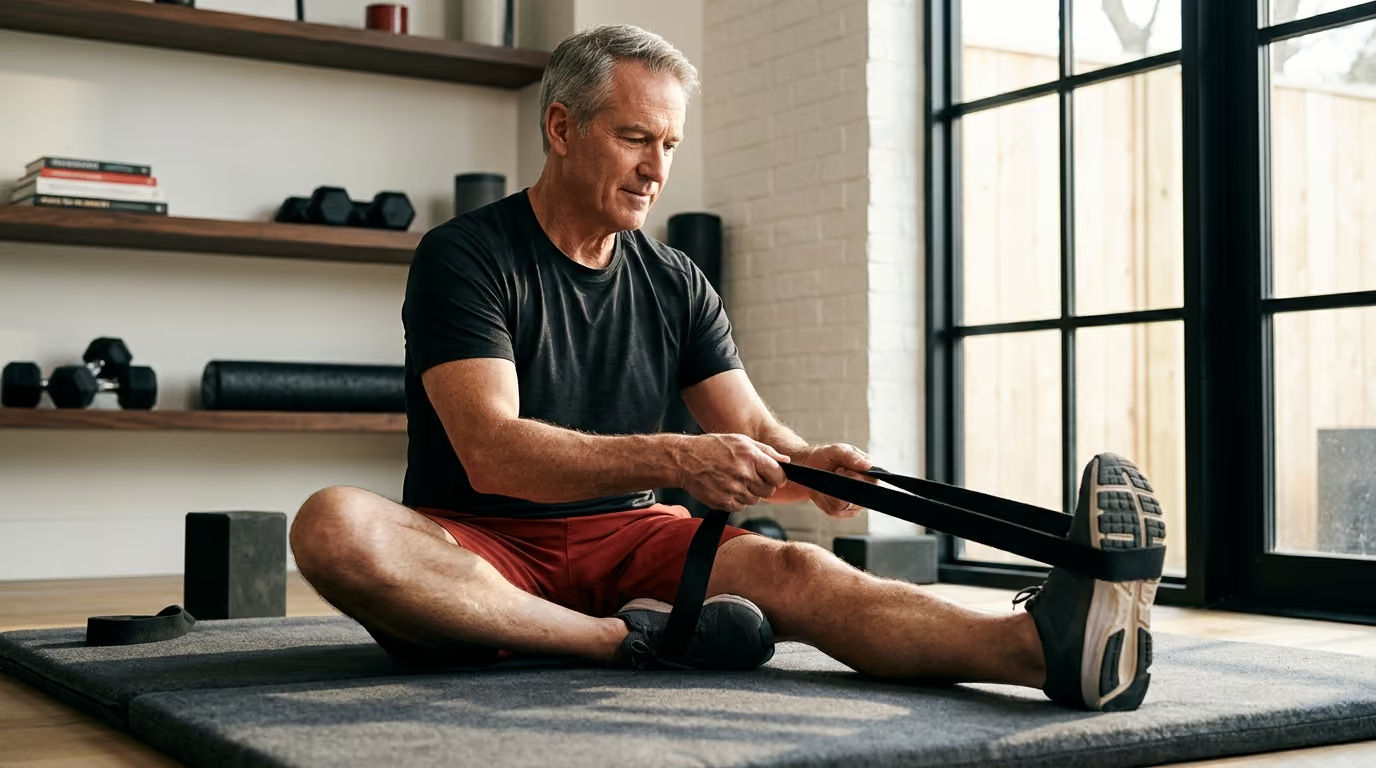
You are jogging down a familiar dirt trail or playing a friendly game of pickleball on a Saturday morning. A loose rock shifts under your shoe, or a sharp return lands two feet to your left. Your brain recognizes the problem instantly, but your body reacts a fraction of a second late. Your foot feels clumsy as it plants, your torso wobbles, and you lose your rhythm.
Most strength routines focus purely on forward and backward movement. Exercises like squats, deadlifts, running, and cycling build power in a straight line. Yet real physical capability demands the ability to push, stop, and redirect sideways.
Maintaining lateral strength and mobility allows you to stay durable, athletic, and agile as you age. Research shows that dynamic side-to-side control changes over time, but structured training can help you maintain high physical capability.
This guide breaks down what the science says about lateral movement, how hip mechanics change after 45, and how to train for real-world balance.
What the research shows about side-to-side movement
Laboratory studies show measurable differences in how younger and older adults handle sudden lateral changes. Much of this research evaluates adults in their late twenties against adults aged 65 and older. These findings highlight how the nervous system and muscular system adapt when forced to move sideways.
In one visual reaction study, researchers tested healthy young women with an average age of 27 against older women with an average age of 70. Participants walked on a track and received an unexpected visual cue to shift into an adjacent lane. The younger group executed the lane shift using a single rapid side-step in 58 percent of the trials. The older group completed the lane change in one step only 26 percent of the time.
The older participants frequently slowed down by an average of 3.3 percent to manage the turn. Younger walkers maintained their forward speed while stepping sideways. Older participants also showed a 22 percent rate of foot-placement errors after stepping, compared to just 3 percent in younger adults.
The issue is rarely an absolute inability to step sideways. The issue is redirecting body mass quickly, cleanly, and without losing forward momentum.
Other laboratory trials study lateral platform shifts that knock standing or marching participants off balance. When the ground moves sideways, healthy older adults use different movement strategies than younger adults. Older adults are far more likely to take multiple short, frantic steps or swing their arms to recover stability.
During marching tests, older adults experienced limb collisions between their swinging foot and stance leg in 55 percent of trials. Younger adults collided only 8 percent of the time. When you must cross one leg over the other under sudden pressure, coordination can break down if not practiced regularly.
Research on narrow pathways shows similar patterns. When the available walking path narrows, older adults spend significantly more neural effort making fine lateral corrections. They prioritize step width adjustments over speed to avoid falling.
When people perform mental tasks while stepping, balance ability dictates when errors occur. Dynamic lateral capability is not just about leg strength. It is an active combination of perception, balance, and rapid muscular reaction.
Why lateral mechanics change after 45
Physical changes in midlife happen gradually. Muscle tissue, connective tissue, and neural pathways undergo subtle shifts that alter how you produce side-to-side force. Normal aging is not a disease, but understanding these structural shifts helps you train smarter.
One primary factor is the decline in rate of force development within the hip abductor and adductor groups. The hip abductors, located on the outside of your hips, include the gluteus medius and minimus. The adductors run along your inner thighs. These muscle groups work together to keep your pelvis level when one foot leaves the ground.
Research demonstrates that the speed of force production in these muscles drops faster than basic slow-speed strength. You might retain enough strength to lift a heavy weight, but generating force in 100 milliseconds requires specific conditioning.
Muscle quality also changes across midlife. Studies comparing older adults who perform wide crossover recovery steps with those who take short medial steps show clear differences in hip torque. Those who struggle with crossover steps produce lower hip-abduction torque.
Tissue scans reveal that these differences often relate to intramuscular fat rather than a total loss of muscle size. When non-contractile tissue accumulates between muscle fibers, the muscle loses some of its snap. That lack of snap limits your ability to drive your leg outward and create a wide base of support.
Proprioception, which is your body's internal awareness of joint position, also shifts over time. When visual feedback is clear, your eyes help guide foot placement. When light is low, such as walking on an unlit path, your nervous system relies heavily on hip position sense.
Research indicates that hip position awareness correlates directly with lateral balance control under low-vision conditions. If your hips and ankles lack clear sensory feedback, your foot placement becomes tentative and irregular.
Core stiffness and spinal control represent the final mechanical piece. When you cut to the right, your right leg pushes the ground away, and your torso must resist collapsing outward. If your trunk tilts excessively, your center of mass shifts past your base of support. Controlling lateral momentum requires your trunk muscles, hips, and ankles to act as a unified braking system.
What changes in lateral capability mean for daily life and recreation
Losing lateral responsiveness changes how you interact with the physical world. The consequences show up in recreation, outdoor sports, and basic daily tasks.
Recreational court sports place heavy demands on your ability to change direction. Tennis, pickleball, basketball, and squash require constant lateral shuffles, sudden cuts, and rapid recovery steps. When your side-to-side capacity drops, your court coverage shrinks.
You may find yourself hesitating before chasing a wide ball because your feet feel glued to the floor. If you try to force a sharp change of direction without adequate lateral conditioning, your knees and lower back absorb the braking forces instead of your hips.
Hiking, trail running, and outdoor walking also demand consistent lateral adjustments. Natural trails are never flat or straight. You must step around roots, navigate loose gravel, and step across muddy patches without breaking stride.
If your lateral balance is sluggish, stepping sideways on a slope creates instability. You spend extra mental energy watching every footfall, which causes fatigue and makes outdoor activities less enjoyable.
Real-world environments require sudden reactions. Moving through a crowded airport, stepping off a moving curb, dodging an enthusiastic dog on a leash, or walking across a slick bathroom floor all require rapid sideways adjustments.
When straight-line strength is your only athletic outlet, your nervous system lacks the coordination to handle these offset forces. Building dynamic side-to-side movement restores physical confidence across every environment you navigate.
For a deeper look into foundational physical capacity, read our resource on strength muscle physical performance.
Core physical components of side-to-side control
Developing reliable lateral capability requires targeting several distinct physical qualities. Focusing on just one muscle or a single exercise does not build complete real-world capability.
Frontal-plane hip strength
The frontal plane divides the body into front and back halves, encompassing all side-to-side movements. Frontal-plane strength requires balanced development between your outer hip abductors and inner hip adductors.
Your hip abductors pull your leg away from the midline, while your adductors pull it inward. During dynamic movement, both muscle groups contract simultaneously to stabilize your pelvis over your standing leg.
If your adductors are weak or tight, your hip abductors cannot stabilize the pelvis efficiently. True lateral strength requires strengthening both sides of the hip joint through complete ranges of motion.
Rate of force development and explosive power
Power represents the intersection of force and speed. In real movement, you rarely have several seconds to build muscular tension. When your foot slips on wet grass, you have a fraction of a second to plant the other foot and catch your weight.
Research shows that power-oriented training for the hip abductors and adductors improves weight-transfer control during balance recovery. Training your muscles to fire with intent teaches your nervous system to recruit motor units instantly.
This explosive capacity allows you to plant hard, push off, and redirect your momentum without sluggish transitions.
Ankle eversion, inversion, and foot stability
Your hips generate and absorb large lateral forces, but your feet and ankles make direct contact with the ground. Side-to-side agility requires strong lateral ankle stability, specifically the ability to handle inversion and eversion.
Inversion occurs when the sole of the foot turns inward, while eversion occurs when it turns outward. If your ankles are stiff or weak, lateral ground forces transfer upward into the knee joint.
Strong foot arches and mobile ankles allow your lower leg to conform to uneven surfaces while maintaining a solid base of support.
Multi-directional trunk stiffness
When your lower body pushes sideways, your spine and pelvis must transfer those forces efficiently. If your core muscles are lax, your upper body continues drifting in the original direction while your legs try to move elsewhere.
This disconnect places high shearing stress on the lumbar spine. Building multi-directional core stiffness trains your obliques, quadratus lumborum, and deep spinal stabilizers to brace against unexpected lateral forces.
For practical guidance on joint health, explore our guide to mobility recovery.
A four-tier progressive framework for lateral training
To build dynamic lateral capability safely, use a structured progression. Jumping straight into intense lateral cutting drills can irritate the knees or hips if you lack baseline capacity.
This four-tier framework moves from foundational strength to reactive, real-world agility.
Tier 1: Building the force base
The first tier develops basic muscular strength and joint stability in the frontal plane. The goal is building capacity in the hips, thighs, and trunk under controlled, predictable conditions.
Key exercise variations for this stage include:
- Lateral Lunges: Step out to the side, sit your hips back, and keep the trailing leg straight. Push through the heel of the bent leg to return to the center. This builds single-leg strength, adductor flexibility, and abductor force.
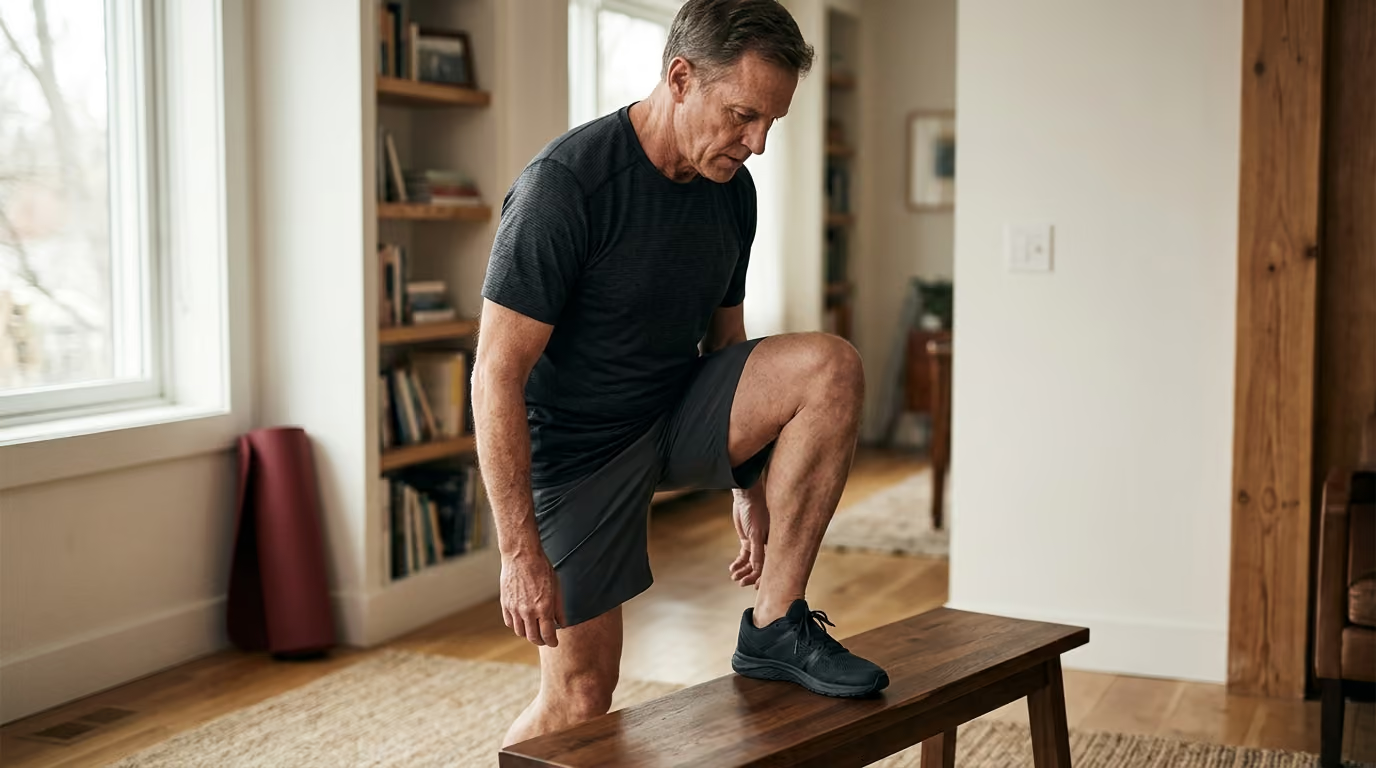
- Controlled Step-Ups with a Lateral Bias: Step laterally onto an elevated box or bench, driving through the hip to stand tall. Control the descent over two to three seconds.
- Copenhagen Planks: Lie on your side with your top foot elevated on a bench and your bottom leg hovering underneath. Hold this position to build adductor strength and lateral core stiffness.
- Standing Cable or Band Hip Abductions: Stand tall on one leg while driving the opposite leg outward against light resistance, keeping your pelvis level.
Perform these movements with deliberate tempo, focusing on joint alignment, smooth control, and a full range of motion.
Tier 2: Developing rapid force and power
Once you establish a solid strength base, introduce exercises that demand faster force production. The focus shifts from moving heavy loads to moving moderate loads with speed and intent.
Effective power drills include:
- Lateral Speed Skater Jumps: Stand on your right foot, push off laterally to land softly on your left foot, and stick the landing. Absorb the force by bending your hip and knee before bounding back.
- Explosive Lateral Step-Ups: Using a low platform, drive up powerfully from the side, achieving full hip extension at the top before stepping down cleanly.
- Medicine Ball Lateral Slams: Stand perpendicular to a solid wall, rotate, and drive a non-bouncing medicine ball laterally into the ground or wall using your hips.
- Short-Distance Lateral Shuffles: Perform quick five-yard shuffles from left to right, focusing on low center-of-mass control and rapid foot push-offs.
Keep repetitions low and rest periods adequate so that every repetition remains explosive and sharp.
Tier 3: Stepping mechanics and controlled redirection
Tier 3 bridges the gap between isolated power and athletic movement. In this tier, you practice structured deceleration, directional changes, and precise foot placement.
Practical drills include:
- The Lateral Deceleration Cut: Jog forward three steps, plant your outside foot at a 45-degree angle, lower your hips, absorb the momentum, and push off into a lateral shuffle.
- Crossover Stepping Drills: Walk laterally by crossing your back foot over the front foot, then stepping out with the lead foot. Practice this slowly along a straight line to build coordination and prevent foot collisions.
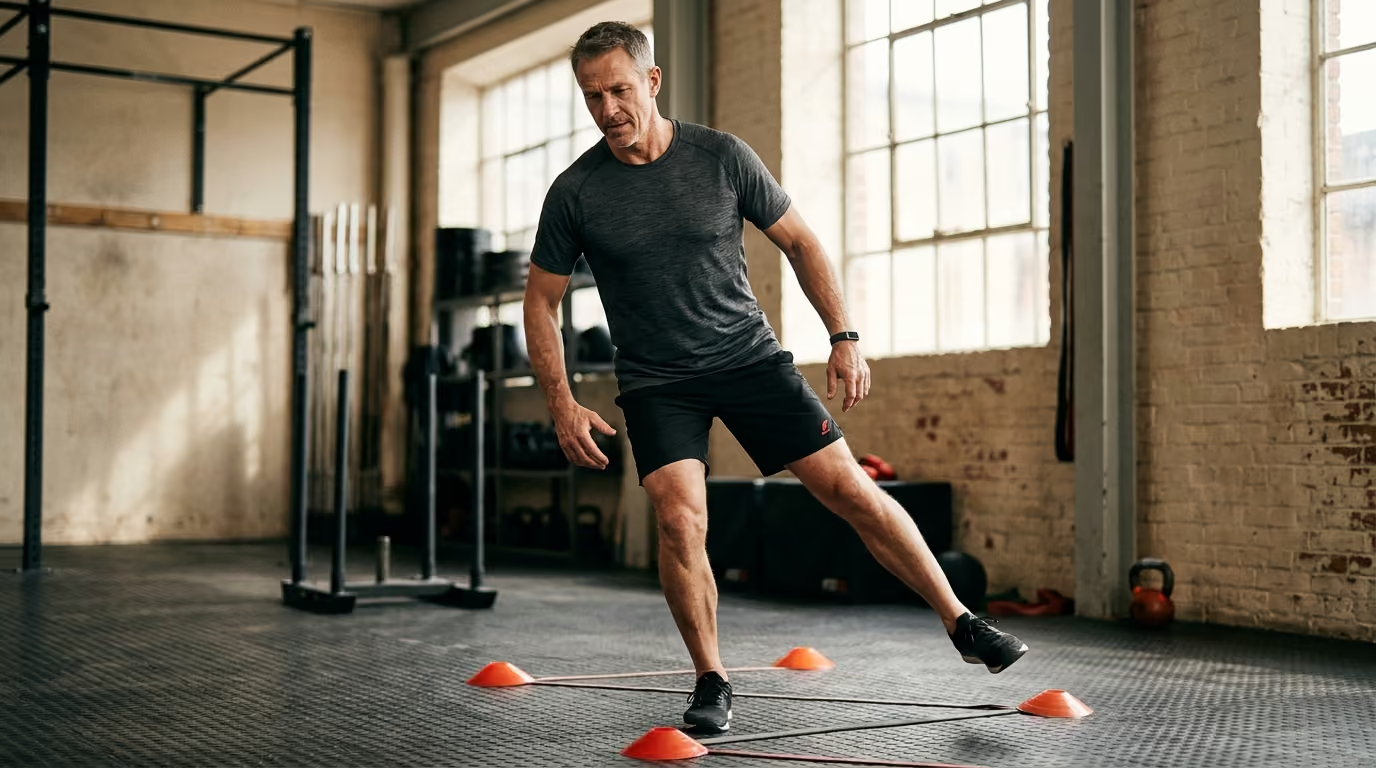
- Figure-Eight Shuffles: Set two cones five yards apart and shuffle in a figure-eight pattern. This teaches continuous weight transitions between inside and outside edges of your feet.
- Mirror Drills: Face a training partner who moves side to side at varying speeds. Match their lateral movements while maintaining a balanced, athletic posture.
Pay close attention to your trunk angle. Keep your torso upright and your center of mass inside your base of support during cuts.
Tier 4: Reactive balance and environmental challenges
The final tier introduces unpredictability. Real life and sport do not come with pre-planned cones or warning signals. You must perceive a stimulus, make a decision, and execute a movement simultaneously.
Advanced integration drills include:
- Externally Cued Direction Changes: Shuffle in place and have a partner point left or right, or call out colors associated with different cones. React instantly without false stepping.
- Uneven Surface Traverses: Practice lateral stepping, shuffling, and balancing across grass, sand, or trail terrain. This refines ankle proprioception and sensory feedback.
- Narrow Path Stepping: Walk along a marked narrow line, inserting sudden sideways steps off the line and back on without losing stride or balance.
- Supervised Perturbation Drills: Under the guidance of a qualified coach or physical therapist, practice recovering balance from light, unexpected pushes at the hips or shoulders.
To learn more about total-body conditioning, check our resource on strength muscle.
Common mistakes in side-to-side training
Many active men recognize the importance of lateral movement but approach it with ineffective methods. Avoiding these common mistakes will save you time and protect your joints.
Relying solely on light resistance band walks
Mini-band lateral walks around the ankles or knees are popular warm-up exercises. While they help activate the gluteus medius, they provide minimal overall conditioning.
A light resistance band does not produce high force, build rapid deceleration capacity, or challenge your dynamic balance. Resistance band walks are a warm-up tool, not a complete lateral training program.
Assuming straight-line strength transfers completely
Heavy back squats, leg presses, and deadlifts build lower-body strength. However, research confirms that maximal straight-line strength does not guarantee dynamic lateral stability.
A study of middle-aged adults found that maximal hip-abduction strength showed no direct correlation with dynamic balance scores. You can possess strong legs while remaining uncoordinated when forced to change direction quickly.
Multi-directional stability requires training movement patterns, not just muscle size.
Ignoring deceleration and braking mechanics
Most people focus on the push-off phase of lateral movement because it feels athletic and powerful. However, joint injuries and balance losses usually occur during the braking phase.
When you cut hard, your quadriceps, glutes, and adductors must work eccentrically to slow down your moving body weight. If you do not condition your muscles to absorb force, your knee ligaments and lower back bear the load.
Always spend time practicing the plant, absorption, and stick phase of lateral jumps and cuts.
Neglecting visual and cognitive processing
In laboratory settings, older adults struggle most when visual input is limited or when performing secondary mental tasks. Training lateral movement in complete isolation while staring straight into a mirror leaves out the sensory component.
Incorporate drills that require looking around, reacting to visual cues, or navigating complex environments. Training your eyes and brain alongside your hips builds functional resilience.
Review our dedicated section on mobility joints functional movement for more movement strategies.
Where the evidence is limited
A responsible look at the science requires acknowledging what researchers do not yet know. Honest appraisal prevents overpromising and helps you make practical decisions.
First, direct long-term data on adults aged 45 to 64 is limited. Most motor control and balance studies compare young university students aged 20 to 30 with older adults aged 68 to 80.
Researchers frequently assume that middle-aged adults sit linearly between these two groups. However, longitudinal studies tracking movement changes continuously from age 45 through 65 are scarce.
We should avoid assuming that data from an 80-year-old in a clinical balance trial applies identically to a fit 52-year-old.
Second, the debate between maximal strength and explosive power training remains open. Some trials show that high-speed power training produces superior balance recovery outcomes compared to traditional slow lifting.
Other trials show equivalent improvements from both methods once total training volume matches. The scientific literature confirms that both strength and rapid force matter, but no single protocol has emerged as universally superior.
Third, there is no standardized test for lateral agility in recreational middle-aged athletes. While researchers use force plates and motion-capture cameras in laboratory settings, these tools are impractical for everyday use.
Field tests like the Y-Balance Test or side-shuttle drills offer practical feedback, but they do not capture every element of real-world agility.
Finally, while commercial programs claim specific exercises prevent sports injuries or eliminate fall risks entirely, the evidence is more nuanced. Multicomponent training consistently reduces injury and fall rates across large populations.
However, no individual exercise provides complete immunity from injury on the sports court or trail.
Practical programming guidelines for your weekly routine
Integrating lateral work into your existing fitness routine does not require redesigning your entire training schedule. Adding a few focused exercises each week makes a noticeable difference in side-to-side stability.
The Weekly Training Structure
Follow public health guidelines from the World Health Organization and the CDC, which recommend multicomponent balance, functional, and resistance training multiple days per week.
Here is how you can organize lateral movements across a typical week:
Session Structure and Exercise Integration
1. Movement Preparation (5 to 8 minutes before workouts)
Use your warm-up window to stimulate neural pathways and prepare the joints for side-to-side forces.
- Ankle Rockers and Circles: 10 slow circles per foot to mobilize the joints.
- Lateral Adductor Rockers: 8 repetitions per side, rocking back onto the heels from a half-kneeling stance.
- Light Lateral Band Shuffles: 2 sets of 10 yards in each direction with a focus on level hips.
2. Primary Strength Work (2 to 3 days per week)
Include one dedicated frontal-plane strength exercise during your lower-body workouts.
- Lateral Goblet Squats: 3 sets of 8 to 10 repetitions per leg using a moderate dumbbell.
- Copenhagen Plank Holds: 3 sets of 15 to 25 seconds per side.
- Single-Leg Lateral Step-Ups: 3 sets of 8 repetitions per leg on a 12-inch box.
3. Power and Agility Drills (1 to 2 days per week)
Perform these drills at the start of your workout when your central nervous system is fresh.
- Lateral Skater Hops: 3 sets of 5 jumps per side, focusing on sticking the landing for 2 seconds.
- Cone Shuffles with Deceleration: 4 sets of 5-yard out-and-back shuffles at 80 percent effort.
4. Real-World Application
Spend time outside the gym using your lateral movement in unstructured settings.
- Play a weekly game of tennis, pickleball, or basketball.
- Hike on natural trails with varying terrain and uneven footing.
- Practice short visual reaction drills on open grass.
Track your movement quality rather than rushing through the exercises. Clean foot placement, level hips, and smooth stops matter far more than moving heavy loads with poor mechanics.
Summary and practical takeaways
Maintaining lateral strength, balance, and mobility after 45 requires training beyond straight-line movements. Side-to-side capability relies on a coordinated combination of hip force, rapid reaction time, trunk stability, and visual processing.
By practicing controlled frontal-plane strength, explosive power, and reactive agility drills, you can protect your joints and preserve your athletic freedom for decades to come.
When to revisit this resource
Review this guide whenever you prepare for a new sports season, notice hesitation when moving on uneven trails, or find your straight-line gym workouts are leaving you feeling stiff in multi-directional movement.
Consistent attention to lateral movement keeps you resilient, agile, and prepared for whatever physical challenges come your way.
Sources
- Systematic Review of the Importance of Hip Muscle Strength ...
- Relationship between hip abductor rate of force development and mediolateral stability in older adults - PubMed
- Low-dose hip abductor-adductor power training improves ...
- Hip Muscle Power, Lateral Balance Function, and Falls in Aging
- Evaluation of hip abductor and adductor strength in the elderly
- HIP ABDUCTOR EXERCISE AND LATERAL STABILITY IN OLDER ADULTS ... : Journal of Geriatric Physical Therapy
- Hip abductor neuromuscular capacity: A limiting factor in mediolateral balance control in older adults? - PubMed
- The effect of unilateral muscle fatigue of hip abductor muscles on ...
- Effects of aging on hip abductor-adductor neuromuscular and ...
- Role of Hip Abductor Muscle Composition and Torque in ...
- Motor and Physical Function Impairments in Middle-Aged and Older Adults in the Baltimore Longitudinal Study of Aging
- Low-dose hip abductor-adductor power training improves neuromechanical weight-transfer control during lateral balance recovery in older adults
Stay sharp
Get the word
Join our newsletter for the best writing advice and stories from the field.