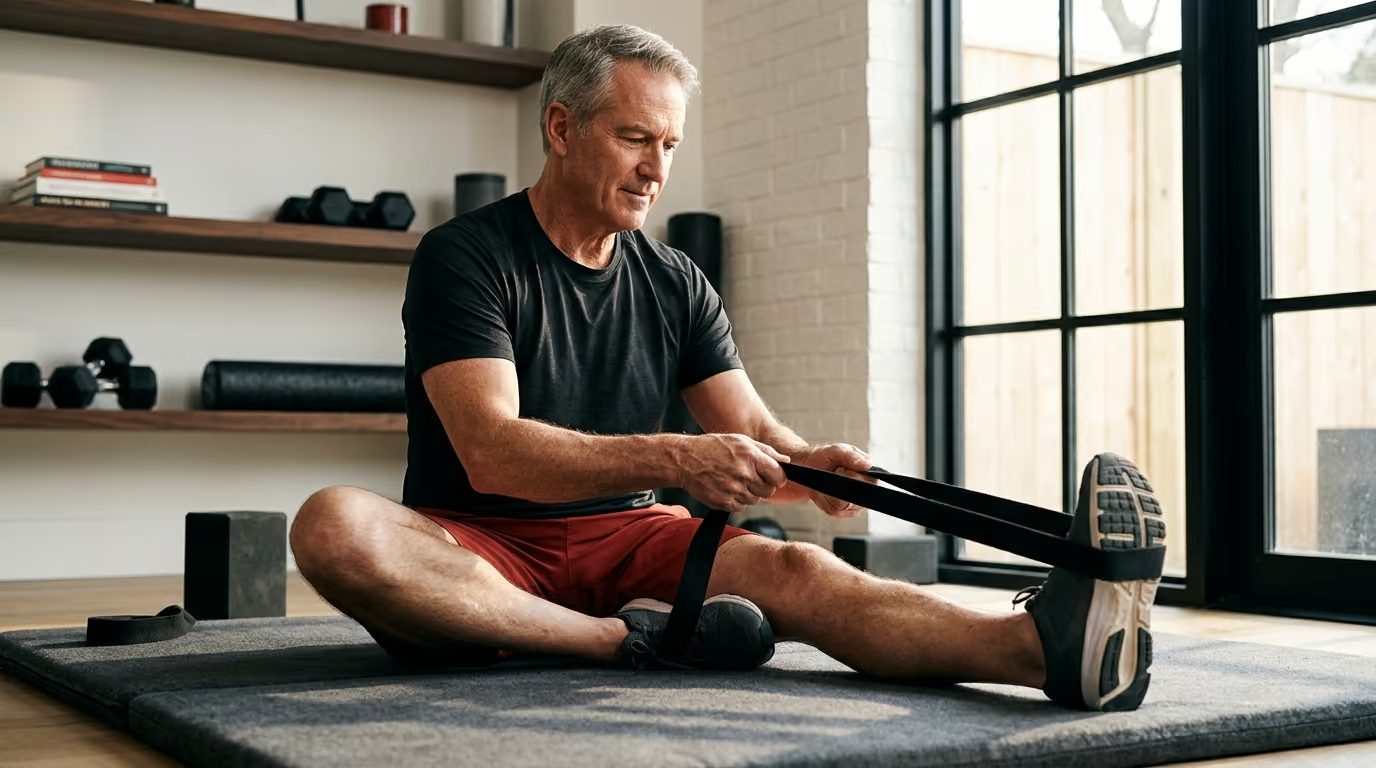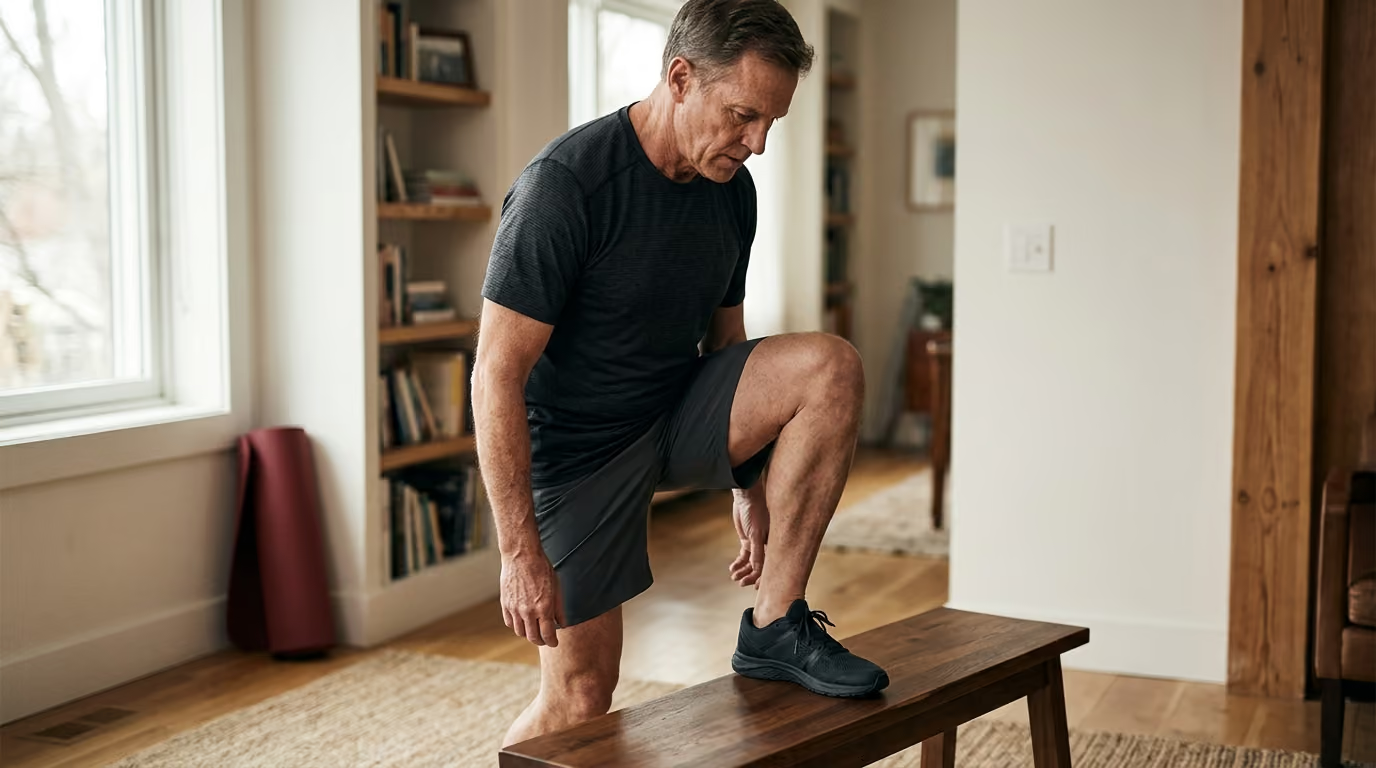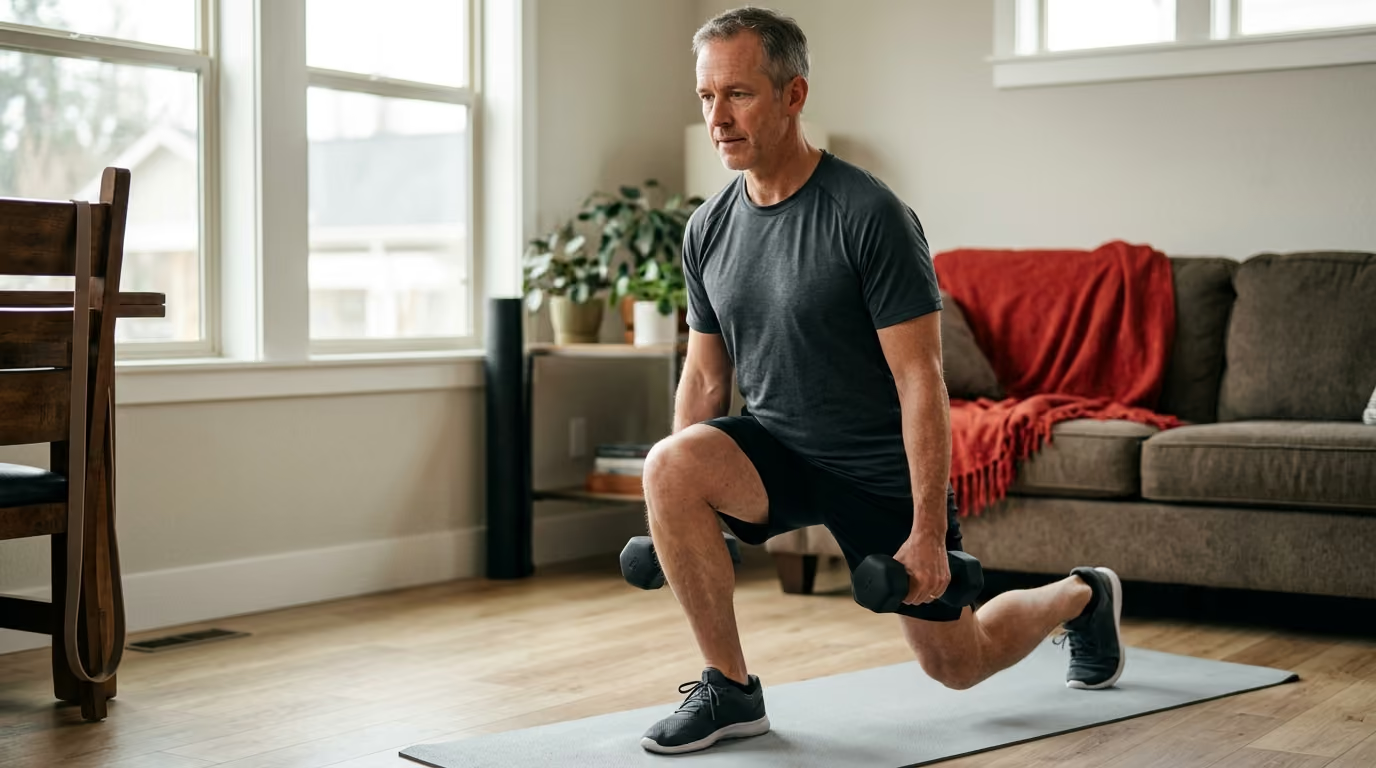
You wake up, swing your legs out of bed, and feel a deep ache in your knees. Perhaps your lower back complains when you bend down to tie your shoes. Maybe your shoulder throbs after an upper body workout that never used to bother you.
Many men over 45 search online for phrases like "stiff joints after lifting" or "how to train around joint pain." They wonder if their joints are wearing out or if they must stop lifting weights, running, or playing sports.
The definitive answer is that you do not need to settle for inactivity. Your joints are living structures that adapt to mechanical stress when given the right dose.
Managing joint health after midlife comes down to understanding load management. This resource explains the science of joint loading, tissue capacity, symptom tracking, and structured progression. It provides a clear roadmap to keep you strong, active, and capable for decades.
The Reality of Joint Tolerance and Training Load
Load management means adjusting the mechanical and metabolic stress placed on your body relative to your current capacity to recover. Load is not just the weight on a barbell. It includes repetitions, total weekly volume, movement speed, joint angles, impact forces, and recovery intervals.
Current clinical guidelines for joint health strongly recommend exercise over rest. Research on joint conditions such as knee and hip osteoarthritis shows that strengthening and low-impact aerobic exercise reduce pain and improve physical function. Major clinical groups like the American Academy of Orthopaedic Surgeons and the National Institute for Health and Care Excellence emphasize physical activity as a core intervention rather than advising people to stop moving.
- TRAINING STRESS vs. TISSUE CAPACITY
- Training Stress Current Tissue Capacity
- Leads to joint irritation, flares, breakdown
- Training Stress Matched to Tissue Capacity
- Stimulates tissue repair, builds joint strength
- Training Stress Minimum Stimulus Needed
- Causes deconditioning, decreases joint tolerance
Data shows that arthritis prevalence rises with age. It climbs from 3.6 percent in younger adults to more than 50 percent in adults aged 75 and older. However, joint stiffness after 45 is not an automatic diagnosis of severe joint disease. Age alone does not dictate whether you can squat, press, hike, or run.
Symptoms reflect an imbalance between the stress you apply and what your tissues can currently handle. When training load exceeds tissue tolerance, joints become irritable. When you match the training dose to your current physical baseline, your body adapts.
Systematic reviews demonstrate the value of this approach. In reviews examining resistance training for knee osteoarthritis, the vast majority of included trials show marked improvements in pain and mobility. Regular physical activity builds muscle support around the joints, improves cartilage nutrient delivery, and preserves function.
You can read more about structured training in our strength and muscle resources for older adults.
Tissue Capacity Changes and Mechanical Stress After Midlife
Joint tissues change as the body moves past age 45. Cartilage undergoes shifts in water content and proteoglycan composition. Tendons and ligaments experience changes in collagen structure, which reduces their elasticity.
These biological shifts are normal parts of the aging process. They do not mean your joints are crumbling, but they do change how tissues respond to mechanical force. Tendons absorb and release energy slightly slower than they did at 25. Cartilage requires consistent, moderate pressure to circulate synovial fluid and stay nourished.
Recovery timelines also lengthen after midlife. Muscle protein synthesis rates and connective tissue repair require slightly more time following hard training sessions. If you repeat intense training days without adequate recovery, micro-stress accumulates faster than tissue remodeling can occur.
- THE JOINT NOURISHMENT CYCLE
- Controlled Movement & Load
- Compresses Joint Cartilage
- Stronger, More Resilient Joint
- Synovial Fluid Exchange
Metabolic and systemic factors play a role as well. Changes in sleep quality, insulin sensitivity, and everyday stress affect systemic inflammation. When lifestyle stress is high, joint tissues are less tolerant of sudden training spikes.
Understanding these mechanisms helps remove the fear of movement. Your joints require mechanical load to maintain their strength. The goal after 45 is to apply that load in a way that respects tissue turnover rates.
The Core Variables of Movement Stress
When a joint feels stiff or irritable, the standard reaction is to stop exercising entirely. A better approach modifies one or more training variables.
You have several distinct levers to adjust training stress. Changing these variables allows you to continue training while reducing joint irritation.
- THE 8 TRAINING LOAD LEVERS
- 1. VOLUME - Sets, reps, total distance, weekly duration
- 2. INTENSITY - Weight, percentage of maximum, movement effort
- 3. FREQUENCY - Sessions per week, consecutive training days
- 4. DENSITY - Rest periods between sets and training blocks
- 5. RANGE OF MOTION - Joint depth, end-range flexion or extension
- 6. RATE OF LOADING - Speed of movement, impact, plyometric force
- 7. SPECIFICITY - Movement pattern and equipment selection
- 8. CONTEXT - Sleep, recovery, footwear, stress levels
Volume
Volume represents the total amount of work performed. This includes sets, repetitions, distance walked or run, and minutes of continuous exercise.
Volume is often the first variable to reduce during a period of joint irritation. Reducing three sets to two lowers cumulative tissue stress while preserving movement patterns.
National physical activity guidelines suggest 150 minutes of moderate aerobic activity and two strength sessions weekly for health benefits. Studies indicate that accumulating up to 10,000 steps daily does not accelerate joint degeneration in adults with mild to moderate joint issues. However, volume must always match your current conditioning level.
Intensity
Intensity refers to the magnitude of the stimulus. In the gym, it means the weight on the bar or the percentage of your one-repetition maximum. In conditioning, it means movement speed, hill gradient, or heart rate zone.
Heavy loads place higher compressive forces across joint surfaces. A 2024 meta-analysis found that moderate resistance training using 50 to 69 percent of one-repetition maximum produced favorable outcomes for knee pain and function. Moderate loads build strength without creating excessive joint strain.
Frequency
Frequency is the number of training exposures per week. It also includes how closely demanding sessions are scheduled.
Spacing workouts allows connective tissues time to complete their remodeling cycle. For example, moving from three lower body workouts to two distinct sessions can relieve accumulated joint stress.
The World Health Organization recommends strength training on at least two days per week. For older adults, adding balance and functional exercises on three days improves stability and physical capacity.
Density
Density is the amount of work completed within a specific timeframe. Short rest intervals increase fatigue, which can compromise technique and place unexpected torque on joints.
Lengthening rest periods between sets lowers density. This allows muscles to recover, maintains movement quality, and prevents joint irritation.
Range of Motion
Joint stress varies across different angles of movement. Deep knee flexion or end-range shoulder extension increases compressive forces on articular surfaces.
Modifying range of motion allows you to work muscles without provoking sensitive joint angles. Examples include box squats above parallel, floor presses, and elevated split squats. You can gradually rebuild full range as tissue capacity improves.
Rate of Loading
Rate of loading describes how quickly force is applied to tissues. Fast movements, jumping, sprinting, and sudden direction changes produce high peak forces.
Slow and controlled tempo allows for steady force distribution. Emphasizing a controlled eccentric phase and pausing briefly before reversing direction protects joints from rapid mechanical spikes.
Exercise Specificity
Different exercises place different demands on the same joint. A barbell back squat places different shearing and compressive forces on the knee compared to a leg press or goblet squat.
When a joint is sensitive, switch to variations that offer external support. Machines, cables, and dumbbells often allow for joint-friendly paths of motion.
Contextual Factors
Joint capacity fluctuates based on life factors outside the gym. Poor sleep, travel, occupational physical labor, and mental stress reduce your recovery capacity.
A training dose that feels easy when well-rested may trigger joint irritation during a stressful week. Good load management requires adjusting training when external recovery is compromised.
Response Monitoring and the 24-Hour Evaluation Method
Monitoring joint symptoms requires a systematic approach. Relying solely on how a joint feels during an exercise can be misleading. Cartilage and tendons often respond hours after training ends.
- THE 24-HOUR RESPONSE MONITORING MODEL
- TIME POINT 1: DURING TRAINING
- Assess comfort, stability, and movement mechanics
- Stop if sharp pain, catching, or form breakdown occurs
- TIME POINT 2: IMMEDIATELY AFTER (1-2 Hours)
- Check for warmth, swelling, or sudden stiffness
- TIME POINT 3: NEXT MORNING (24-Hour Check)
- Evaluate morning stiffness duration and joint mobility
- Confirm baseline function before applying new training stress
The Three-Phase Evaluation Timeline
A reliable monitoring system evaluates three specific time points:
- During the session: Mild discomfort is acceptable if it remains stable and does not cause you to limp or alter your form. Sharp, catching, or rapidly escalating pain means you must stop or modify the movement.
- Immediately post-session: Check for marked stiffness, warmth, or swelling within two hours of finishing.
- The next morning: The 24-hour response is the most reliable indicator of tissue tolerance. If morning stiffness lasts longer than 30 minutes, or if pain is higher than your baseline, the previous day's load exceeded current capacity.
The Traffic-Light System
Use this framework to guide your day-to-day training decisions:
- THE TRAFFIC LIGHT SYSTEM
- GREEN LIGHT
- Symptoms are mild or absent.
- Joint returns to baseline within 24 hours.
- Action: Maintain load or make a small progression.
- YELLOW LIGHT
- Morning stiffness is prolonged.
- Mild swelling or altered gait occurs.
- Action: Reduce one load variable or insert an active recovery day.
- RED LIGHT
- Significant swelling, joint locking, or severe pain.
- Inability to bear weight normally.
- Action: Stop aggravating activity and seek medical evaluation.
Green Light
- Symptoms are mild or absent during movement.
- Movement quality remains smooth and symmetrical.
- No swelling or instability occurs.
- The joint returns to baseline by the next morning.
- Action: Maintain your current training plan or make a small, planned progression.
Yellow Light
- Discomfort increases noticeably during the final sets.
- Morning stiffness the next day lasts longer than normal.
- You notice minor swelling or a slight change in your walking mechanics.
- Action: Do not progress load. Repeat the session with reduced volume, shorten the range of motion, or take an extra recovery day.
Red Light
- Severe or rapidly escalating joint pain occurs.
- Significant joint swelling develops.
- The joint catches, locks, or gives way.
- You cannot bear weight without limping.
- Symptoms follow a sudden acute trauma.
- Action: Stop the provocative exercise immediately. Consult a qualified healthcare professional for a formal assessment.
Learn more about tracking your recovery in our mobility and recovery section.
Exercise Selection and Structural Modification Strategies
Exercise selection is one of your most powerful tools for managing joint stress. The right exercises strengthen the muscles around the joint while keeping articular stress within a tolerable range.
- EXERCISE SELECTION HIERARCHY
- STAGE 1: ISOMETRIC HOLDS
- Static contractions, no joint movement, pain relief
- Examples: Wall sits, Spanish squats, glute bridges
- STAGE 2: SUPPORTED ISOTONIC MOVEMENTS
- Controlled tempo, partial range of motion, guided paths
- Examples: Box squats, incline dumbbell presses, cable rows
- STAGE 3: FULL RANGE COMPOUND LIFTS
- Free weights, multi-joint coordination, progressive overload
- Examples: Goblet squats, Romanian deadlifts, floor presses
- STAGE 4: DYNAMIC & IMPACT MOVEMENTS
- Faster velocity, jumping, running, multidirectional work
- Examples: Step-downs, trail hiking, jogging, sport drills
Strength Training Principles
Strength training builds force-absorbing capacity in muscles and tendons. When surrounding muscles are strong, they absorb shock that would otherwise transfer directly to joint cartilage.
Guidelines from the American Academy of Orthopaedic Surgeons support strength training for joint health. Useful categories include:
- Isometric contractions: Holding a static position against resistance creates muscle tension without joint movement. This helps build baseline strength and can reduce pain sensitivity.
- Controlled isotonic lifts: Movements like Romanian deadlifts, goblet squats, and split squats train muscles through a functional range. Use a controlled eccentric descent of two to three seconds.
- Machine-based work: Leg presses, chest-supported rows, and hamstring curls provide stability. They allow you to challenge muscles without demanding excessive joint stabilization.
- PRACTICAL EXERCISE MODIFICATIONS
- STANDARD EXERCISE JOINT-FRIENDLY ALTERNATIVE
- Barbell Back Squat Goblet Box Squat or Leg Press
- Barbell Bench Press Incline Dumbbell Press (Neutral Grip)
- Overhead Barbell Press Half-Kneeling Landmine Press
- Conventional Deadlift Trap Bar Deadlift (High Handles)
- Forward Walking Lunge Reverse Step-Up or Split Squat
Low-Impact Aerobic Conditioning
Cardiovascular exercise improves metabolic health, delivers nutrients to cartilage, and aids weight management. Aerobic work should challenge your cardiovascular system without overloading sensitive joints.
Clinical guidelines strongly endorse low-impact aerobic activity for joint comfort. Options include:
- Brisk walking: An effective, low-barrier activity. Adjust surface and footwear if joint sensitivity occurs.
- Stationary cycling: Delivers continuous, cyclical motion to knees and hips with minimal impact. Adjust seat height to avoid excessive knee flexion at the top of the pedal stroke.
- Rowing and elliptical training: Provide full-body aerobic conditioning while keeping ground reaction forces low.
- Aquatic exercise: Water provides buoyancy, which unloads body weight from the spine, hips, and knees while offering gentle resistance.
Mobility and Movement Prep
Mobility work for men over 45 should focus on active control rather than aggressive, passive stretching. Forcing an irritable joint into extreme ranges can aggravate joint capsules and surrounding tendons.
Focus on:
- Active joint rotations: Slow, controlled circles through the shoulders, hips, and ankles improve synovial fluid circulation.
- Light loaded mobility: Movements like goblet squat holds or Jefferson curls gently load tissues at end ranges.
- Dynamic warm-ups: Five to ten minutes of light cardiovascular work followed by bodyweight movement patterns prepares joint tissues for lifting.
Explore full functional movement guides in our mobility and functional movement resources.
Neuromuscular Control and Balance
Joint stiffness often alters your natural movement patterns. Over time, the brain adopts protective compensation strategies that place abnormal loads on other tissues.
Neuromuscular training restores balance, joint position awareness, and movement confidence. Effective exercises include:
- Single-leg balance drills: Standing on one leg while maintaining level hips trains foot, ankle, and hip stabilizers.
- Step-and-hold patterns: Stepping onto a low platform and stabilizing for two seconds trains deceleration control.
- Tandem stance and reaching: Reaching in various directions while maintaining a narrow base challenges hip and core coordination.
Deload Protocols and Flare Management
Even with smart programming, joint fatigue accumulates over time. A deload is a planned, temporary reduction in training stress that allows tissues to repair and adapt.
- PLANNED vs. REACTIVE DELOADS
- PLANNED DELOAD (Proactive)
- Scheduled every 4 to 8 weeks.
- Reduce total training volume by 40-50%.
- Maintain movement patterns, lower total fatigue.
- REACTIVE DELOAD (In Response to Symptoms)
- Triggered by persistent morning stiffness or a yellow/red response.
- Temporarily remove provocative exercises.
- Replace with low-impact aerobic work and active mobility.
Planned Deloads
A planned deload is scheduled before symptoms appear, typically every four to eight weeks.
During a planned deload:
- Reduce total sets per exercise by 40 to 50 percent.
- Keep the weights moderate, using roughly 60 to 70 percent of your normal working resistance.
- Maintain regular movement frequency to keep joints mobile.
- Focus on movement quality, technique, and recovery habits.
Reactive Deloads and Flares
A reactive deload happens when a joint flare occurs. Clinical definitions describe a flare as a temporary increase in pain, stiffness, or swelling that impairs normal function for at least 24 hours.
When a flare strikes, avoid the urge to stop moving completely. Total bed rest leads to rapid deconditioning, muscle loss, and increased stiffness.
Instead, follow this flare protocol:
- Unload the painful pattern: Temporarily remove the specific exercise that provoked the flare.
- Maintain gentle movement: Use pain-free walking, stationary cycling, or gentle pool exercise to encourage circulation.
- Preserve unaffected training: If your knee is irritated, continue training your upper body and core.
- Gradually reintroduce load: Once symptoms settle back to baseline, reintroduce the movement at 50 percent of previous volume and build up slowly.
Breaking the Boom-Bust Cycle
Many men over 45 fall into a destructive cycle:
- THE BOOM-BUST CYCLE
- Joint Feels Good
- Train Too Hard / Too Much
- Complete Rest & Loss of Strength
- Pain Flare & Frustration
- The joint feels good for a few weeks.
- Training volume and intensity are increased rapidly.
- Multiple demanding activities are stacked on the same weekend.
- A painful joint flare occurs.
- All exercise is halted for several weeks.
- Tissue capacity declines due to inactivity.
- The cycle begins again at an even lower baseline capacity.
Breaking this cycle requires pacing. When you have a day where your joints feel exceptional, do not double your workout volume. Stick to your planned training numbers and let tissue capacity build steadily over months.
Systematic Re-Exposure for Demanding Physical Activities
General gym strength does not automatically prepare your joints for high-impact or complex movements. Running, jumping, trail hiking, and racquet sports impose rapid loading rates that require specific adaptation.
- 7-STAGE GRADUAL RE-EXPOSURE FRAMEWORK
- STAGE 1: Daily Function (Normal walking, stairs, household tasks)
- STAGE 2: Controlled Strength (Supported lifts, tempo work, machines)
- STAGE 3: Volume Tolerance (Adding sets, reps, and walking duration)
- STAGE 4: Range & Velocity (Deeper joint angles, faster concentric)
- STAGE 5: Low Impact (Short jog intervals, light bounding, step-downs)
- STAGE 6: Activity Specifics (Hills, sprint drills, sport cuts)
- STAGE 7: Full Return (Unrestricted training and sport participation)
The Staged Progression Framework
Follow this progressive pathway to reintroduce demanding activities safely:
- Stage 1: Daily function. Confirm you can walk briskly for 30 minutes, climb stairs, and perform household tasks without next-day symptoms.
- Stage 2: Basic strength. Build consistent lower body and trunk strength using slow, supported exercises for four to six weeks.
- Stage 3: Volume expansion. Increase total session duration, weekly sets, or walking distances while keeping movement speed stable.
- Stage 4: Range and tempo. Restore deeper movement ranges and slightly faster lifting tempos during strength training.
- Stage 5: Low-level impact. Introduce short run-walk intervals, low step-downs, or light skipping drills on forgiving surfaces.
- Stage 6: Activity-specific demands. Add hills, uneven trail surfaces, acceleration drills, or sport-specific footwork.
- Stage 7: Full participation. Return to unrestricted training, monitoring the 24-hour response after each demanding session.
Practical Case Scenarios
Scenario 1: Knee Stiffness After Resuming Squats
A 52-year-old man returns to barbell squats after two months off and experiences knee stiffness and swelling the next morning.
- The load error: Sudden jump in depth, volume, and external resistance.
- The adjustment: Switch to a goblet box squat set slightly above parallel. Perform two sets of eight repetitions with a three-second lowering phase. Add stationary cycling for ten minutes post-workout.
- The progression: Add one set per week. Lower the box height only after four consecutive sessions produce zero next-day stiffness.
Scenario 2: Hip Irritation From Weekend Hiking
A 58-year-old man tolerates neighborhood walking but develops anterior hip pain after a six-mile mountain hike with steep descents.
- The load error: Simultaneous increase in distance, terrain unevenness, and downhill braking forces.
- The adjustment: Return to flat trail walking for three to four miles. Add twice-weekly step-ups, single-leg bridges, and lateral band walks.
- The progression: Reintroduce incline walking on a treadmill first. Add short trail hills before attempting long mountain descents.
Scenario 3: Achilles and Ankle Irritation From Running
A 49-year-old man begins running three miles every other day after a long break and develops morning Achilles stiffness.
- The load error: Introducing continuous elastic impact without sufficient tendon conditioning.
- The adjustment: Switch to a run-walk protocol consisting of one minute of jogging and two minutes of walking for twenty minutes total. Perform straight-leg and bent-knee calf raises three times per week.
- The progression: Increase running intervals by 30 seconds per week only if the morning tendon response remains completely stable.
Common Misconceptions Around Joint Discomfort and Exercise
Misunderstandings about joint biology lead many men to make poor training decisions. Here are three common claims that the evidence does not support.
- MYTHS vs. SCIENTIFIC EVIDENCE
- MYTH: "Joint pain always indicates tissue damage."
- FACT: Pain reflects sensitivity and load tolerance, not structural
- breakdown. Many pain-free adults have joint changes on MRI.
- MYTH: "Rest is the best treatment for arthritic joints."
- FACT: Complete rest weakens supporting muscles and reduces cartilage
- lubrication. Controlled load stimulates tissue health.
- MYTH: "All training progression must follow a strict 10% rule."
- FACT: Fixed percentage rules ignore individual recovery, movement
- type, and life stress. Response monitoring is far superior.
Claim 1: Pain Always Means Tissue Damage
Many people believe that any sensation in a joint during exercise means cartilage is wearing away.
Pain is an internal alarm system influenced by tissue sensitivity, past injuries, fatigue, and nervous system activation. It does not correlate directly with structural damage. Many adults over 50 have joint changes visible on an MRI while remaining completely pain-free and athletic.
Discomfort during training should be managed, but mild sensations do not mean your joints are breaking down.
Claim 2: Complete Rest Is the Safest Cure
When a joint hurts, stopping all physical activity seems logical. However, prolonged rest causes muscle atrophy, decreases tendon stiffness, and reduces synovial fluid circulation in cartilage.
Inactivity lowers your baseline capacity. When you eventually return to activity, your joints are less prepared for mechanical stress than before. Active modification is consistently superior to total rest for joint health.
Claim 3: Fixed Percentage Rules Work for Everyone
A common fitness guideline suggests never increasing weekly training load by more than ten percent.
Rigid percentage formulas fail to account for exercise type, movement speed, sleep, or individual training history. A ten percent increase in low-intensity cycling has a very different joint impact than a ten percent increase in sprinting or heavy squatting.
Scientific reviews show that stand-alone workload ratios cannot reliably predict injury risk. Adjusting load based on individual 24-hour symptom response is much more reliable than following generic percentage rules.
Review evidence on healthy aging in our longevity science guides.
Scientific Boundaries and Gaps in Load Prescription
While exercise science provides clear principles for joint health, several areas of research remain limited or early in their development.
First, optimal resistance training dosage for joint conditions remains an estimate. While recent meta-analyses suggest that moderate volume and intensity yield favorable results, these findings represent population averages. What relieves joint irritation in one person may provoke symptoms in another due to anatomical and movement differences.
Second, much of the research on load monitoring models comes from tendon rehabilitation rather than whole-joint osteoarthritis. Applying 24-hour pain monitoring models from Achilles tendinopathy to complex knee or hip conditions is clinically useful, but direct comparative trials in osteoarthritis populations are limited.
Third, popular commercial recovery tools lack robust evidence for joint cartilage repair. Massage guns, compression boots, and specialized joint supplements are widely marketed, but current research shows minimal effect on joint structural health or long-term load tolerance.
Fourth, the acute-to-chronic workload ratio, once heavily promoted in sports science, has shown significant statistical and practical limitations in recent reviews. It should not be used as a stand-alone tool for prescribing joint loads in recreational athletes over 45.
Finally, long-term randomized trials comparing different strength training periodization models in older adults with joint discomfort remain scarce. Most clinical trials last between 8 and 24 weeks. We rely on foundational biomechanical principles and individual symptom monitoring to guide multi-year training plans.
The Practical Takeaway
Staying strong, mobile, and active after 45 does not require avoiding challenging exercise. It requires matching your training volume, intensity, and movement selection to your current joint capacity, and using your 24-hour symptom response to guide smart progression.
Weekly Action Checklist
Use this checklist to audit and adjust your joint load management this week:
- [ ] Audit your training volume: Identify any sudden jumps in sets, mileage, or frequency over the past three weeks.
- [ ] Implement the 24-hour check: Evaluate joint comfort and morning stiffness the day after your hardest sessions.
- [ ] Adjust your range of motion: If an exercise causes joint irritation, modify depth or use an elevated variation for four weeks.
- [ ] Control your movement tempo: Use a deliberate two to three second lowering phase on all compound strength exercises.
- [ ] Schedule your next deload: Mark a deload week on your calendar four to six weeks from today.
- [ ] Separate high-demand days: Ensure at least 48 hours of recovery or low-impact activity between heavy lifting or impact sessions.
- [ ] Establish your baseline: Pick two strength sessions and two low-impact aerobic sessions, and execute them consistently before adding load.
Sources
- Osteoarthritis in over 16s: diagnosis and management
- Guideline Osteoarthritis: assessment and management
- Osteoarthritis in over 16s: diagnosis and management
- Knee Exercises-OrthoInfo - AAOS - Adirondack Joint Surgery
- Arthroscopy Association of Canada Position Statement on Exercise for Knee Osteoarthritis: A Systematic Review of Guidelines - Saad Masud, Brendan Sheehan, Alexis Rousseau-Saine, Allison Tucker, Emilie Sandman, Ivan Wong, Jarret Woodmass, Jas Chalal, Joel Lobo, John Grant, Marie-Eve LeBel, Mark Somme
- Osteoarthritis Treatment Guidelines from Six Professional Societies
Stay sharp
Get the word
Join our newsletter for the best writing advice and stories from the field.