Most fitness marketing suggests that restoring your movement after 45 requires an array of specialized tools. Commercial catalogs promote vibrating rollers, weighted sticks, balance pods, and specialized massage hooks as necessary gear.
The clinical evidence suggests the opposite. The most reliable tools for preserving physical independence and joint range cost almost nothing.
Men in midlife and beyond do not suffer from a lack of equipment. They suffer from routines that prioritize passive gadgets over active loading, balance practice, and ground transitions.
This guide evaluates the most common home mobility tools against peer-reviewed research. It separates evidence-supported equipment from unnecessary purchases so you can build a capable, durable body without wasted expense.
Examine What Mobility Research Actually Demonstrates
The term mobility is often confused with passive flexibility. Passive flexibility describes how far an external force can push a joint. Mobility is active, usable control throughout a full range of motion.
When researchers measure physical independence in older adults, they examine functional metrics. These include gait speed, timed sit-to-stand performance, functional reach, and floor-transfer capability.
The available clinical research does not show that men over 45 require unique, male-only mobility devices. Most large trials group participants as healthy adults or community-dwelling older adults.
Public health institutions base their guidance on broad physical capabilities rather than proprietary gear. The World Health Organization recommends that adults perform multicomponent physical activity at least three days per week.
This activity must emphasize functional balance and muscle strengthening at moderate or greater intensity. The guidelines also advise major muscle strengthening on two or more days per week.
Crucially, these global standards do not mandate specific brand-name machines or stretching devices. The goal is challenging your muscles, joints, and nervous system across varied planes of movement.
- Evidence-Based Movement Hierarchy
- 1. Active Multi-Component Movement (Balance, Strength, Gait)
- 2. Progressive Resistance (Bands, Bodyweight, Free Weights)
- 3. Stable Environmental Support (Chairs, Countertops, Walls)
- 4. Optional Range-of-Motion Aids (Foam Rollers, Dowels, Straps)
(Note: Diagrammatic representation removed for plain text layout per formatting rules)
Research confirms that active interventions consistently outperform passive ones. Sitting on a foam roller or pressing against a massage gun provides temporary sensory feedback. It does not create long-term structural or neuromuscular adaptations on its own.
Building lasting physical freedom requires loaded movement through full ranges of motion. You can learn more about structured joint work in our guide to functional joint movement.
Understand Why Joint Capacity and Balance Shift After 45
Physical changes across midlife are normal biological processes rather than sudden diseases. Understanding these shifts helps clarify why certain tools are useful while others are irrelevant.
Connective Tissue and Collagen Changes
Tendons, ligaments, and joint capsules experience gradual shifts in hydration and collagen turnover with age. Connective tissues lose some resting elasticity and become stiffer.
This stiffness is not an irreversible defect. It is a biological adaptation to habitual positions and training loads.
Passive stretching alone does not rebuild tendon stiffness or tensile tolerance. Connective tissues require mechanical tension from resistance training to stimulate collagen synthesis and maintain healthy architecture.
Changes in Muscle Architecture and Sarcopenia
Muscle mass and high-threshold motor units decline gradually if they are not deliberately preserved. Fast-twitch muscle fibers, which provide rapid force production during a stumble, decline faster than slow-twitch fibers.
Loss of strength around the hips, ankles, and spine reduces joint stability during daily tasks. When muscles lack capacity, joints absorb higher passive stress during simple movements.
No passive stretching strap or roller can halt the loss of muscle tissue. Progressive resistance is the only proven training method that preserves motor units and functional force output.
Neuromuscular and Vestibular Recalibration
Balance is an active process managed by three integrated systems. Your eyes provide visual feedback, your inner ear manages vestibular balance, and your joints provide proprioceptive data.
Joint receptors in the feet, ankles, and neck send signals to the brain regarding body position. If you sit in fixed positions all day, those neural pathways receive less varied input.
Balance declines when these systems are not challenged regularly. Restoring stability requires deliberate balance training, varied foot positions, and head movement rather than standing on soft balance toys.
Master Floor Movement and Bodyweight Transitions
Getting down to the ground and returning to standing is one of the most reliable markers of physical capability. It requires hip flexion, ankle dorsiflexion, core stability, and upper-body pressing strength.
The Value of Ground Transitions
Floor exercises force you to navigate gravity without the artificial support of chairs or machine tracks. Practicing kneeling, half-kneeling, rolling, and seated hip rotations trains multiple joints simultaneously.
The floor acts as a diagnostic tool. If you cannot get up from a flat rug without substantial discomfort, your limitation is functional strength and active range.
Specialized mats with marked lines or measuring grids do not improve this capacity. A standard firm surface provides all the sensory feedback needed to train ground mobility.
Evaluating Exercise Mats
A standard exercise mat is a tool for personal comfort and skin protection. It offers cushioning for knees, elbows, and hips on hard surfaces.
Research does not show that thicker, high-end mobility mats produce superior joint mobility. If a mat is too soft or squishy, it actually reduces stability during kneeling or standing drills.
Select a firm, non-slip mat that protects your joints without creating an unstable base. If you train on clean carpet, you may not need an exercise mat at all.
Modifying Ground Work for Safety
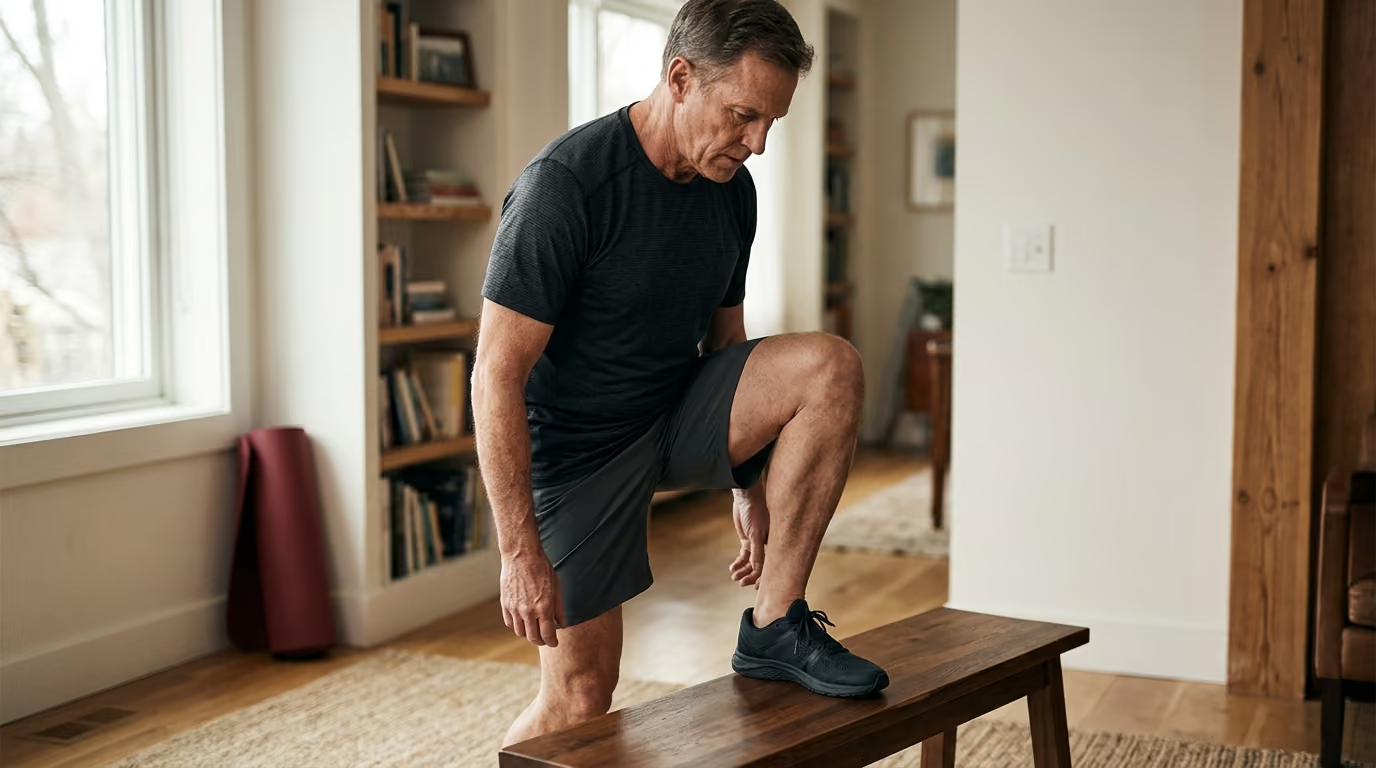
Floor training is valuable, but forcing floor transitions when you lack baseline strength creates unnecessary injury risk. If you have severe joint pain or balance limitations, start with elevated surfaces.
Use a sturdy bench, a low couch, or a stable chair to practice transitional movements. Begin with controlled step-ups, supported lunges, and elevated hip openers.
Gradually lower the working height as your strength, hip range, and confidence improve. The objective is progressive adaptation, not reckless struggle on an unforgiving floor.
Deploy Resistance Bands for Targeted Joint Function
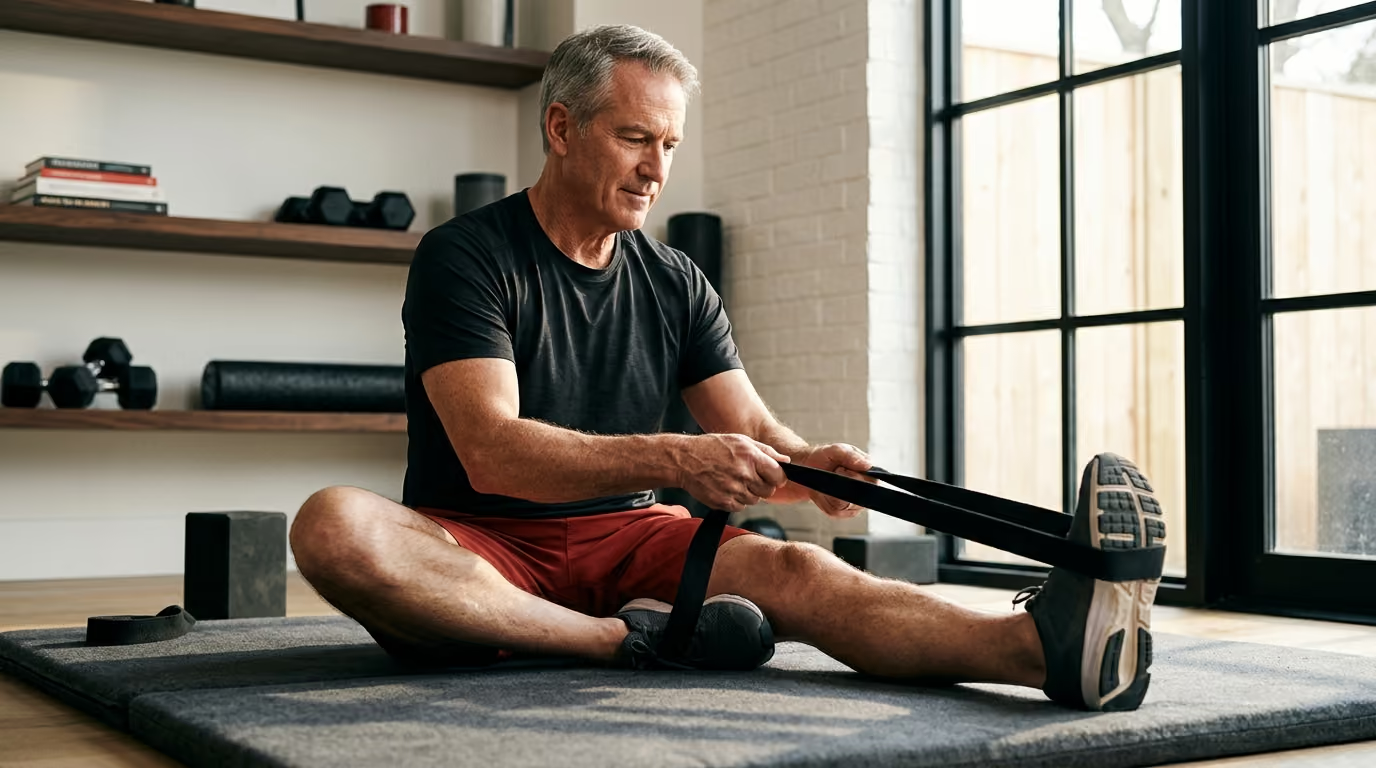
Elastic resistance bands are among the most thoroughly researched and cost-effective tools for home mobility and strength. They provide dynamic, accommodating resistance across variable ranges of motion.
Clinical Evidence for Resistance Bands
Systematic reviews demonstrate clear functional benefits from elastic band training in older populations. A meta-analysis published in the journal Physical Activity and Rehabilitation examined community-dwelling adults using elastic resistance.
The analysis found that band exercises significantly improved functional reach with a standardized mean difference of 1.18. It also improved timed up-and-go test performance by a mean difference of 2.89 seconds.
A comprehensive systematic review of 28 trials with 1,697 participants confirmed these broad adaptations. Band training improved upper-limb flexibility, lower-limb flexibility, physical balance, and muscular endurance.
These measurable gains translate directly to easier stair climbing, reaching overhead, and stable walking. Explore more about active physical maintenance in our section on healthy aging and longevity.
Why Bands Excel for Midlife Joints
Bands offer an accommodating resistance curve. Tension is lightest at the beginning of the movement where joints are often most vulnerable.
Tension increases as the band stretches, matching the natural mechanical leverage of your muscles. This property allows men over 45 to train shoulders and hips without painful joint compression.
Bands can also provide assisted mobility. Wrapping a band around a sturdy anchor allows you to unload bodyweight during deep squats or assist tight shoulders through active overhead reaches.
Practical Applications for Band Training
- Shoulder Dislocates and Pull-Aparts: Use a light loop band to restore thoracic extension, scapular retraction, and shoulder external rotation.
- Resisted Lateral Steps: Place a loop band around the ankles or above the knees to activate the gluteus medius and improve lateral pelvic stability.
- Assisted Deep Squats: Anchor a heavy band overhead to support your torso while working through a full hip and ankle range of motion.
- Terminal Knee Extensions: Anchor a band at knee height to train quad lockout and reinforce knee joint stability.
- Seated or Standing Rows: Train the posterior chain, mid-back posture, and grip strength without spinal loading.
- Resistance Band Progression Model
- Level 1: Joint Warm-Up & Assisted Range (Light tension, high reps)
- Level 2: Controlled Dynamic Movement (Moderate tension, tempo control)
- Level 3: Loaded End-Range Strength (Heavy tension, peak holds)
A common limitation in the research is that bands do not always reverse severe frailty in clinical populations. However, for active men over 45, bands remain one of the most effective, low-risk tools available.
Evaluate Free Weights for Long-Term Structural Support
Dumbbells, kettlebells, and weight plates are often categorized exclusively as muscle-building tools. In clinical reality, progressive resistance with free weights is one of the most effective methods for expanding functional mobility.
Loaded Stretching and Active Range of Motion
True mobility requires strength at the outer boundaries of your joint range. Lifting a light or moderate weight through a complete movement path forces muscles to lengthen under load.
Exercises like Romanian deadlifts, goblet squats, and dumbbell pullovers act as loaded stretches. They train your nervous system to tolerate deep positions while building structural strength.
A weight provides tangible mechanical feedback. The downward pull of a light dumbbell assists your hips or ankles into deeper flexion than passive stretching can achieve alone.
Free Weights Versus
Specialized Mobility Tools
Unlike specialized stretching machines, free weights offer quantifiable progression. You can add two pounds, increase repetitions, or slow down the eccentric tempo.
Research from public health authorities confirms that muscle-strengthening activity involving all major muscle groups twice weekly supports joint function. Dumbbells deliver this requirement with complete movement freedom.
You do not need heavy barbells to gain these benefits. A simple pair of adjustable dumbbells or two moderately heavy kettlebells provides adequate loading for home use.
Foundational Loaded Mobility Exercises
- Goblet Squat with a Pause: Hold a dumbbell at chest height and squat between your knees. Use the counterweight to keep your spine upright while expanding hip and ankle depth.
- Single-Leg Romanian Deadlift: Hold a weight in one hand while hinging on the opposite leg. This develops hamstring length, hip stability, and single-leg balance simultaneously.
- Dumbbell Pullover on the Floor: Lie flat on your back and slowly lower a dumbbell overhead toward the floor. This expands thoracic extension and lats flexibility while protecting the shoulders.
- Suitcase Carry: Walk slowly carrying a single heavy dumbbell at your side. This builds core stiffness, hip alignment, and functional grip strength.
For a deeper look into programming resistance exercises, read our guide on strength and muscle maintenance.
Assess Foam Rollers and Self-Myofascial Release Devices
Foam rollers, massage balls, and vibrating tools dominate modern fitness retail. Marketing claims suggest these devices break up scar tissue, release fascia, and permanently cure joint tightness.
The peer-reviewed evidence tells a very different story.
What the Research Shows on Foam Rolling
A systematic review and multilevel meta-analysis of 26 high-quality trials examined the effects of foam rolling. Researchers found that rolling produced a significant acute improvement in range of motion compared to resting quietly, showing a standardized mean difference of 0.74.
However, foam rolling was not superior to standard stretching. The comparison between foam rolling and active stretching showed a standardized mean difference of -0.02, representing no statistical difference.
Furthermore, the meta-analysis noted that foam rolling appeared less effective in male cohorts compared to female cohorts. The authors recommended further study, but the data indicates that men should not expect outsized gains from rolling alone.
The Myth of Tissue Realignment
A standard foam roller cannot mechanically break down scar tissue or melt dense fascia. Human fascia is remarkably tough and requires massive mechanical forces to deform permanently.
The temporary looseness you feel after rolling is a neurological event, not a mechanical restructuring. The pressure stimulates mechanoreceptors in your skin and muscle tissue.
These receptors send temporary inhibitory signals to the central nervous system, reducing resting muscle tone for roughly fifteen to thirty minutes. Once you stand up and resume normal activity, that neural inhibition fades.
- Foam Rolling: What It Does vs. What It Does Not Do
- DOES: Provide short-term neural relaxation (15-30 min window)
- DOES: Offer mild sensory feedback before training sessions
- DOES NOT: Break down scar tissue or reshape fascia
- DOES NOT: Produce permanent, long-term functional mobility gains
- DOES NOT: Replace active strength, balance, or ground work
Vibrating Rollers and Percussion Guns
Commercial manufacturers claim that adding high-frequency vibration increases the effectiveness of foam rolling. Meta-analyses show vibrating foam rollers provide a modest incremental boost in short-term hip and knee range with an effect size of 0.53.
However, vibrating tools show no significant improvement at the ankle joint and no long-term functional superiority. Massage guns provide localized sensory stimulation that may feel relaxing, but they do not build joint capacity.
A standard, inexpensive high-density foam roller or a simple lacrosse ball achieves the same temporary neurological effect as a three-hundred-dollar powered device. If rolling helps you prepare for a lifting or walking session, use it briefly as a warm-up aid.
Do not rely on it as a standalone strategy for joint health.
Question Mobility Sticks and Unstable Balance Devices
Commercial fitness trends often introduce proprietary tools designed to solve balance and posture problems. Mobility sticks and unstable balance boards are two common examples that require careful, critical analysis.
The Real Role of Mobility Sticks and Dowels
Mobility sticks are long, rigid or semi-flexible poles marketed for posture alignment, leverage stretching, and balance support. While they look technical, published clinical trials do not show that commercial sticks are superior to simple movement drills.
A stick can serve a practical purpose as an active-assisted reaching tool. It provides a third point of contact with the ground during deep lunges, single-leg hinges, or rotational thoracic sweeps.
However, a five-dollar wooden broom handle, a PVC pipe, or a standard wooden dowel provides the exact same biomechanical function. Spending significant money on branded mobility sticks does not produce additional physical adaptations.
Unstable Surfaces: Foam Pads and Wobble Boards
Unstable balance equipment, such as inflatable discs, soft balance pads, and wobble boards, is widely promoted for fall prevention. The logic seems straightforward: standing on an unstable surface should train your body to balance on unsteady ground.
Clinical research into fall prevention does not support this assumption for general fitness. Public health programs, such as the CDC STEADI initiative, focus on progressive balance challenges on firm, predictable ground.
Standing on a soft foam pad forces your ankle muscles into reactive twitches. It alters the natural sensory input your feet receive from the earth.
Training balance on an unstable surface makes you better at balancing on that specific unstable surface. It does not transfer reliably to walking on concrete, stepping off curbs, or navigating uneven hiking trails.
A Safer, More Effective Balance Progression
Genuine balance training challenges your center of mass while your feet remain anchored to a solid, stable foundation. Progressive stance variations on firm ground build reliable balance without dangerous falls.
- Parallel Stance: Stand tall with feet together, eyes forward, holding a kitchen counter lightly with your fingertips.
- Semi-Tandem Stance: Shift one foot forward so the heel rests beside the big toe of the back foot. Hold for thirty seconds.
- Full Tandem Stance: Place the heel of one foot directly in front of the toes of the other, forming a single straight line.
- Single-Leg Stance: Lift one foot an inch off the ground while maintaining an upright posture on the standing leg.
- Dynamic Head Turns: Perform tandem or single-leg stances while slowly turning your head left and right to challenge the vestibular system.
Use a sturdy kitchen counter, wall, or heavy chair for fingertip support. This provides safety while your nervous system adapts to new balance thresholds.
Separate Evidence-Based Practices from Common Industry Claims
Navigating midlife fitness requires filtering commercial marketing through scientific rigor. Several common claims regarding mobility tools are not supported by clinical evidence.
Misreading 1: You Must Smash Tight Tissues Before Every Workout
Many men spend thirty minutes rolling, kneading, and pressing their muscles on hard devices before lifting weights. Research shows that prolonged, painful soft-tissue work can cause muscle fatigue and desensitize tissue without adding functional performance.
A brief three-minute warm-up using active bodyweight drills and light resistance bands prepares joints far more effectively. Dynamic movement increases core temperature, circulates synovial fluid within joint capsules, and activates neural pathways.
Misreading 2: Specialized Stretching Devices Reverse Spinal Aging
Inversion tables, back-stretching arcs, and spinal traction wheels are frequently advertised to men over 45 with promises of restoring youthful discs. While traction may offer brief symptomatic relief for certain nerve compressions, it does not permanently change spinal structure.
Spinal health is maintained through trunk muscular endurance, hip mobility, and regular walking. Relying on passive decompression devices distracts from the active core strengthening required to support the spine during physical labor.
- Common Claim vs. Clinical Evidence
- Claim: "Special tools break down scar tissue permanently."
- Reality: Human fascia is too dense; rolling offers short-term relief.
- Claim: "Unstable wobble boards prevent everyday falls."
- Reality: Firm-surface balance and leg strength transfer better.
- Claim: "Inversion tables permanently rebuild spinal discs."
- Reality: Discs require core strength, hip movement, and walking.
Misreading 3: Passive Flexibility Protects Joints from Injury
Holding a passive, static stretch for several minutes does not train a joint to handle external forces. If you can passively pull your knee to your chest but lack the hip flexor strength to lift it there actively, that range is unusable.
Joint injuries occur when external loads exceed the muscular capacity to control a specific position. Mobility must always be paired with strength and motor control to offer physical resilience.
To review broader recovery concepts, check our resource center on active recovery and mobility methods.
Identify Where Clinical Movement Evidence Remains Thin
A balanced evaluation of fitness equipment must clearly acknowledge gaps in the current scientific literature.
Limited Cohorts of Men Aged 45 to 60
The majority of clinical mobility trials evaluate two distinct age groups: college-aged young adults or adults aged 65 to 85 with diagnosed mobility limitations. Direct, high-powered trials looking specifically at healthy, working men aged 45 to 60 are relatively sparse.
We must generalize findings from broader healthy adult and older-adult populations. While fundamental physiological principles apply, individual training history, injury background, and occupational demands create wide variations in how men respond to specific tools.
Lack of Long-Term Comparative Trials
Few long-term trials compare proprietary mobility tools directly against each other. For instance, no large, multi-year randomized trial compares a name-brand mobility stick against a standard wooden dowel or pure bodyweight movement.
Most commercial claims rely on short-term markers, such as acute range of motion measured immediately after a five-minute session. These acute measurements do not prove long-term improvements in functional capability, pain reduction, or joint longevity.
Inconclusive Data on Vibration and Percussion Devices
While small acute studies show minor boosts in blood flow from vibration therapy, long-term functional trials remain inconclusive. Peer-reviewed literature does not prove that vibrating foam rollers or percussion guns improve walking speed, fall prevention, or heavy lift capacity.
These devices should be viewed as comfort-driven luxury items rather than foundational training equipment.
Build a Realistic Home Mobility Setup for Daily Capability
Creating an effective home mobility environment does not require an expensive gym or complicated equipment. A lean, evidence-based toolkit focuses on versatility, progressive resistance, and environmental safety.
- The Evidence-Based Home Mobility Kit
- 1. Clear Floor Area: Non-slip mat or clean carpet
- 2. Stable External Anchor: Sturdy chair, counter, or doorway
- 3. Resistance Band Set: 3 loop bands, 2 long continuous bands
- 4. Progressive Free Weight: 1-2 adjustable dumbbells (10-30 lbs)
- 5. Basic Sensory Tool (Optional): 1 standard high-density roller
- 6. Alignment Guide (Optional): 1 wooden dowel or broom handle
Tier 1: Essential Foundational Tools (Zero to Low Cost)
- A Clear Floor Area: An open six-by-six space with a firm, non-slip mat or clean carpet. This is your primary station for hip transitions, floor-to-stand drills, and core work.
- A Stable External Anchor: A sturdy kitchen chair, a reliable countertop, or a clear section of wall. This provides immediate, secure support for progressive balance training and supported single-leg work.
- A Set of Resistance Bands: A combination of light, medium, and heavy loop bands, along with two long continuous loop bands. These provide variable resistance for shoulders, hips, and assisted joint mobility.
Tier 2: Functional Loading Additions (Moderate Cost)
- A Pair of Adjustable Dumbbells or Moderate Kettlebells: A weight range between 10 and 35 pounds is sufficient for loaded stretching, goblet squats, hinges, and weighted carries.
- A 5-Foot Wooden Dowel or PVC Pipe: An inexpensive tool for verifying spinal alignment during hinges, performing shoulder pass-throughs, and assisting deep lunges.
Tier 3: Optional Sensory Aids (Low Priority)
- A High-Density Foam Roller: A firm, untextured roller used for brief pre-workout sensory stimulation or relaxing tight muscles after long desk work.
- A Lacrosse or Tennis Ball: A precise tool for pinpointing tight areas around the glutes, upper back, and soles of the feet.
How to Structure a 15-Minute Daily Mobility Session
You can integrate these foundational tools into a simple, highly effective daily movement routine. Perform this sequence three to four days per week.
- Sensory Warm-Up (2 Minutes): Spend sixty seconds rolling the upper back and glutes on a foam roller to decrease resting muscle tension.
- Band-Assisted Movement (4 Minutes): Perform 15 shoulder pass-throughs with a light band, followed by 10 monster walks in each direction with a loop band around your knees.
- Loaded Joint Range (5 Minutes): Complete 2 sets of 8 goblet squats using a dumbbell, pausing at the bottom for three seconds to open the hips and ankles. Follow with 8 dumbbell Romanian deadlifts to load the hamstrings.
- Balance and Ground Transitions (4 Minutes): Stand in tandem stance near a counter for thirty seconds per side. Finish by performing 3 controlled transitions down to the floor and back up to standing without rushing.
This practical sequence combines sensory feedback, active resistance, loaded range of motion, and balance practice without complicated devices. If you want to explore wider movement strategies, visit the Everfitguys home resource library.
Key Takeaways
- Focus on active capability over passive tools: Lasting mobility requires active muscle control, joint stability, and progressive loading rather than passive stretching gadgets.
- Resistance bands offer the highest evidence-to-cost ratio: Clinical trials prove bands improve functional reach, balance, and flexibility in aging adults.
- Foam rollers provide only short-term neural relief: Rolling increases temporary range of motion for roughly fifteen minutes but does not permanently break down scar tissue or reshape fascia.
- Balance training works best on solid ground: Progress through firm-surface stance variations using a chair or counter for support rather than buying unstable wobble boards.
- Free weights build durable mobility: Loaded exercises like goblet squats and Romanian deadlifts act as loaded stretches that build strength at your joints' outer boundaries.
- Keep your home setup simple: A clean floor area, a stable chair, a set of resistance bands, and a pair of dumbbells provide everything you need for lifelong movement freedom.
True joint mobility after 45 is not purchased in a box of specialized gadgets, but built through consistent, progressive movement on solid ground.
Sources
- World Health Organization 2020 guidelines on physical ... - PMC
- 2020 WHO guidelines on physical activity and sedentary behavior - PMC
- World Health Organization 2020 guidelines on physical ...
- RECOMMENDATIONS - WHO Guidelines on Physical Activity ...
- Effectiveness of resistance exercise using elastic bands on flexibility ...
- (PDF) the effect of resistance band exercise on
Stay sharp
Get the word
Join our newsletter for the best writing advice and stories from the field.