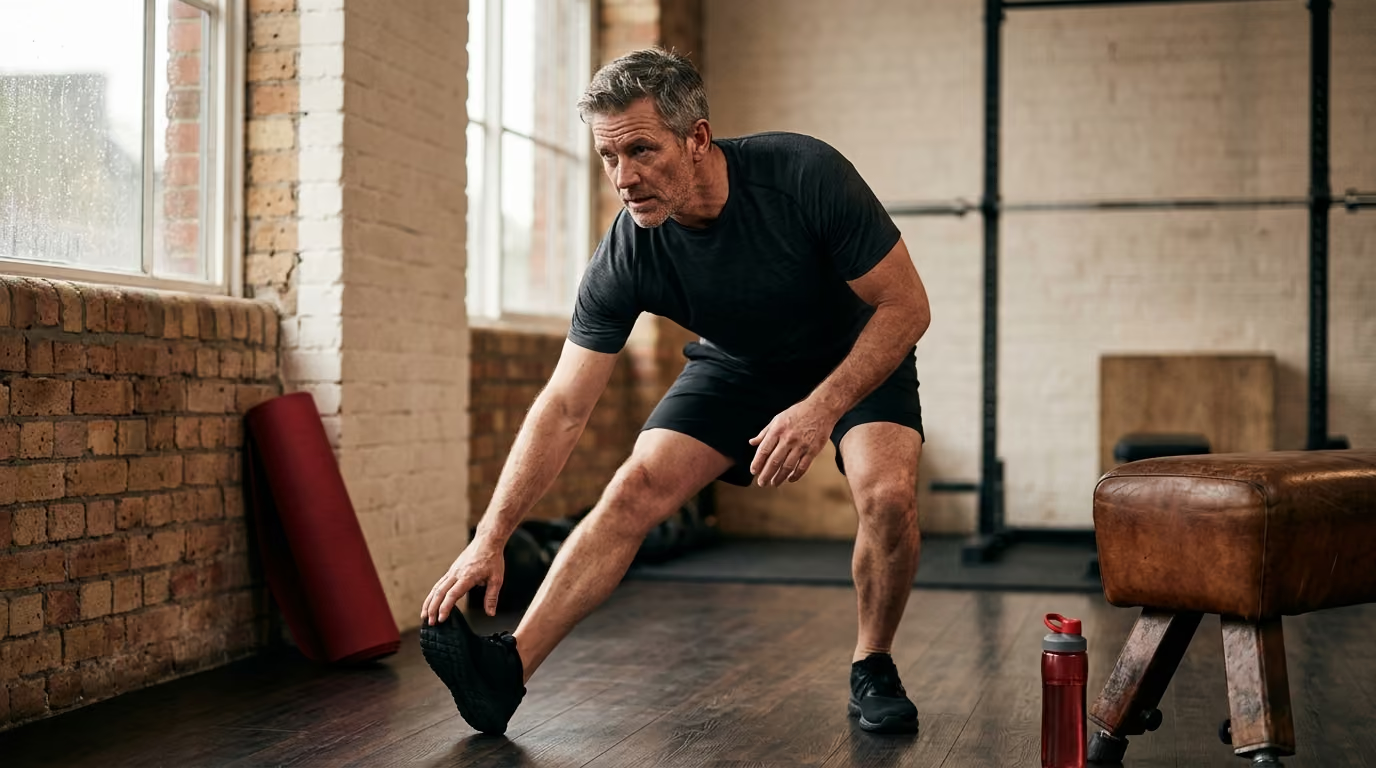
You step out of your car after a long commute, walk into the gym locker room, and head straight to the squat rack. Your lower back feels tight from sitting. Your knees feel stiff, and your shoulders resist moving overhead.
You face a choice that many men face after 45. You can either load the barbell immediately and hope your joints warm up under heavy iron, or you can spend thirty exhausting minutes rolling on foam cylinders and stretching bands until you are too tired to lift well.
Neither choice serves you well. Jumping into heavy or fast movements with cold tissues invites joint irritation. Spending half an hour on passive stretching drains the nervous system and wastes limited training time.
A proper warm-up is movement preparation, not a separate workout. Its single goal is to get your body ready for the specific session ahead. When done correctly, it leaves you feeling mobile, coordinated, and ready to perform without robbing you of energy.
What the research shows about warming up
The scientific evidence on warming up shows clear benefits when routines match the activity. A systematic review of warm-up studies revealed that structured preparation improved performance in 79 percent of the athletic criteria examined. The same review showed that 17 percent of warm-up protocols caused a decrease in performance.
This finding proves that warming up is not automatically helpful. The structure, duration, and intensity of your preparation decide whether your performance improves or suffers.
Research clearly separates dynamic movement from passive static stretching. A 2023 systematic review and network meta-analysis demonstrated that dynamic stretching significantly improved sprint times compared to resting controls. In that same analysis, holding passive static stretches caused a notable decrease in sprint performance.
Dynamic preparation also improves vertical jump height. Studies show that dynamic protocols lasting roughly seven to ten minutes create positive changes in jump power. The benefits vary based on age, duration, and the background of the athlete.
The evidence on injury risk reduction is strongest for structured neuromuscular programs. Large systematic reviews of the FIFA 11+ program show that dynamic movement preparation containing balance, landing control, and strength exercises reduced sports injuries by 25 to 30 percent. While those trials examined soccer players, the core finding applies broadly. Active movement preparation protects tissues better than passive stretching alone.
Brief static stretching is not completely harmful in every scenario. Systematic reviews examining upper-body power found that short static stretches held for under thirty seconds did not harm performance. Long static stretches held for minutes, however, reduce muscle stiffness and dampen high-speed power output.
Why movement preparation changes after 45
Your body at 45 operates differently than it did at 25. This change is not a disease or a failure of health. It is a natural shift in tissue biology, joint mechanics, and daily routine.
Connective tissues lose a small amount of water content as the decades pass. Tendons and ligaments become less compliant when you sit for long hours. The fluid inside your joint capsules requires active movement to circulate and lubricate cartilage surfaces.
Motor unit recruitment also changes with age. The nervous system becomes slightly slower at activating fast-twitch muscle fibers if you do not regularly train them. A warm-up acts as an electrical primer, waking up nerve pathways before you ask them to produce high force.
Daily life adds another layer of restriction. Decades of desk work, driving, and repetitive stress create posture habits. Hips become stiff in flexion, thoracic spines lose rotation, and ankles lose dorsiflexion.
Past injuries also leave a physical footprint. An old meniscus trim, an ankle sprain from college, or a cranky shoulder cuff changes how your body distributes load. A targeted warm-up re-establishes symmetry and joint stability before you add speed or heavy weight.
Understanding these biological changes allows you to build better mobility and joint function without wasting effort on useless drills.
The core principles of an effective warm-up
To design an effective routine, you must understand the difference between flexibility and mobility. Flexibility is the passive range of motion available around a joint. Mobility is your ability to actively control and produce strength within that range.
A lifter may possess the passive flexibility to drop into a deep squat when holding onto a doorframe. If he lacks the active hip control and core stability to handle load at the bottom, passive flexibility will not protect his spine. Warm-ups must build active control, not loose joints.
You must also separate general preparation from specific preparation. General preparation raises body temperature and heart rate through easy whole-body motion. Specific preparation mirrors the exact movement patterns, speeds, and loads of your planned workout.
The golden rule for men over 45 is simple: prepare, do not pre-fatigue. A warm-up should never leave you sweating heavily, breathless, or physically weak before your first working set.
An effective warm-up uses four defined phases, often organized through the RAMP framework:
Raise
This phase elevates core body temperature, increases heart rate, and boosts blood flow to working muscles. It lubricates stiff joints and improves tissue elasticity through easy, rhythmic movement.
Activate
This phase wakes up key muscle groups that support major joints. It focuses on the glutes, deep core, rotator cuff, and upper back to ensure proper joint tracking.
Mobilize
This phase takes your major joints through the active ranges of motion required by the sport or workout. You move dynamically through hips, ankles, spine, and shoulders rather than holding passive stretches.
Potentiate
This final phase bridges the gap between warm-up drills and the main activity. It uses gradual increases in speed, resistance, or power to prepare your nervous system for heavy work.
A step-by-step movement preparation framework
You can apply a five-step algorithm to any activity. This process takes between eight and twelve minutes and adapts to any gym session, sport, or outdoor trip.
Step 1: Identify session demands
Look at the main activity you are about to start. Determine which joints will bear the highest loads, which planes of motion dominate the movement, and what speeds you will reach.
A heavy deadlift session requires hip hinge control and core stiffness. A tennis match demands rapid lateral deceleration and rotational trunk speed. Match your preparation to those exact stresses.
Step 2: Raise temperature gradually
Spend three to five minutes moving at an easy, conversational pace. You can walk briskly on an incline, spin on a stationary bike, or use a rowing machine.
Your goal is mild warmth and deeper breathing. Stop well before you accumulate muscular fatigue or heavy sweat.
Step 3: Mobilize key joints dynamically
Select two or three dynamic drills that target the joints you will use most. Focus on dynamic ankle dorsiflexion, hip extension, hip internal rotation, and thoracic spine rotation.
Move through smooth, controlled ranges without forcing your joints past comfort limits. Perform six to ten repetitions per side with steady breathing.
Step 4: Activate stabilizing muscle groups
Choose two low-load activation movements that target joint stabilizers. Use bodyweight glute bridges, bird dogs, band pull-aparts, or side planks.
Perform these drills with slow tempo and high focus on muscle contraction. Do not rush through them, and keep total repetitions under ten per set to avoid local fatigue.
Step 5: Potentiate movement patterns
Rehearse the exact movement of your workout using progressive loading or graduated speed. For strength training, use empty barbells and progressive warm-up sets.
For running, cycling, or court sports, use build-up sprints, practice swings, or lateral shuffles at increasing speeds. When your potentiation sets feel crisp and powerful, your warm-up is complete.
Activity-specific warm-up routines
Different sports place unique demands on the body. A single generic warm-up cannot prepare you for both a heavy bench press and an eight-mile trail hike. Use these tailored sequences for your chosen activity.
Lower-body strength training
Lifting heavy loads requires joint alignment, abdominal bracing, and smooth hip and ankle mechanics. Your routine should prepare your hips, knees, and lumbar spine for compression and shear forces. You can explore our guides on strength and muscle development for broader programming ideas.
1. General raise: 3 minutes
Spin on an upright bike or walk on an inclined treadmill at a light pace. Keep your breathing easy and rhythmic.
2. Ankle rocks: 8 reps per side
Place one foot several inches from a wall in a half-kneeling position. Drive your knee forward over your second toe without letting your heel lift off the floor.
3. Bodyweight squat with pause: 8 reps
Stand with your preferred squat stance. Lower yourself under control, pause for two seconds in the bottom position while maintaining tension, and stand up smoothly.
4. Half-kneeling hip flexor glide: 6 reps per side
Kneel on one knee with your front foot flat. Tuck your pelvis underneath your torso to engage your rear glute, then shift forward slightly until you feel a gentle stretch in the front of your hip.
5. Specific barbell progression: 3 to 4 sets
Perform one set of five repetitions with the empty bar. Add moderate weight for three repetitions, then perform two single repetitions at seventy and eighty-five percent of your working weight.
Upper-body strength training
Upper-body workouts place high demands on the glenohumeral joints, scapular stabilizers, and thoracic spine. Your preparation must encourage good shoulder blade movement without tiring your pressing muscles.
1. General raise: 3 minutes
Use an arm-and-leg fan bike or a rowing machine at an easy effort.
2. Scapular push-ups: 10 reps
Assume a solid plank or push-up position with your arms straight. Without bending your elbows, pinch your shoulder blades together, then push the ground away to spread them wide.
3. Band pull-aparts: 12 reps
Hold a light resistance band in front of your chest with straight arms. Pull the band apart by retracting your shoulder blades, pause briefly, and return under control.
4. Quadruped thoracic rotations: 8 reps per side
Position yourself on hands and knees with one hand placed behind your head. Rotate your elbow down toward your opposite wrist, then rotate upward toward the ceiling, following your elbow with your eyes.
5. Specific pressing progression: 3 to 4 sets
Perform five reps with an empty barbell or light dumbbells. Increase the weight across three short sets of three, two, and one repetition before your first working set.
Hiking and trail walking
Hiking involves prolonged aerobic output, uneven ground, and heavy downhill braking forces. Your routine must prepare your calves, ankles, knees, and balance systems for unstable surfaces.
1. Easy flat walking: 5 minutes
Walk at a normal pace on flat ground near the trailhead before strapping on your full backpack.
2. Standing calf raises with pause: 10 reps
Stand on flat ground or a low curb. Rise up onto the balls of both feet, hold the top position for two seconds, and lower your heels slowly.
3. Low platform step-downs: 8 reps per leg
Stand on a low rock or step. Slowly reach one heel forward toward the ground by bending your stance knee, lightly touch the ground without shifting weight, and return to standing.
4. Standing hip openers: 6 reps per leg
Stand tall on one leg while holding a trekking pole for balance. Lift your opposite knee toward your chest, rotate it out to the side, and lower it smoothly to the ground.
5. Pack integration: 2 minutes
Put on your backpack, adjust the hip belt, and walk at a moderate pace on a gentle grade before hitting steep terrain.
Cycling and interval training
Cycling demands sustained pelvic stability, hip flexion, and smooth cardiovascular ramp-up. A cold start into hard intervals shocks both the circulatory system and the patellar tendons.
1. Low-resistance spinning: 5 minutes
Pedal at a very low power output with a high cadence between 85 and 95 revolutions per minute. Keep your upper body relaxed on the handlebars.
2. Standing chest and thoracic extensions: 5 reps off the bike
Step off the bike briefly. Place your hands on your lower back, gently extend your upper spine upward, and take three deep breaths to reverse seated posture.
3. Cadence build-ups: 3 sets of 30 seconds
Increase your pedaling cadence to 100 or 105 revolutions per minute for thirty seconds without increasing gear resistance. Spin easily for thirty seconds between each build-up.
4. Power progressive efforts: 3 sets of 20 seconds
Increase your gear resistance to match your planned interval wattage. Ride for twenty seconds at target power, then spin easily for forty seconds.
5. Final recovery spin: 2 minutes
Spin easily at low resistance to clear any mild lactate before beginning your formal interval block.
Racquet sports and pickleball
Court sports demand rapid acceleration, sudden lateral braking, and rotational power. Your warm-up must activate stabilizing muscles in all three planes of movement.
1. Easy court jogging and side shuffles: 3 minutes
Jog forward lightly along the court lines, transition into easy side shuffles, and jog backward with short, controlled steps.
2. Walking lunges with trunk rotation: 6 reps per leg
Step forward into a lunge. Once stable, gently rotate your torso toward the side of your front lead leg, return to center, and step forward into the next repetition.
3. Lateral skaters: 8 reps per side
Perform gentle, low-impact side-to-side bounds. Land softly on one foot with a bent knee, balance for one second, and push off to the opposite side.
4. Shadow swings: 10 reps forehand and backhand
Stand on the court with your racquet or paddle. Rehearse smooth groundstrokes at half-speed, focusing on footwork and hip rotation rather than power.
5. Short-court dinking and rally progression: 3 minutes
Start hitting balls from near the non-volley zone or service line at low speed. Gradually step back to the baseline as your timing and footwork feel coordinated.
Golf
The golf swing produces high rotational velocity and compressive forces across the spine and lead hip. Warming up properly protects your lower back and improves swing consistency. Systematic reviews show that dynamic warm-ups improve club-head speed and ball striking accuracy.
1. Brisk walk: 3 minutes
Walk briskly from the parking lot around the clubhouse or practice green to increase core temperature.
2. Standing hip hinges: 8 reps
Place a golf club across the front of your thighs. Push your hips backward while keeping your back flat, feel the tension in your hamstrings, and return to standing.
3. Club-assisted thoracic turns: 8 reps per side
Hold a mid-iron across your chest against your shoulders in your golf posture. Rotate your torso back as if making a backswing, pause for one second, and rotate smoothly through to a simulated finish.
4. Split-stance weight shifts: 6 reps per side
Assume a staggered stance with your lead foot forward. Shift your body weight smoothly into the lead heel while rotating your hips, mimicking the transition phase of the swing.
5. Progressive club ladder: 10 to 12 swings
Start with a pitching wedge or nine-iron, taking three half-swings followed by three full swings. Move to a five-iron for three swings, and finish with two smooth driver swings at eighty percent effort.
Real-world case examples for active men
Examining how different men apply these principles highlights how warm-ups solve real training challenges. These illustrative examples show how targeted preparation addresses specific limitations.
Case 1: The desk worker returning to heavy squats
Mark is a 52-year-old accountant who sits for eight hours a day before his evening strength workouts. For months, his first two sets of squats felt painful in his hips and knees. He used to spend twenty minutes rolling his IT bands on a hard roller, which provided no lasting relief.
Mark changed his approach to dynamic movement preparation. He started with three minutes on a stationary bike to warm his knees. He followed with ten ankle rocks per side, eight bodyweight squats with a two-second pause at the bottom, and eight half-kneeling hip flexor glides.
He then performed four progressive warm-up sets with the barbell, starting with the empty bar and adding weight in small steps. His hip stiffness vanished because he replaced passive rolling with active joint mobility and progressive loading.
Case 2: The weekend tennis player avoiding calf strains
David is a 48-year-old software executive who plays competitive singles tennis on Saturday mornings. In previous seasons, he experienced recurring calf tightness and shoulder soreness during the second set. His old routine consisted of leaning against a fence to stretch his calves for two minutes before serving full-speed.
David replaced static stretching with an active court progression. He began with light jogging and lateral shuffles for three minutes. He added ten standing calf raises with a pause at the top, followed by walking lunges with torso rotations and shadow swings.
He finished by hitting short-court balls for three minutes before moving to the baseline and hitting six progressive practice serves. His calf tightness stopped recurring because his Achilles tendons and calf muscles were gradually prepared for high-speed deceleration.
Case 3: The recreational golfer protecting the lower back
Robert is a 60-year-old architect who plays eighteen holes every Sunday. He used to arrive five minutes before tee time, take two violent swings with his driver, and step onto the first tee. By the sixth hole, his lower back felt stiff, and his swing lost distance.
Robert adopted a seven-minute pre-round sequence. He walked briskly around the driving range, performed standing hip hinges with an iron across his thighs, and practiced thoracic rotations with a club across his shoulders.
He then hit five balls with a wedge, four with a seven-iron, and three smooth drives before heading to the first tee. His lower-back discomfort cleared up because his thoracic spine and hips regained active rotation, sparing his lumbar spine from excessive twisting force.
Case 4: The road cyclist preparing for high-intensity intervals
Paul is a 47-year-old cyclist who rides three days a week. When doing interval sessions, he used to pedal easily for two minutes and jump straight into his first four-hundred-watt effort. His legs felt heavy, his heart rate spiked abruptly, and his power dropped on later intervals.
Paul adjusted his warm-up to include a ten-minute metabolic ramp. He spun easily for five minutes at high cadence, performed three thirty-second high-cadence spin-ups, and completed three twenty-second efforts at his target interval power with full recovery between each.
When he began his formal workout, his aerobic system was fully engaged and his blood vessels were dilated. His power output remained steady across all intervals, and his recovery between efforts improved.
Case 5: The hiker rebuilding stability after an ankle sprain
Greg is a 50-year-old hiker who suffered a severe lateral ankle sprain two years ago. While his cardiovascular fitness was strong, he felt hesitant and unstable on rocky downhill trail sections. He previously tried stretching his calves aggressively on rocks, which made his ankle feel loose rather than secure.
Greg shifted his warm-up to balance and deceleration drills. At the trailhead, he performed five minutes of easy walking, followed by ten calf raises, single-leg balance holds on flat ground, and controlled step-downs off a low rock ledge.
This short routine woke up his ankle proprioceptors and peroneal stabilizing muscles. His balance on rocky descents improved immediately because his nervous system was primed to stabilize the joint under dynamic load. You can read more about structured recovery in our mobility and recovery resources.
Common mistakes and misreadings of the science
Many popular warm-up habits rest on outdated ideas or misread exercise science. Avoiding these five common mistakes will save you time and preserve your training energy.
Mistake 1: Stretching every muscle statically before power or speed
Holding long static stretches before explosive movements temporarily reduces muscle stiffness and dampens the stretch-shortening cycle. Meta-analyses show that prolonged static stretching decreases sprint speed and vertical jump power when performed right before activity.
Save static stretching for after your workout or as a dedicated evening mobility session. If you have a specific joint restriction that blocks safe exercise form, use a brief stretch of fifteen seconds and follow it immediately with active movement drills.
Mistake 2: Equating sweating with joint readiness
Breaking a sweat simply means your internal body temperature has risen and your sweat glands are working. It does not mean your hips are ready to squat, your shoulders can stabilize a press, or your ankles can handle trail impacts.
A general sweat from sitting in a sauna or jogging on a treadmill does not prepare your nervous system for high-force or high-speed movement. Specific movement rehearsal is required for joint safety and performance.
Mistake 3: Turning warm-ups into exhausting workouts
Some fitness programs prescribe intense calisthenic circuits, burpees, and heavy core routines before lifting. This pre-fatigues the very muscles you need for stability, reducing your strength and focus during the main workout.
A warm-up must remain low in volume. Keep repetitions moderate, stay far away from muscular failure, and stop the warm-up the moment your body feels loose and alert.
Mistake 4: Believing foam rolling is mandatory
Foam rolling and massage guns can provide short-term comfort and temporary decreases in perceived muscle stiffness. Systematic reviews show that foam rolling produces no significant performance advantages over dynamic stretching.
If foam rolling makes you feel better, you can use it for one or two minutes on targeted areas. It is an optional tool, not a mandatory foundation of physical readiness.
Mistake 5: Assuming men over 45 should only perform gentle movements
Aging does not mean you must limit your warm-up to slow, passive, or fragile movements. If your session involves heavy lifting, sprinting, or fast court play, your warm-up must gradually reach those speeds and forces.
The American College of Sports Medicine guidance emphasizes that older adults should progress toward moderate and vigorous efforts as capacity allows. Tailor your preparation to the demands of the sport, not to an arbitrary age limit. Check our broader collection of healthy aging articles for more evidence-based training principles.
Where the evidence remains limited
While the science supporting dynamic warm-ups is solid, several claims in the fitness industry lack strong proof. Knowing where the research is thin helps you avoid over-complicated routines.
Injury prevention in non-team sports
Most high-quality evidence for warm-up injury reduction comes from large team sports like soccer and rugby. These studies evaluate structured neuromuscular routines like the FIFA 11+ program across thousands of athletes.
Direct clinical trials examining injury prevention from warm-ups in recreational weightlifters, hikers, golfers, and older cyclists are scarce. We can logically apply the principles of neuromuscular control, but claiming that a specific warm-up guarantees complete protection from lifting or hiking injuries is unsupported by data.
Individual stretching thresholds
Research shows broad trends regarding dynamic versus static stretching, but individual response varies widely. Some individuals experience no power loss after short static stretches, while others feel sluggish.
Science has not established an exact universal second-by-second duration for stretching that applies to every man over 45. You must use research guidelines as starting points and observe your own performance response.
Long-term joint preservation claims
Commercial programs often claim that specific warm-up exercises prevent long-term cartilage loss or reverse existing osteoarthritis. There are no long-term randomized controlled trials proving that pre-workout mobility drills alter the structural progression of joint osteoarthritis over decades.
A warm-up improves acute joint comfort and movement mechanics during the session. It should be valued for immediate readiness rather than marketed as a structural cure for joint aging.
Safety, screening, and red flags
Physical preparation should improve your comfort, but it cannot replace professional medical evaluation when serious symptoms arise. Being aware of basic health screening principles ensures you train safely.
The American College of Sports Medicine outlines clear pre-exercise screening factors. These include assessing your current activity level, known cardiovascular or metabolic conditions, and the presence of symptoms suggestive of underlying disease.
Training discomfort is normal. This includes mild muscular effort, temporary stiffness that eases as you move, and deeper breathing. Concerning clinical symptoms are entirely different and require prompt attention.
Stop your warm-up immediately and seek medical evaluation if you experience any of the following warning signs:
- Chest pain, pressure, tightness, or squeezing discomfort.
- Unexplained dizziness, lightheadedness, or fainting.
- Unusual shortness of breath out of proportion to your light effort.
- Irregular, fluttering, or racing heartbeat.
- Joint locking, sudden giving way, or sharp acute pain.
- Severe numbness, tingling, or sudden muscular weakness in a limb.
Men with pre-existing orthopedic conditions, past surgeries, or cardiovascular risk factors should work with a physical therapist or physician to adjust their preparation routines. For more practical frameworks, review our full catalog of men's health research guides.
The Takeaway
The best warm-up for a man over 45 is the shortest practical sequence that raises core temperature, restores joint mobility, activates key stabilizers, and progressively rehearses the exact movements of your workout. Keep your preparation active, match it to the demands of your sport, and finish feeling primed rather than tired.
When to revisit this resource
Revisit this guide whenever you begin a new sport, notice persistent joint stiffness at the start of workouts, or find that your current preparation routine is taking too much time and energy. Use the activity-specific frameworks to adjust your preparation whenever your training goals change.
Sources
- The Impact of the FIFA 11+ Injury Prevention Program on ...
- The FIFA 11+ injury prevention program for soccer players
- Effect of specific exercise-based football injury prevention programmes on the overall injury rate in football: a systematic review and meta-analysis of the FIFA 11 and 11+ programmes
- Effectiveness of FIFA injury prevention programs in reducing ...
- The Effects of Adherence to the FIFA 11+ Program on Injury Risk in Soccer Players: A Systematic Review and Meta-analysis - PubMed
- The Impact of the FIFA 11+ Neuromuscular Training ... - PMC
- Effects of the FIFA 11 training program on injury prevention and performance in football players: a systematic review and meta-analysis - Mansueto Gomes Neto, Cristiano Sena Conceição, Alécio Jorge Alves de Lima Brasileiro, Camila Santana de Sousa, Vitor Oliveira Carvalho, Fabio Luciano Arcanjo de J
- Effectiveness of FIFA 11+ Injury Prevention Programs in ...
Stay sharp
Get the word
Join our newsletter for the best writing advice and stories from the field.