How to Maintain Physical Capability After 45 With Five Core Movement Patterns
On September 13, 2026, BikeRadar published the article "Your 80-year-old self will thank you for doing these 5 simple midlife exercises" to introduce a framework of five movement patterns designed to maintain everyday physical capability.
The publication bases its long-term physical outlook on the Swedish Physical Activity and Fitness project. Researchers associated with the Karolinska Institutet followed adult participants over a 47-year period. During this time, the research team repeatedly measured the fitness, strength, and muscular endurance of the adults. The project sought to track how physical performance changes across a normal lifespan.
According to the published account, researchers noted that physical performance began declining around age 35. This functional decline occurred regardless of how fit the participants had been when they were younger. However, the data also showed a clear path for physical improvement later in life. The article reports that participants who became more active later in adulthood improved their physical capacity by five to 10 percent.
Maria Westerstahl, an expert associated with the project, quoted that it is never too late to start moving. This statement supports a practical rather than fatalistic interpretation of age-related decline. The long-term project aimed to distinguish between unavoidable physical changes and the capacity to improve. Tracking individuals across decades provided an encouraging distinction between natural aging and preventable physical decline.
How to Structure the Five Movement Patterns
To address these physical changes, the publication outlines a routine built around five broad movement patterns. These include the squat, hinge, push, pull, and carry. This specific framework focuses on maintaining useful strength and everyday mobility rather than pushing for peak athletic performance. Coach Jason Smith, described as a Fit in Midlife coach, provided the exercise selection and technique guidance for the piece.
Smith frames the five movements as a compact way to preserve the usable strength required for daily life. This includes basic tasks like standing from a chair, lifting heavy objects, and opening heavy doors. Treating these categories as a checklist allows men to organize their routines logically. The checklist should contain one knee-dominant movement, one hip-dominant movement, one pushing motion, one pulling motion and one loaded carry.
Why Lower Body Mechanics Protect Independence
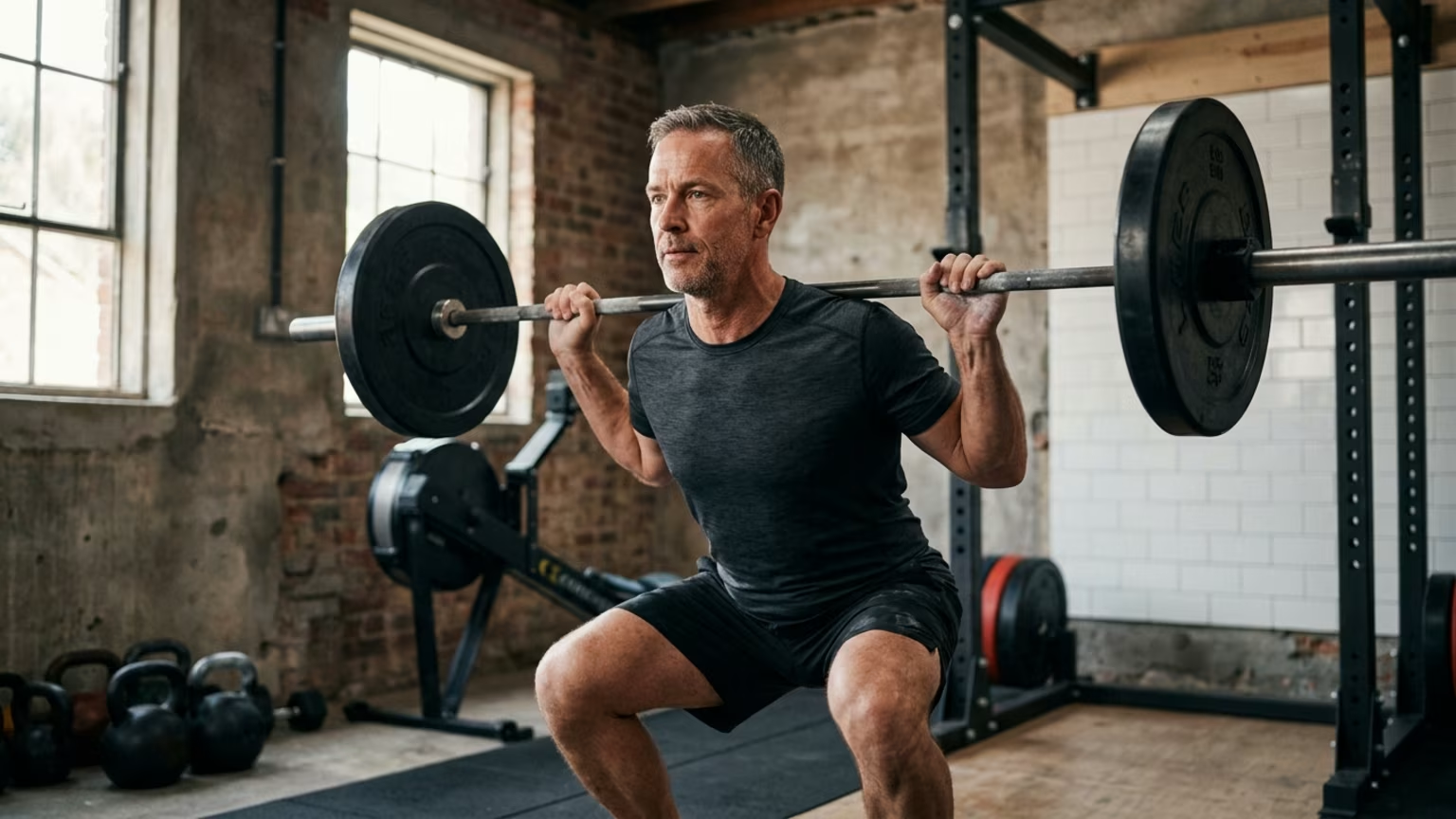
The squat and hinge patterns form the foundation of the lower body routine. The squat section recommends starting with bodyweight for 10 to 15 repetitions. Participants are advised to descend only as far as comfortable before adding load gradually. Smith notes that squats can support leg strength, physical balance, and the ability to rise from a seated position.
Using structured strength training is presented as a foundation for healthy aging and everyday mobility by many physical therapists. The hinge movement uses kettlebells or dumbbells to train safe lifting mechanics. This pattern focuses on pushing the hips backward, maintaining a tall chest, and driving the hips forward to stand. Smith describes the hip hinge as a specific way to practice bending and lifting through the hips rather than repeatedly rounding the spine.
Men often struggle with this movement initially because years of sitting can alter hip mobility. Practicing the hinge allows individuals to retrain their glutes and hamstrings to handle daily lifting tasks safely. This guidance is especially relevant for men returning to training after years of desk work, cycling, or inconsistent exercise. The advice prioritizes proper technique, manageable loading, and steady progression instead of pushing for maximal weights.
How to Preserve Upper Body and Trunk Strength
The upper body components focus on pushing, pulling, and carrying loads securely. The push category begins with incline push-ups against a wall or bench. This modification provides an accessible entry point for people who cannot perform floor push-ups with good control. Using an incline reduces the percentage of body weight the upper body must support.
Participants can eventually progress to standard floor push-ups or a bench press. The pull category includes exercises like rows or pulldowns. These movements require controlled lowering and a focus on drawing the elbows toward the ribs. Smith notes that pulling exercises are useful for upper-back strength and shoulder control.
Strengthening the upper-back muscles helps counteract the rounded shoulder posture common in modern office workers. A controlled lowering phase also builds muscular endurance alongside pure strength. This holds true for people who spend substantial time sitting or riding in a forward-flexed position.
Finally, the carry category recommends farmer's carries over a distance of 30 to 40 metres. Participants hold dumbbells or kettlebells while maintaining an upright posture. Smith characterizes carries as whole-body strength work because they combine grip, trunk, shoulder, and lower-body demands. Readers should use carries conservatively at first because grip and walking control can fail before the legs feel challenged.
How to Manage Weekly Training Frequency
BikeRadar recommends training these five movement patterns three times per week. A returning exerciser could begin with two short full-body sessions weekly. They can then consider a third session if recovery, sleep, and joint comfort remain good. Practical guidelines for experienced lifters returning to the gym to rebuild physical strength suggest treating this cadence as a cautious adaptation rather than a rigid protocol.
Instead, individuals should use the five patterns as a flexible checklist. This allows men to swap specific exercises if a movement begins to irritate their joints. If a barbell squat feels uncomfortable, a bodyweight version remains perfectly acceptable. The goal is to stimulate the muscles without forcing the body into compromised mechanical positions.
The routine also involves adding short daily mobility drills to the schedule. Suggested mobility work includes forward folds, hip-flexor stretches and thoracic-spine rotations. The publication also recommends deep-squat holds and resistance-band pull-aparts.
For more demanding cardiovascular conditioning, the article suggests one to two sessions per week. Cycling, rowing, and uphill walking are identified as relatively joint-friendly options. These activities provide a useful bridge for men who want cardiovascular conditioning without making every session a high-impact running workout. This approach aligns with the World Health Organization's physical activity guidance for older adults.
WHO recommends adults accumulate 150 to 300 minutes of moderate-intensity aerobic activity each week. Alternatively, adults can aim for 75 to 150 minutes of vigorous activity weekly. The organization also recommends muscle-strengthening activity involving all major muscle groups on at least two days per week. For older adults, WHO suggests multicomponent activity prioritizing functional balance and strength.
Why Monitoring Recovery Prevents Overuse Injuries
The publication strongly recommends gradual loading, controlled movement, thorough warm-ups, and scheduled rest days. Smith cautions that recovery capacity declines faster than work capacity after age 50. Proper pacing allows the body to adapt to the new stimulus without breaking down. To avoid overtraining, the article identifies several warning signs that training intensity may be exceeding recovery capacity.
These markers include disrupted sleep, persistent joint aches, a rising resting heart rate, and a sudden loss of motivation. Ignoring these warning signs frequently leads to overuse injuries or joint inflammation. Men who experience these symptoms should schedule easier sessions or take additional rest days. Setting boundaries around regular nightly sleep protects executive function and physical recovery for midlife men who want to stay active.
Caveats and Clinical Limitations
While the Swedish project provides encouraging observational data, the specific five-exercise plan was not presented as a controlled trial. Claims about squats stimulating bone density, carries predicting longevity, pulling exercises reducing neck pain, and the movements addressing major aging threats are presented largely through practitioner guidance. A 47-year observational project can show functional patterns over time. It does not establish that exercise alone caused every reported physical improvement.
The article headline suggests an older version of the reader will thank them for exercising. This phrasing should not be interpreted as absolute proof that these exact movements prevent disability, falls or osteoporosis. It also does not prove they prevent back pain or mortality. Furthermore, men with existing joint pain, osteoporosis, or cardiovascular disease may need professional assessment before adding loaded squats or carries.
The programme does not replace adequate sleep, balanced nutrition or routine medical care. It also serves as a supplement to balance practice and broader aerobic activity. The definition of a joint-friendly option is also context-dependent. Cycling or uphill walking may be comfortable for one person but aggravate symptoms for another.
This variation depends on joint condition, individual technique and bike fit. The terrain and training dose also impact whether an activity feels comfortable. Learning why total inactivity harms aching joints and how midlife weight training restores support requires an individualized approach. The most defensible promise is improving useful movement capacity from an individual's present baseline.
What this changes: Rather than assuming age-related physical decline is entirely unavoidable, this combined research confirms that structured movement can meaningfully improve functional capability from a person's current baseline.
How Everfitguys helps
Navigating a weekly routine in midlife requires balancing the demand for strength training against a naturally decreasing physical recovery capacity, and Everfitguys translates clinical data to help you find that sustainable middle ground. Poor sleep, stress and slower recovery frequently derail these workout plans, so Everfitguys analyzes current physiological research to help you build habits that safely preserve your everyday strength.
Sources
Stay sharp
Get stories
The best writing on craft and life, delivered once a week. No noise, just the good stuff.