Getting Stronger After 50: Why Movement Velocity Matters

On September 27, 2026, Men's Journal published a report highlighting power training as a crucial complement to standard strength routines for older adults. The news story summarized a 2026 systematic review and updated American College of Sports Medicine guidance on lifting velocity.
The Scale of Recent Resistance Training Research
The data supporting this shift toward movement speed comes from an unusually large pool of clinical evidence. The 2026 systematic review and meta-analysis cited by Men's Journal analyzed 16 distinct clinical studies. Researchers focused specifically on older demographics by evaluating 801 adults aged 60 and older. This concentrated analysis allowed scientists to isolate how different lifting speeds affect an aging physical system.
The broader guidance from the American College of Sports Medicine rests on an even larger foundation of clinical data. The organization's 2026 position stand synthesized 137 systematic reviews representing more than 30,000 participants. This massive review of the literature marked the organization's first major resistance training update since 2009. The updated guidelines aimed to clarify how older adults should structure their weekly physical routines.
To illustrate the practical effects of these updated guidelines, the news report highlighted specific clinical trials. One randomized trial evaluated older adults over a 12-week period to measure specific muscular adaptations. The researchers compared the effects of traditional-speed bodyweight resistance exercises against explosive lifting phases. This specific timeline allowed the researchers to track meaningful changes in neuromuscular control.
Another study published in 2024 provided further methodological insight into how older men respond to speed work. This trial tracked men aged 65 to 88 through an eight-week home-based physical program. The participants performed specific movements like knee extensions and sit-to-stands in a controlled environment. By focusing on these fundamental human movements, the researchers could evaluate changes in daily physical capacity.
Clinical Outcomes and Physiological Adaptations
The systematic review provided clear evidence that traditional resistance work remains highly effective for mature adults. The researchers reported that standard resistance training reliably improved muscle mass, absolute strength, and functional performance. However, they observed a notable distinction when they evaluated different lifting speeds across the participant pool. Among the velocity approaches analyzed, maximal intended movement velocity produced the strongest results for functional performance.
The specific clinical trials highlighted in the report detailed exactly how these functional improvements manifested physically. After 12 weeks of explosive bodyweight training, participants demonstrated a significantly greater improvement in the early rate of force development in their toe grip. The researchers concluded this kind of specific neuromuscular adaptation might help prepare older adults for quick movements in daily life. This physical quality dictates how rapidly a muscle can recruit fibers to generate necessary force.
The 2024 study of older men reinforced these findings regarding practical power generation and daily capability. After eight weeks of fast-intent knee extensions and sit-to-stands, the fast-training group increased their peak power by 24 percent. Generating peak power requires a combination of raw physical force and deliberate movement speed. This ability to produce rapid force is heavily influenced by how aging changes movement, making intentional speed work a valuable addition to standard routines.
Implementing the Updated Guidelines
Based on these extensive physiological findings, the American College of Sports Medicine updated its practical programming recommendations. The organization now advises that power work should utilize moderate loads of about 30 to 70 percent of a one-repetition maximum. The lifter must perform the actual lifting phase of the repetition as quickly as possible. This moderate load allows the nervous system to practice rapid fiber recruitment without the extreme systemic fatigue of maximal lifting.
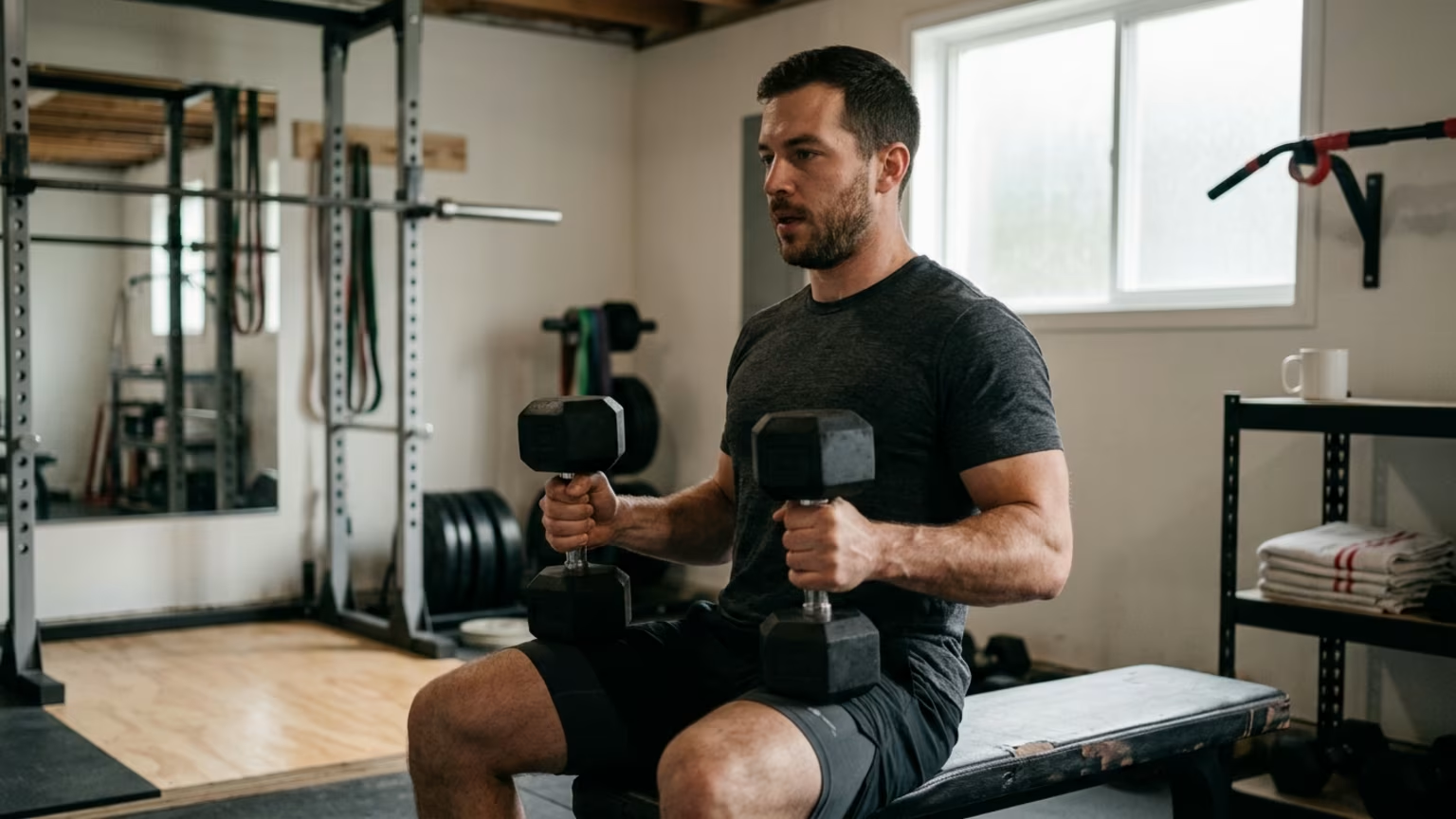
The organization provides specific starting points for older adults looking to implement these functional improvements safely. The guidance suggests beginning with lighter dumbbell and kettlebell exercises to maintain high movement quality. Programming can include a broad range of one to six repetitions per set, depending on the movement. A complete routine might involve two to six sets across one to three sessions weekly.
Training for speed rather than just heavy weight changes how the body handles physical stress. Lifters often focus entirely on heavy barbells when managing progressive overload after 45, which can eventually tax the joints. Moving a moderate weight quickly provides a unique stimulus to the central nervous system without requiring excessive loads. This specific adaptation supports rapid physical reactions like standing quickly from a low chair or recovering from a sudden stumble.
Consistent power training helps active adults maintain their physical reserve as they navigate midlife and beyond. A routine that combines heavy strength work with focused speed work creates a highly capable physical foundation. Maintaining this broad spectrum of physical ability is critical for redefining physical independence as men age. Mature adults can maintain remarkable power output when they train the nervous system intentionally and consistently.
Medical Considerations and Structural Caveats
While the physiological benefits of power training are clear, the reporting includes several critical structural caveats. Men's Journal explicitly clarifies that maximal intended velocity only describes the intention to lift quickly. It absolutely does not mean using uncontrolled, chaotic, or unsafe movement patterns during a working set. The proper application requires a controlled lowering phase followed by a deliberate and quick lifting phase.
The systematic review noted that maximal intended velocity performed best among the analyzed velocity approaches for functional performance. However, the article does not provide precise effect sizes, confidence intervals, or study-level quality ratings. This omission makes it difficult to quantify exactly how large the advantage of speed work is compared to standard lifting. Readers should not assume that explosive training completely outclasses traditional heavy lifting for all physical goals.
The impressive 24 percent peak power increase reported in the 2024 study carries strict contextual limitations. This specific finding emerged from an eight-week trial of older men performing only knee extensions and sit-to-stands. These results should not be generalized to all exercises, all older adults, or long-term daily life outcomes. A 24 percent increase on a controlled leg machine does not guarantee identical improvements on a complex free weight exercise.
Interpreting Practical Measurements and Limits
The 12-week toe grip trial measured a highly specific variable rather than tracking actual real-world accidents. The researchers recorded the early rate of force development in a clinical setting over a short period. They did not measure actual falls, injury rates, or long-term physical independence among the participants. The conclusion that this training may help with quick daily movements is an interpretation rather than definitive proof of fall prevention.
The programming ranges provided by the American College of Sports Medicine are intentionally broad and highly conditional. Suggesting one to six repetitions across one to three sessions weekly covers a vast spectrum of physical volume. These ranges depend entirely on the individual's baseline ability, physical health, and prior resistance training experience. They do not constitute a universal or personalized prescription for determining how much strength training you need.
Furthermore, the reporting does not establish that power training is appropriate for every single physical condition. Explosive movements place different demands on connective tissue and joints than slow, grinding repetitions do. The research does not confirm safety for people with joint problems, cardiovascular disease, or severe balance limitations. Anyone dealing with relevant health issues must seek individualized advice from a qualified clinician before attempting explosive movements.
Mature adults must balance the desire for physical progression with intelligent joint management and recovery protocols. Attempting to accelerate a heavy load through a compromised joint can quickly lead to painful physical setbacks. Understanding how to interpret physiological feedback is a necessary skill for making informed recovery decisions throughout a training cycle. The primary goal is to build long-term physical capability rather than forcing a rapid movement through sharp joint pain.
Speed work should serve strictly as a complement to standard resistance training rather than a complete replacement. The systematic review reported that basic resistance training successfully improved muscle mass and baseline strength alongside functional performance. A well-rounded physical routine requires a balanced approach to both heavy force production and moderate-load speed work. By incorporating this massive update to the 2009 resistance training recommendations, these findings alter current best practices by establishing that training for fast movement velocity is just as critical as lifting heavy loads for maintaining physical capability after 50.
How Everfitguys helps
Applying these updated movement velocity guidelines to a weekly routine requires careful exercise selection when structural limitations are present. Stiffness, joint pain and reduced mobility that limits activity frequently frustrate mature men seeking better physical capacity, and Everfitguys translates the primary clinical research to help them rebuild their real-world function safely.
Sources
Stay sharp
Get stories
The best writing on craft and life, delivered once a week. No noise, just the good stuff.