Nonsurgical Care for Knee Osteoarthritis Focuses on Supervised Exercise
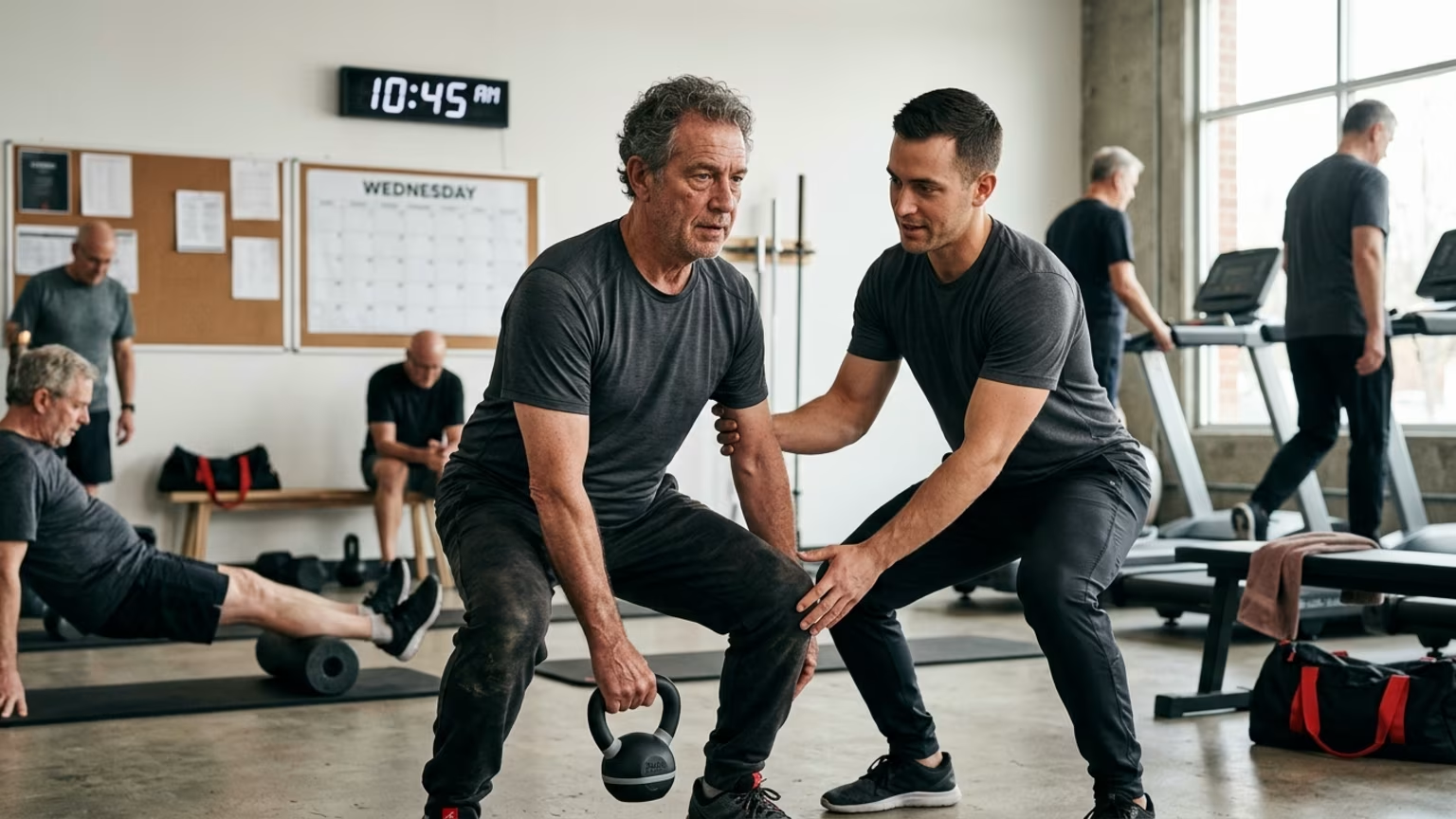
On September 12, 2026, Nowak Orthopedic Associates published an article synthesizing major clinical guidelines to establish supervised exercise as the primary nonsurgical care for knee osteoarthritis. The publication outlines a clear physical therapy progression for joint health before patients consider medications or injections.
Organizing the Initial Rehabilitation Plan
The Nowak Orthopedic Associates article synthesizes the 2026 clinical practice guideline from the VA and DoD for nonsurgical hip and knee osteoarthritis. It pairs this evaluation with the non-arthroplasty management guideline from the American Academy of Orthopaedic Surgeons. The resulting framework organizes treatment as a clear stepped progression. Practitioners prioritize regular supervised sessions for the first six to eight weeks of care.
Initial physical therapy plans commonly run six to twelve weeks before tapering. This extended schedule helps the patient become more independent with their movement routine. Clinicians individualize the program frequency and exercise selection according to baseline strength, swelling and cardiovascular fitness. They also factor in pain irritability, comorbidities and the patient's access to physical therapy facilities.
The Veterans Affairs guideline system publicly lists this 2026 clinical practice guideline titled "The Non-Surgical Management of Hip & Knee Osteoarthritis." It positions this management pathway alongside separate guidance on overweight and obesity management. For men over 45, this structured approach is directly relevant to maintaining physical independence. The protocol addresses the fundamental physical requirements for walking, hiking, cycling and travel.
By establishing a formal timeline, the framework treats knee strength and mobility after 45 as a dedicated medical process. It prevents patients from relying on an occasional stretch routine that lacks professional progression. Practitioners evaluate true function instead of just asking patients about their daily discomfort.
The Supervised Exercise Foundation
Conservative treatment should begin with supervised exercise, patient education and appropriate weight management. The article describes this overall approach as a ladder rather than a menu. Patients start with foundational care and only add complex treatments when symptoms justify the change. Supervised physical therapy produces more consistent and durable improvements than unsupervised or mixed programs.
The recommended exercise frequency is structured physical therapy approximately three times weekly when possible. During the early phase, completing two to three sessions per week is a primary target. The proposed focus moves beyond general cardio to target specific functional mechanics. Programs prioritize quadriceps strength, gait mechanics and overall walking tolerance.
Utilizing Aquatic and Yoga Modalities
The article identifies aerobic, resistance, aquatic and yoga-based exercise as effective approaches. A cited 2023 network meta-analysis notes that all these methods improved pain and function. Aquatic exercise and yoga appeared particularly useful for addressing joint stiffness and mobility limitations. These modalities offer varied ways to maintain joint longevity during the early stages of a rehabilitation program.
For patients who find land-based exercise too painful, pool-based training is a legitimate starting point. It serves as a primary entry point rather than a lesser alternative. Patients can use the water to reduce joint load while building early foundational strength. They can then progress gradually toward land-based loading as their tolerance improves.
Tracking Measurable Functional Progress
The orthopedic practice recommends defining a measurable functional goal and reassessing progress every few weeks. Clinicians should track metrics like walking speed, single-leg stance, stair pain or activity tolerance. The article gives an illustrative example where a timed walk improves from 42 seconds to 35 seconds. This shows why measurable function provides better feedback than a vague statement that it still hurts.
Focusing on functional capacity helps patients evaluate their true physical capabilities objectively. A timed walk or balance test offers concrete data on walking tolerance over time. Objective measurements keep the focus on independence rather than chasing complete pain elimination. This testing strategy helps older men track their lower-body mobility after 45 accurately.
Managing Flares Without Complete Rest
A symptom flare after exercise does not automatically mean the patient should stop moving entirely. The article recommends reducing the load, intensity or impact for several days. Total rest can actually set a patient back more than a carefully modified training session. The appropriate response always depends on the severity of the flare and the specific clinical situation.
Patients can modify their range of motion or reduce their total training volume during acute pain. Using exercise alternatives and regressions keeps the surrounding muscles active without overloading the sensitive joint. The article also views braces, orthotics, canes and walkers as tactical tools for flare periods. These devices support activity but should not replace fundamental strength and movement work.
Medication Hierarchy and Surgical Avoidance
When medication becomes necessary, the article places topical NSAIDs before oral NSAIDs or acetaminophen. Medication should strictly support exercise and weight management rather than replace them. Oral NSAIDs can be effective but require careful attention to gastrointestinal, kidney and cardiovascular risks. They also present potential medication interaction risks that require professional medical oversight.
The synthesis characterizes corticosteroid injections as useful for short-term flares. Relief from cortisone lasts for weeks rather than providing a permanent solution. Injections and procedures should wait until after months of optimized conservative care. Severe or rapidly worsening symptoms remain the exception and may warrant an earlier specialist evaluation.
The article states that AAOS guidance advises against arthroscopic lavage or debridement for primary knee osteoarthritis. To further support nonsurgical care, the AAOS launched a Pain Management Resource Center in August 2026. This resource center provides educational tools for discussions about medications, recovery plans, nutrition and opioid safety. These resources frame treatment decisions around shared planning rather than single procedures.
Understanding Protocol Limitations
The article is a practitioner synthesis and does not replace the complete AAOS or VA/DoD guideline documents. It does not reproduce the full guideline methods, evidence tables or grading criteria. The recommendation of three weekly sessions is a practical target rather than strict proof that every patient requires exactly three visits. Clinicians must adapt the schedule based on individual patient needs.
Weight management is recommended for those carrying excess weight, but it is not a universal requirement. The article does not establish that every man with knee pain needs to lose weight. It also does not specify a universal target or imply that body weight explains every knee problem. Conservative care may delay joint replacement, but the article does not claim it guarantees total prevention.
Assessing Advanced Procedures
The article describes the evidence for platelet-rich plasma treatments as limited in quality. It notes significant variation in cost, preparation and treatment protocols for these injections. Results for hyaluronic acid injections are similarly characterized as inconsistent. Patients should not view these procedural options as proven, universally effective or appropriate for everyone.
Emerging interventions like genicular artery embolization and denervation are placed after foundational exercise. The article notes that larger randomized evidence remains limited for these specific options. Persistent locking, major swelling or inability to bear weight require immediate clinical evaluation. These severe symptoms are clear exceptions to the usual period of conservative care.
This clinical synthesis confirms that structured supervised exercise serves as the most durable foundation for managing knee osteoarthritis, shifting the primary treatment focus from early surgical intervention to consistent physical rehabilitation.
How Everfitguys helps
Structuring a conservative rehabilitation plan for knee osteoarthritis requires interpreting clinical guidelines rather than relying on isolated treatment claims. Declining focus, memory and mental sharpness often complicate the aging process alongside joint changes, and Everfitguys analyzes current physiological research to help you maintain both mental and physical capability. Read the research
Sources
Stay sharp
Get stories
The best writing on craft and life, delivered once a week. No noise, just the good stuff.